

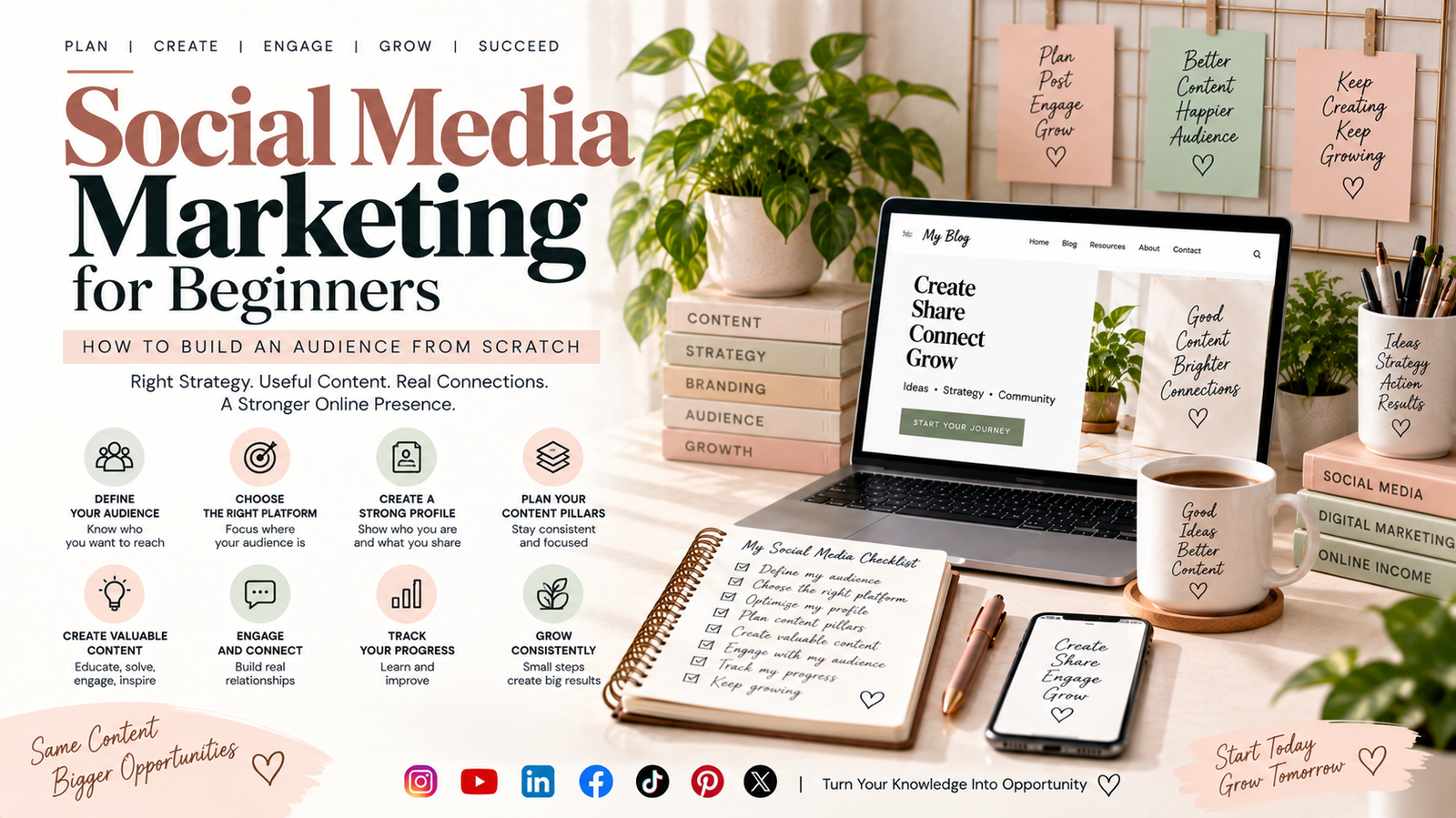
Starting social media can feel overwhelming.
You create an account, publish a few posts, use some hashtags, and wait for people to follow you. But sometimes nothing happens. Your posts receive very little engagement, and you are left wondering what you are doing wrong.
The problem is usually not that social media “doesn’t work.” The bigger problem is that there is no clear strategy behind the content.
Social media marketing is not simply about posting every day. It is about understanding your audience, creating useful content, choosing the right platforms, building relationships, and consistently giving people a reason to follow you.
Whether you are a beginner, freelancer, blogger, creator, or small business owner, you can start building an audience from scratch with a simple and consistent approach.
What Is Social Media Marketing?
Social media marketing is the process of using platforms such as Instagram, Facebook, YouTube, LinkedIn, TikTok, Pinterest, or X to build awareness, connect with an audience, share content, and support business or personal goals.
Your goal could be:
- Building a personal brand
- Promoting a business
- Growing a blog
- Finding potential clients
- Increasing website traffic
- Building a community
- Selling products or services
- Growing a YouTube channel
- Establishing yourself as an expert
The important point is that social media should support a clear objective.
Posting without knowing what you want to achieve can quickly become exhausting.
Why Is Building an Audience Important?
An audience is more than a follower count.
A person who regularly reads your posts, watches your videos, saves your content, visits your website, or recommends your work can be more valuable than hundreds of inactive followers.
A strong audience can help you:
Build trust → Increase visibility → Create opportunities → Generate traffic → Develop income
For example, a freelance content writer could use social media to share writing tips, SEO lessons, blog-writing examples, and personal experiences. Over time, these posts can demonstrate expertise and attract potential clients.
Step 1: Define Who You Want to Reach
Before creating content, define your audience.
Ask:
- Who am I creating content for?
- What problems do they have?
- What questions do they ask?
- What information are they searching for?
- What type of content do they enjoy?
- What result do they want?
For example, instead of targeting “everyone interested in marketing,” you might focus on:
Beginners, students, freelancers, bloggers, creators, and small business owners who want to improve their online presence.
A specific audience makes content creation much easier.
Step 2: Choose the Right Social Media Platform
You do not need to be active everywhere.
Start with one or two platforms where your target audience is already spending time.
Useful for visual content, short-form videos, carousels, personal branding, lifestyle content, and product-based businesses.
YouTube
Useful for tutorials, educational content, reviews, storytelling, demonstrations, and long-term searchable content.
Useful for professional content, personal branding, networking, career-related topics, B2B services, and thought leadership.
Useful for communities, local businesses, groups, discussions, and reaching established audiences.
TikTok
Useful for short-form, entertaining, educational, and trend-driven content.
The best platform depends on your audience, content format, and objective.
Step 3: Create a Clear Profile
When someone discovers your account, they should understand what you offer within a few seconds.
Your profile should communicate:
Who you are + What you share + Who you help
For example:
Helping beginners learn content writing, blogging, SEO, and digital marketing through simple practical tips.
Also pay attention to:
- Profile photo
- Username
- Bio
- Website link
- Contact information
- Consistent branding
Your profile is often the first step in converting a visitor into a follower.
Step 4: Build Your Content Pillars
Content pillars are the main topics you regularly discuss.
Instead of asking yourself every morning, “What should I post today?”, create 3–5 consistent categories.
For a digital marketing account, your pillars might be:
- Content Writing
- SEO
- Blogging
- Social Media Marketing
- Online Income
Now you have a foundation for dozens of posts.
For example, under SEO you could create:
- Beginner SEO tips
- Keyword research mistakes
- On-page SEO tips
- Internal linking ideas
- Common ranking problems
This approach makes your content more focused and helps your audience understand what they can expect from you.
Step 5: Create Different Types of Content
Not every post needs to sell something.
A healthy social media strategy usually includes different content purposes.
Educational Content
Teach something useful.
Examples:
- “5 Beginner SEO Mistakes”
- “How to Find Blog Topics”
- “What Is Internal Linking?”
Problem-Solving Content
Address a specific problem.
Example:
“Your website isn’t getting traffic? Check these five things first.”
Inspirational Content
Share lessons, experiences, progress, or useful perspectives.
Engagement Content
Ask questions, create discussions, or invite opinions.
Promotional Content
Introduce your services, products, blog posts, or offers.
The goal is to create a balanced content mix rather than turning every post into an advertisement.
Step 6: Give People a Reason to Follow You
People follow accounts when they expect future value.
Your content should answer the question:
“Why should someone come back tomorrow?”
You could promise:
- Practical tips
- Beginner-friendly tutorials
- Industry insights
- Helpful resources
- Case studies
- Content ideas
- Step-by-step guides
For example, an account focused on blogging could consistently provide blogging tips, SEO lessons, content ideas, writing techniques, and monetization strategies.
Consistency in topic builds familiarity.
Step 7: Focus on the First Few Seconds
For short-form content, the opening matters.
Instead of starting with:
“Hello everyone, today I am going to talk about SEO…”
Try a stronger opening:
“Your blog may not be ranking because of these three SEO mistakes.”
The second version immediately introduces a problem.
Useful hooks can include:
- “Stop making this beginner mistake…”
- “Before you publish your next blog, check this.”
- “Nobody tells beginners this about SEO.”
- “If you’re starting from zero, do this first.”
- “Here are three things I wish I knew earlier.”
The hook should accurately represent what the content delivers. Avoid misleading clickbait.
Step 8: Create Content That Is Easy to Consume
Social media users often scroll quickly.
Make your content easy to understand with:
- Short paragraphs
- Clear headlines
- Simple language
- Strong visual hierarchy
- Examples
- Lists
- Captions with useful information
For educational content, a simple structure works well:
Problem → Explanation → Solution → Example → Action
This structure also connects naturally with content writing and blogging.
Step 9: Be Consistent Without Burning Out
You do not need to post ten times a day.
Choose a schedule you can realistically maintain.
For example:
Monday: Educational post
Wednesday: Practical tip
Friday: Problem-solving post
Sunday: Personal or community-focused content
Consistency is more sustainable when you create content in batches.
You can spend one day generating ideas, another day preparing visuals, and then schedule your posts.
Step 10: Engage With Your Audience
Social media is not a one-way publishing platform.
Respond to comments, answer questions, acknowledge useful feedback, and participate in relevant conversations.
If someone asks:
“How do I choose keywords for my first blog?”
Instead of replying only:
“Use keyword research tools.”
Give a useful answer and, when relevant, direct them to a detailed resource on your website.
This creates a bridge between social media content and your blog.
Step 11: Use Social Media to Support Your Blog
Your social media accounts and website should not operate separately.
Suppose you publish a blog titled:
“How to Write a Blog Post That People Actually Want to Read.”
You can turn that one article into:
- An Instagram carousel
- A short video
- A LinkedIn post
- A checklist
- A quote graphic
- A short tutorial
- A discussion question
This is called content repurposing.
One useful piece of content can become multiple social media assets.
Step 12: Understand Social Media Metrics
Follower count is only one metric.
Pay attention to:
- Reach
- Impressions
- Engagement
- Saves
- Shares
- Comments
- Profile visits
- Website clicks
- Video watch time
- Leads or enquiries
For educational content, saves and shares can be particularly useful signals because they indicate that people found the information valuable enough to keep or share.
Do not judge your entire strategy from one post.
Look for patterns over several weeks.
Step 13: Learn From Your Best Content
Suppose you publish ten posts and discover that three consistently perform better.
Study them.
Ask:
- What topic did they cover?
- What hook did they use?
- What format worked?
- Was the topic solving a specific problem?
- Did people save or share it?
- Did it generate website visits?
Then create more content around the underlying topic—not necessarily an identical copy.
Successful content can reveal what your audience wants more of.
Step 14: Avoid Common Beginner Mistakes
Some common mistakes include:
- Trying to use every platform at once
- Posting without knowing the target audience
- Copying competitors without adding originality
- Focusing only on follower numbers
- Selling in every post
- Using irrelevant trends
- Ignoring comments
- Changing topics constantly
- Giving up after a few weeks
- Using AI-generated content without editing or adding personal insight
Social media growth is usually a process of testing, learning, and improving.
A Simple 30-Day Social Media Plan
If you are starting from zero, keep your first month simple.
Week 1: Foundation
- Define your audience
- Choose your main platform
- Optimize your profile
- Select 3–5 content pillars
- Create a list of 20 content ideas
Week 2: Start Publishing
Publish useful educational and problem-solving content.
Focus on clarity rather than perfection.
Week 3: Engage and Experiment
Respond to comments and test different formats, hooks, and topics.
Notice what gets meaningful engagement.
Week 4: Analyze and Improve
Review your metrics.
Identify your strongest topics and formats.
Then use those insights to plan your next month.
Social Media Marketing + Content Writing and Blogging
Strong social media marketing depends heavily on good content.
You need to know how to:
- Research topics
- Understand your audience
- Write useful information
- Create strong headlines
- Tell stories
- Explain ideas clearly
- Create calls to action
- Repurpose content
That is why content writing and blogging can support your social media strategy.
Your blog can provide depth, while social media can help you distribute and discuss that content.
The two can work together:
Blog → Social Content → Audience → Website Traffic → Trust → Opportunities
Building an audience from scratch takes more than posting frequently.
Start with a clear audience, choose the right platform, create focused content pillars, provide useful information, engage with people, and measure what works.
Do not chase every trend or become obsessed with follower numbers.
Instead, build a recognizable content system that consistently helps your audience.
With time, your social media presence can become more than a collection of posts. It can become a valuable part of your digital marketing, content writing, blogging, personal branding, and online growth strategy.
Internal-link journey:
Digital Marketing for Beginners → Social Media Marketing → Social Media Content Strategy → Instagram Marketing → YouTube → AI Content Creation → Personal Branding
For more practical tips on content writing, blogging, SEO, digital marketing, and building your online presence, explore more resources at mehfuzasultana.com.
Add a Comment