

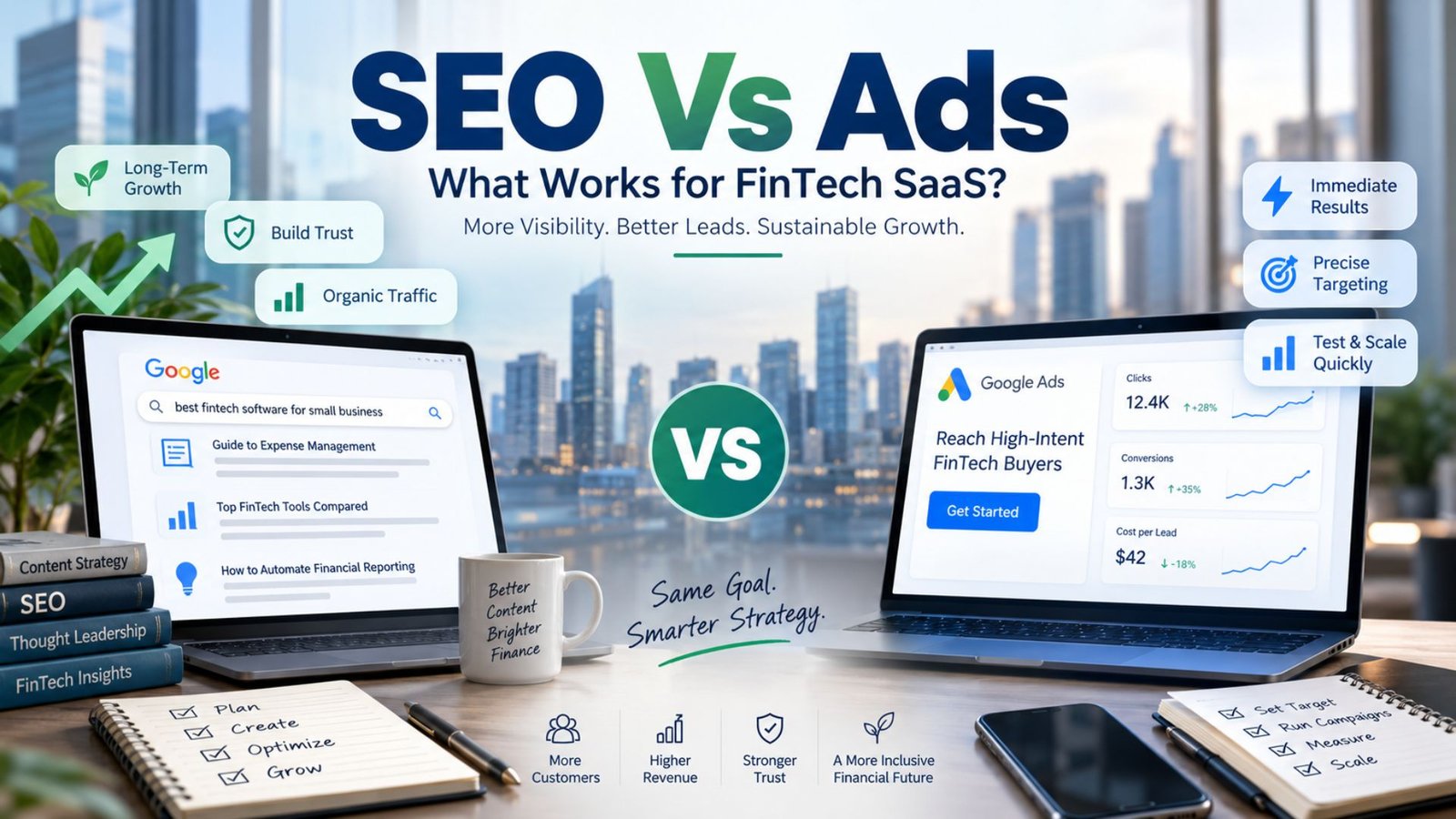
A FinTech SaaS company can rank on Google and still struggle to acquire profitable customers. It can also spend heavily on paid ads, generate leads quickly, and discover that those leads cost more than the customers are worth.
That is why the SEO-versus-Ads debate heis not really about choosing the cheaper channel.
The better question is: which channel can acquire the right customers at an acceptable cost, at the speed the business needs
For FinTech SaaS, the answer depends on customer acquisition cost (CAC), customer lifetime value (LTV), search intent, competition, sales-cycle length, budget and how much trust a prospect needs before handing over financial data or committing to a new platform.
SEO can build a durable organic acquisition channel. Paid advertising can capture existing demand quickly. For many companies, the strongest strategy is to use each for what it does best.
SEO for FinTech SaaS: Why Organic Search Matters
FinTech buyers rarely make a software decision after seeing one product page. They research first.
A finance manager may search for “expense management software for small businesses.” An operations leader may compare payment automation tools. A startup founder might search for ways to automate financial reporting before they ever visit a vendor’s website.
Those searches represent different stages of intent.
A useful SEO strategy should therefore go beyond publishing generic blog posts. It should create content for the questions prospects ask before, during, and immediately before a purchase.
For example:
| Search intent | Example query | Useful content |
| Informational | “What is automated expense management” | Educational article |
| Problem-aware | “How to reduce manual invoice processing” | How-to guide |
| Commercial | “Best expense management software” | Comparison page |
| High-intent | “Expense management software pricing” | Product/pricing page |
| Brand | “[Product] alternatives” | Comparison or alternative page |
This is where content writing and blogging become part of a broader acquisition strategy rather than an SEO activity performed in isolation. Google’s guidance emphasizes creating helpful, reliable, people-first content instead of producing pages primarily to manipulate search rankings.
SEO also has a compounding advantage. A useful page can continue attracting relevant organic visitors after publication. But “organic” does not mean free. Research, subject-matter expertise, content production, technical SEO, link acquisition and updates all require investment.
The biggest limitation is time.
A new FinTech SaaS company competing against established financial brands cannot assume that publishing a few articles will produce meaningful traffic immediately. SEO is usually a longer-term investment.
Paid Ads for FinTech SaaS: Where They Have an Advantage
Paid advertising addresses a different problem: how to capture demand now.
Google Search campaigns allow businesses to advertise to people actively searching for relevant products and services, with targeting around keywords and campaign goals.
Consider a SaaS company selling automated accounts-payable software. Instead of waiting for a new page to rank for a competitive commercial search, the company can test paid search around relevant high-intent terms and send prospects to a focused product or demo page.
That speed is valuable for a new product, a new market, or a company trying to validate its positioning.
Ads can also function as a research channel.
Suppose one message-“automate invoice processing” consistently produces better-qualified prospects than “reduce finance workload.” That insight can influence landing pages, sales messaging, product positioning and future SEO content.
But paid traffic has an obvious limitation: the meter is always running. A campaign can produce an impressive click-through rate while generating weak business results. Google recommends looking at conversion and conversion-value metrics rather than treating clicks or impressions as the final measure of success.
For a SaaS company with a long sales cycle, this distinction is critical. A $100 lead is not necessarily expensive if it becomes a customer worth thousands of dollars over several years. Conversely, a cheap lead can be a poor acquisition channel if almost none of those leads become customers.
SEO vs Ads: Key Differences for FinTech SaaS
| Factor | SEO | Paid Ads |
| Cost | Investment in content, expertise and optimization | Ongoing media spend |
| Speed | Usually slower | Fast visibility |
| Long-term value | Can compound over time | Usually depends on continued spending |
| Trust | Educational content can build authority | Paid placement provides visibility but requires strong messaging |
| Scalability | Scales through content and organic reach | Scales through budget, targeting and optimization |
| Targeting | Strong alignment with search intent | Precise campaign and keyword targeting |
| Conversion potential | Strong across research journeys | Strong for high-intent searches |
| Best use case | Sustainable organic acquisition | Immediate demand capture and testing |
The important point is that these channels should not be judged by traffic alone. A FinTech SaaS company should compare qualified leads, conversion rates, CAC, sales velocity, and LTV.
A channel generating 1,000 visitors is not automatically better than one generating 100. If those 100 visitors produce more qualified opportunities and higher-value customers, the smaller channel may be commercially stronger.
Which Is Better for FinTech SaaS: SEO or Ads
SEO is usually the better choice when the company has time to build an organic acquisition engine. It works particularly well when prospects conduct substantial research before buying and when the business can consistently produce useful, expert-level content.
SEO is also attractive when the company wants to reduce its dependence on continuously paying for every visit. Ads are usually the better choice when speed matters.
A newly launched FinTech product, a new feature, a new geographic market or an urgent pipeline target may justify paid acquisition. But the decision should start with economics.
Imagine two SaaS products.
One generates $500 in annual revenue per customer. Another generates $10,000 from a long-term business account. The second company may be able to support a much higher CAC if its retention and margins justify it.
That means there is no universal “good” CAC for FinTech SaaS. The acceptable acquisition cost depends on the economics of the business.
Competition matters too. If major FinTech brands dominate the most obvious commercial keywords, simply increasing bids may not be the smartest strategy. A company may get better results by identifying narrower search intent around specific workflows, integrations, implementation problems, or underserved customer segments.
Why FinTech SaaS Companies Should Consider Using Both
SEO and Ads become more powerful when they are treated as connected parts of the same acquisition system. Imagine a prospect searching for “automated expense reporting.” They might first discover an SEO article, leave the site, later click a paid search ad, read a product page, and finally book a demo several weeks later.
If the company evaluates only the last interaction, it may undervalue the original organic content. This is why attribution matters. The objective is not to prove that SEO or Ads “won” the customer. It is to understand how different touchpoints contributed to the journey.
Paid search can provide fast feedback about keywords and messaging. SEO can turn those insights into durable content assets. Strong organic pages can then support paid campaigns by giving prospects more information before they convert.
There is another reason FinTech companies need this balanced approach: trust.
Financial software can handle sensitive information, payments, reporting, or compliance-related workflows. A prospect may therefore evaluate more than features and price. Security, transparency, reliability, privacy, regulatory positioning, and operational resilience can influence the decision.
PwC’s recent financial-services research highlights cybersecurity, third-party risk, resilience and trust as significant concerns for the sector.
That makes authoritative educational content particularly valuable but it also means marketing claims need to be accurate and supportable.
A Practical SEO + Ads Strategy for FinTech SaaS
A small FinTech SaaS company does not need to launch a huge content operation and an expensive ad program simultaneously.
Start with the economics.
1. Define the commercial target.
Estimate acceptable CAC based on LTV, margins, retention and sales-cycle length. This gives both SEO and Ads a business benchmark.
2. Map search intent.
Separate informational, problem-aware, commercial, and high-intent searches. Match each type with the appropriate content or landing page.
3. Build an SEO foundation.
Create a focused group of expert articles around the problems the product actually solves. Add comparison pages, implementation guides, FAQs, and product-led content as search demand becomes clearer.
4. Test high-intent Ads.
Start with tightly relevant searches rather than trying to buy every possible keyword. Define meaningful conversions such as qualified demos, trials, or sales not just clicks.
5. Feed paid insights into SEO.
Use search terms, ad messages, landing-page performance, and conversion data to identify topics worth developing organically.
6. Connect marketing to revenue.
Track what happens after the lead enters the funnel. Compare channels based on qualified opportunities, customers acquired, CAC, sales-cycle velocity, and eventual LTV. Google’s conversion-measurement guidance supports using conversion data to understand which campaigns and keywords drive valuable customer activity.
7. Reinvest based on evidence.
If SEO consistently produces qualified organic opportunities, expand the content engine. If specific paid campaigns produce profitable customers, scale them carefully. If neither works, fix the offer, targeting, landing page, or positioning before simply increasing volume.
So, what works for FinTech SaaS
SEO is usually the stronger long-term asset. Ads are usually the faster acquisition accelerator. But neither should be judged in isolation. The right decision comes down to the economics and the buying journey.
Use SEO when prospects need education, comparison, and trust before they buy. Use Ads when you need immediate visibility, high-intent demand capture, or fast market feedback.
Use both when the business needs today’s pipeline without sacrificing tomorrow’s acquisition engine.
Most importantly, don’t optimize for traffic simply because traffic is easy to report.
Optimize for qualified customers at a sustainable CAC relative to LTV.
That is the real answer to the SEO-versus-Ads question. The best FinTech SaaS marketing strategy is not the channel that generates the most clicks. It is the system that turns search intent into trust, trust into qualified opportunities, and qualified opportunities into profitable customers.
[…] For a practical look at how SEO can work alongside paid advertising for a SaaS business, read our guide on SEO Vs Ads – What Works for FinTech SaaS. […]