

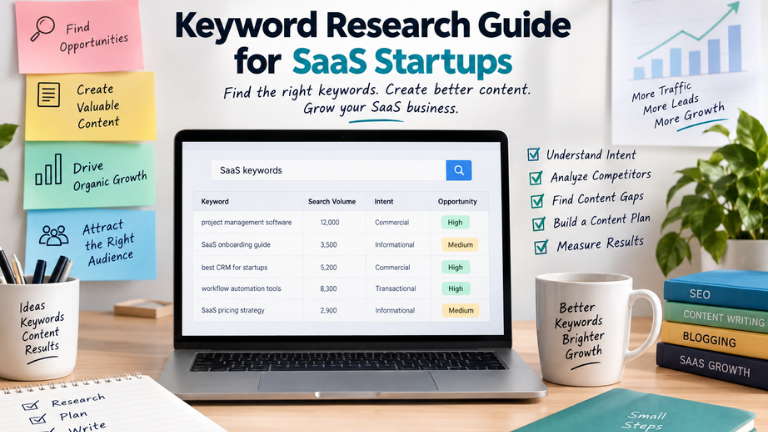
A SaaS startup can spend weeks creating a detailed blog post that gets almost no relevant traffic. The problem isn’t always the writing. Sometimes, the topic was never aligned with what potential customers were searching for in the first place. That is why keyword research should happen before the content calendar is filled with blog titles.
For SaaS startups keyword research is more than finding popular phrases. It helps uncover customer problems, understand search intent, identify commercial opportunities and decide which pages deserve the team’s limited time and resources.
Done well, it connects SEO with product positioning, content creation, lead generation and the broader customer journey.
What Is Keyword Research
Keyword research is the process of discovering and evaluating the words and phrases people use when searching for information, products or solutions.
For a SaaS startup, these searches might include:
- “project management software for small teams”
- “how to automate invoice processing”
- “best CRM for startups”
“email marketing software pricing”
“customer support automation tools”
The goal isn’t to build the longest possible keyword list.
The real goal is to find searches that connect a customer problem, a relevant audience and something your business can genuinely help solve.
That distinction matters when resources are limited. Ten focused articles that attract potential customers can be more valuable than 50 posts that generate traffic from people who will never use the product.
Google’s search guidance also emphasizes creating helpful, reliable, people-first content rather than producing content primarily to manipulate search rankings.
Why Keyword Research Matters for SaaS Startups
SaaS buyers don’t use the same search language throughout their buying journey. Someone who has just discovered a problem might search:
“How can I automate employee onboarding”
A prospect who understands the problem might search:
“employee onboarding automation software.”
Someone closer to making a purchase could search:
“employee onboarding software pricing.”
These searches may relate to the same product category, but they represent different levels of intent.
If a SaaS website only targets broad product terms, it can miss prospects who are still researching. If it publishes only educational content. It may attract visitors without giving high-intent prospects a clear path toward a product or demo. Good keyword research helps connect both sides of the journey.
Step 1: Start With Your Customer, Not a Keyword Tool
Before opening Ahrefs, Semrush, Google Keyword Planner or another SEO tool, understand the person you’re trying to reach.
Ask:
- Who uses the product
Who makes the buying decision - What problem are they trying to solve
What alternatives are they using today - What questions do they ask before purchasing
- What objections could prevent them from buying
Imagine a SaaS startup selling expense management software.
Its search landscape might look like this:
Problem: “How to track employee expenses”
Solution: “Employee expense management software”
Commercial comparison: “Best expense management tools for startups”
Purchase: “Expense management software pricing”
This is a better starting point than entering “expense management” into a keyword tool and immediately choosing the highest-volume suggestions.
Step 2: Build a Seed Keyword List
Seed keywords are broad topics that describe your product, audience, industry, use cases, or customer problems.
For a project-management SaaS, seed topics could include:
- project management
- task management
- team collaboration
- project planning
- workflow automation
- productivity software
For accounting software, they might include:
- accounting software
- invoice automation
- expense management
- financial reporting
- bookkeeping software
Think of a seed keyword as a starting point not necessarily the final keyword you want to rank for. Its purpose is to give you a set of themes that can later be expanded into more specific opportunities.
Step 3: Expand the Keyword Universe
Once you have your seed topics, look for related searches. Keyword research tools can help uncover variations, related terms, search-volume estimates, competition indicators and questions. But don’t automatically select the keywords with the largest numbers.
For example:
“CRM” is broad and highly competitive.
Compare that with: “CRM for small recruitment agencies.”
The second phrase may have considerably less search demand, but it tells you much more about the audience, use case, and potential business value.
For a startup relevance can matter more than raw search volume.
Step 4: Understand Search Intent
Search intent describes what a person is actually trying to accomplish when they search. A useful framework is:
| Search Intent | Example | Recommended Page |
| Informational | “What is workflow automation” | Blog post or guide |
| Problem-aware | “How to automate repetitive tasks” | How-to article |
| Commercial | “Best workflow automation software” | Comparison page |
| Transactional | “Workflow automation software pricing” | Product/pricing page |
| Navigational | “[Brand] alternatives” | Alternatives page |
This is one of the most important parts of keyword research. A keyword should never be evaluated separately from the page you intend to create for it. Someone searching “what is expense automation” probably needs an explanation before a pricing pitch.
Someone searching “expense automation software pricing” is much closer to evaluating a purchase. The keyword tells you what the person typed. Search intent helps you understand why they typed it.
Step 5: Evaluate Keywords Beyond Search Volume
Search volume is useful but it shouldn’t determine your strategy by itself.
Evaluate each opportunity across five factors:
Relevance: Does the keyword directly relate to your product, audience or expertise
Intent: Is the searcher learning, solving a problem, comparing solutions or preparing to buy
Business value: Could this audience realistically become a trial user, demo request, subscriber or customer
Competition: Can your website realistically compete with the pages currently ranking
Content fit: Can you create something genuinely useful and specific for this search
A keyword that performs well across these factors can be more valuable than a high-volume term with weak business relevance.
How Should a SaaS Startup Prioritize Keywords
This is where keyword research becomes a business decision rather than a spreadsheet exercise.
Use this order:
Relevance – Intent – Business Value – Competition – Content Fit
For example, imagine a startup finds two potential keywords.
Keyword A has high search volume but attracts a broad audience and has little connection to the company’s product.
Keyword B has lower search volume but directly describes the problem the product solves and has commercial intent.
Keyword B may deserve priority.
The point isn’t that low-volume keywords are always better. It’s that search volume should be interpreted alongside business relevance and intent.
Step 6: Find Long-Tail Keywords
Long-tail keywords are usually more specific search phrases. Examples include:
- “best CRM for small SaaS startups”
- “how to automate recurring invoices”
“project management software for remote teams” - “email marketing tools for ecommerce startups”
These searches can reveal a specific audience, problem, workflow or use case. They can also give smaller SaaS companies opportunities to create highly focused resources instead of immediately competing for broad terms dominated by established websites.
However, “long-tail” doesn’t automatically mean “easy to rank.” Always evaluate the actual search results and the quality of competing pages.
Step 7: Research Competitors and Find Content Gaps
Competitor research shouldn’t mean copying another company’s blog. Instead, look for patterns. Check:
- Which topics competitors cover repeatedly
- Which product categories they create landing pages for
- Which questions their content answers
- Which use cases they target
- Which comparison pages they publish
- Which customer segments they focus on
- Where their content appears incomplete or outdated
A content gap can reveal an opportunity. For example, several competitors might publish general articles about project management software while none provides a detailed guide for project management workflows for small creative agencies. That narrower topic could give a SaaS startup a more focused editorial angle.
The objective isn’t simply to find something competitors haven’t written about. It is to find a topic where your company can provide more specific and useful information for the audience you want to attract.
Step 8: Turn Keywords Into a Content Plan
Keyword research becomes valuable when it changes what you publish.
Instead of maintaining a spreadsheet full of disconnected keywords, group related searches into content clusters. For a customer-support SaaS one cluster might look like:
Customer Support Automation
What is customer support automation
How to automate customer support
- Customer support automation benefits
- Customer support automation tools
- Best customer support software for startups
- Customer support software pricing
These pages can then connect to relevant product and supporting pages.
Keyword Mapping: Turning Research Into Pages. Once keywords are prioritized assign each opportunity to the page type that best satisfies its intent.
| Keyword | Intent | Page Type | Funnel Stage |
| What is workflow automation | Informational | Educational guide | Awareness |
| How to automate workflows | Problem-aware | How-to article | Awareness |
| Best workflow automation software | Commercial | Comparison page | Consideration |
| Workflow automation software pricing | Transactional | Product/pricing page | Decision |
| [Brand] alternatives | Commercial | Alternatives page | Consideration |
This process is called keyword mapping. It helps prevent multiple pages from competing for the same search and gives every keyword a clear role in the website.
Step 9: Measure What Actually Matters
Ranking is not the final goal. For a SaaS startup, the important question is whether organic visibility attracts the right audience. Track metrics such as:
- Impressions
- Organic clicks
- Click-through rate
- Search queries
- Average position
- Organic traffic
- Demo or trial conversions
- Qualified leads
- Customers generated from organic search
Google Search Console’s Performance report provides data such as clicks, impressions, CTR, average position, queries and pages, which can help identify what searches and content are driving visibility.
It is also useful to look for high-impression low-CTR queries. These can reveal opportunities to improve titles, descriptions or the alignment between the page and the searcher’s expectations. A page that ranks but attracts the wrong visitors isn’t necessarily a successful SEO asset.
Common Keyword Research Mistakes
Choosing keywords only because they have high volume. High volume doesn’t guarantee relevance, conversions or business value. Creating one article for every keyword variation
Several closely related searches may deserve one comprehensive resource instead of multiple thin pages. Ignoring search intent, The right keyword with the wrong page type can still produce a poor user experience.
Copying competitor topics
Competitor research should reveal opportunities, not become a content-copying exercise.
Stuffing keywords into the article
Repeating a phrase unnaturally doesn’t make content more useful. Keywords should guide the topic and structure while the writing remains natural. Never updating the research search behavior changes. New competitors appear. Products evolve. Your keyword strategy should be reviewed as you gather new data.
How Keyword Research Supports Content Writing and Blogging
Keyword research gives content writers a clearer understanding of what readers want to know. But keywords should guide content not dictate every sentence. Good content writing and blogging still depends on useful explanations, strong examples, logical organization, original insights and a clear understanding of the audience.
A practical workflow is:
Research – Group – Match Intent – Map – Create – Optimize – Measure – Update
This keeps SEO connected to editorial quality. Your research should influence the topic, title, headings, examples, internal links and page format. The final article should still sound natural and answer the reader’s question completely.
A Simple Keyword Research Workflow for SaaS Startups
If you’re starting from scratch, use this process:
1. Define your audience.
Identify who uses, buys, and influences the purchase of your SaaS product.
2. List customer problems.
Write down the questions, frustrations, and tasks your product helps solve.
3. Create seed keywords.
Turn those problems, products, features, and use cases into broad topics.
4. Expand the list.
Use keyword tools, Google suggestions, competitor research, customer conversations, forums, and existing website data.
5. Group by search intent.
Separate informational, problem-aware, commercial, transactional, and navigational searches.
6. Prioritize opportunities.
Evaluate relevance, intent, business value, competition, and content fit.
7. Map keywords to pages.
Decide whether each opportunity belongs on a blog post, landing page, comparison page, alternatives page, product page, or another format.
8. Measure and refine.
Review impressions, clicks, CTR, queries, conversions, and business outcomes. Then update your content strategy based on what the data shows.
For a practical look at how SEO can work alongside paid advertising for a SaaS business, read our guide on SEO Vs Ads – What Works for FinTech SaaS.
Keyword research isn’t about finding a list of popular phrases and placing them into blog posts. For a SaaS startup it is a way to understand what potential customers need, how they describe their problems and where your content can genuinely help.
The strongest keyword strategy connects three things:
What people search for + what your business solves + what your content can explain better than competing pages.
Start with customer problems rather than keyword tools. Prioritize relevance and intent instead of chasing search volume alone. Map keywords to the right pages, use competitor research to find genuine content gaps and measure whether organic traffic is producing the right audience.
When keyword research becomes part of your content writing, blogging, and SEO process, it stops being a spreadsheet exercise.
It becomes a practical system for deciding what to create, who it should reach and how that content can contribute to SaaS growth.
Ready to Build a Smarter SaaS Content Strategy
Turn your keyword research into content that attracts the right audience, answers real questions and supports your business goals. Explore more practical SEO, content writing and blogging tips on Mehfuza Sultana.
Add a Comment