

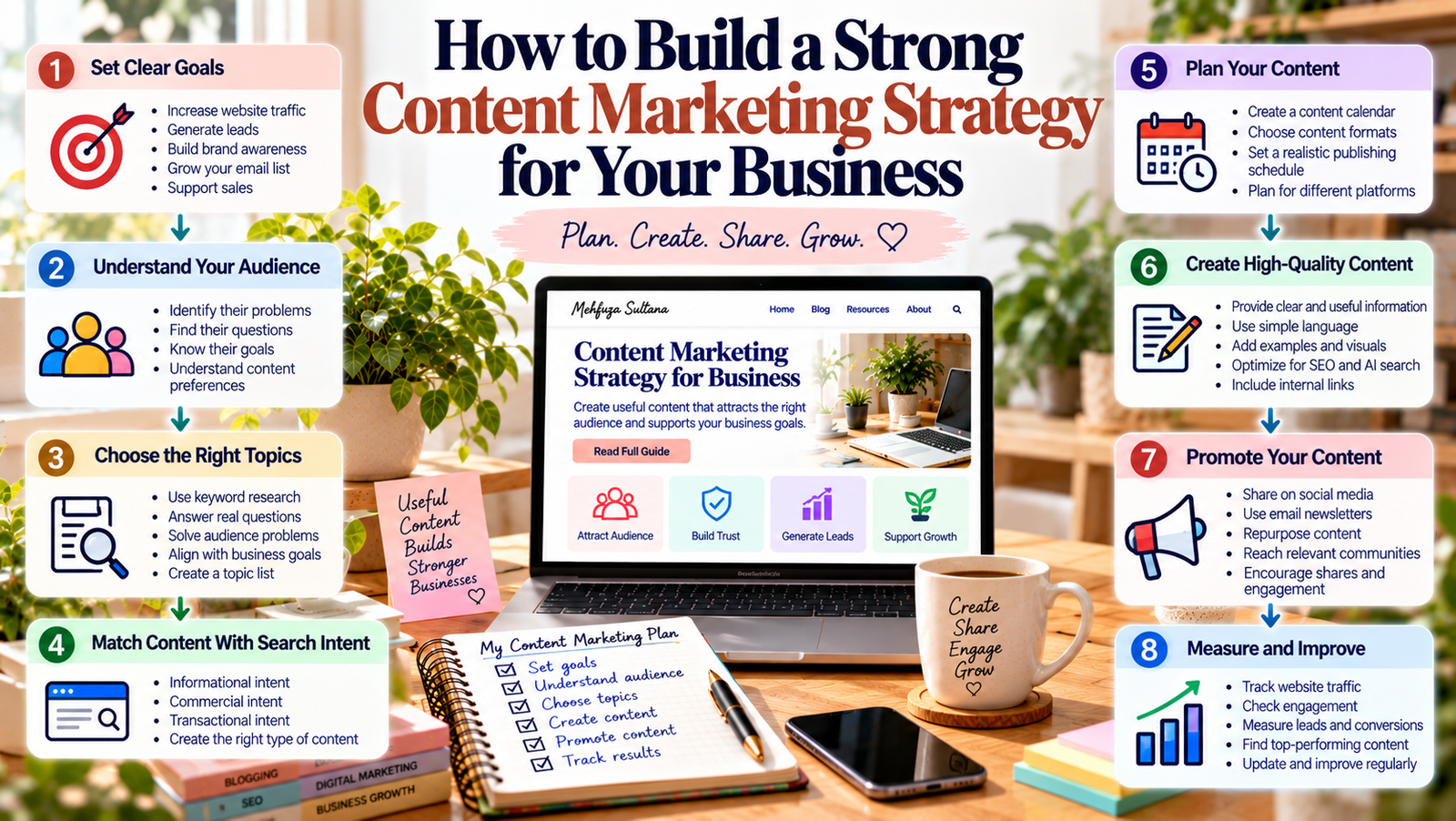
Creating content is easy. Creating content that attracts the right people and supports your business goals takes a clear plan. A strong content marketing strategy helps you decide what to create, who you want to reach, where to publish, and how to measure your results.
You do not need to publish content every day. Instead, focus on creating useful content that answers real questions and solves problems for your audience. With the right approach, your content can support brand awareness, website traffic, leads, and long-term growth.
In this guide, you will learn how to build a simple content marketing strategy from the ground up. You will also learn how to choose topics, understand your audience, plan content, promote your work, and improve your results.
What Is a Content Marketing Strategy?
A content marketing strategy is a plan for creating, publishing, and promoting useful content for a specific audience.
This content can include:
- Blog posts
- Social media posts
- Videos
- Emails
- Guides
- Case studies
- Infographics
- Checklists
- Ebooks
The goal is not simply to create more content. Instead, your content should have a clear purpose.
For example, a blog post may bring visitors from Google. A social media post may introduce your brand to new people. An email may help you build a relationship with an existing audience.
Therefore, each piece of content should support a larger business or marketing goal.
Why Your Business Needs a Content Marketing Strategy
Publishing random content can make your marketing difficult to manage. You may have many ideas, but you may not know which ones deserve your time.
A clear strategy gives your content direction.
It can help you:
- Understand what your audience needs
- Choose useful topics
- Create content consistently
- Improve your website traffic
- Build trust with readers
- Support your SEO efforts
- Generate leads
- Promote products or services
- Measure content performance
For example, if your goal is to increase organic traffic, you can focus on topics your audience searches for on Google.
If you want more leads, you can create helpful guides and add clear calls to action.
As a result, your content becomes part of a larger marketing system instead of a collection of unrelated posts.
Start Your Content Marketing Strategy With Clear Goals
Before creating content, decide what you want it to achieve.
Your goal should be specific enough to guide your decisions.
Some common content goals include:
- Increase website traffic
- Generate leads
- Build brand awareness
- Grow an email list
- Increase product interest
- Educate potential customers
- Build authority in a topic
For instance, a new website may focus on organic traffic first. A service business may focus more on leads. Meanwhile, an established brand may use content to educate customers and support sales.
Choose one or two main goals first. This makes your strategy easier to manage.
Understand Your Target Audience
Good content starts with a clear understanding of your audience.
Think about the people you want to reach. Ask yourself:
- What problems do they have?
- What questions do they ask?
- What information do they need?
- What goals are they trying to achieve?
- What type of content do they prefer?
- What stops them from taking action?
You can learn more by reviewing comments, customer questions, social media discussions, reviews, and search results.
Your existing website data can also provide useful information about the topics people already visit.
The better you understand your audience, the easier it becomes to create useful content.
Choose the Right Content Topics
Once you understand your audience, start building a list of topics.
Do not choose topics only because they seem interesting. Instead, connect each topic with an audience need or business goal.
Keyword research can help you discover what people search for. You can also study related questions and common problems.
For example, a website about freelancing could cover:
- How to Start Freelancing
- How to Create a Freelance Portfolio
- How to Find Freelance Clients
- How to Write a Freelance Proposal
- How to Set Freelance Rates
You can also use a keyword mapping guide to organize related keywords and connect them with the right pages.
This approach helps prevent random topic selection.
Match Content With Search Intent
Finding a keyword is only one part of content planning. You also need to understand why someone searches for it.
Search intent usually falls into a few common categories:
Informational Intent
The person wants to learn something.
Examples include:
- What is content marketing?
- How does SEO work?
- What is keyword research?
Commercial Intent
The person is researching options before making a decision.
Examples include:
- Best email marketing tools
- SEO tools for small businesses
- Best website platforms for bloggers
Transactional Intent
The person is ready to take action.
Examples include:
- Buy SEO software
- Hire a content writer
- Sign up for an email marketing tool
Navigational Intent
The person wants to find a specific website, brand, or page.
Understanding intent helps you create content that matches what readers actually need.
Build Content Around Topic Groups
A strong content marketing strategy should not depend on isolated blog posts.
Instead, group related topics together.
For example, if your main topic is blogging, you could create supporting content about:
- Blog writing
- Keyword research
- Blog SEO
- Content planning
- Internal linking
- Content promotion
- Blog monetization
Your main guide can then connect with these supporting articles.
This creates a clear content structure and helps readers discover more useful information.
It also gives search engines more context about the topics your website covers.
For more information, see our guide on how to build a blog SEO strategy.
Create a Realistic Content Plan
A strategy becomes easier to follow when you turn it into a practical publishing plan.
Start by deciding how often you can realistically publish.
You could publish:
- One article each week
- Two articles each week
- Two articles each month
- A mix of blogs and social posts
Consistency matters more than publishing a large amount of content at once.
Create a simple content calendar with details such as:
| Content | Topic | Keyword | Format | Publish Date |
|---|---|---|---|---|
| Blog | Beginner SEO Guide | SEO for beginners | Article | Week 1 |
| Blog | Keyword Research | keyword research | Article | Week 2 |
| Social Post | SEO Tip | SEO tips | Image | Week 2 |
| Blog | Content Planning | content strategy | Article | Week 3 |
You can also use a blog content calendar to organize publishing dates and upcoming topics.
Create Useful and Easy-to-Read Content
Your content should help the reader do something, understand something, or solve a problem.
Avoid writing only to increase word count.
Instead, focus on:
- Clear explanations
- Useful examples
- Simple language
- Short paragraphs
- Descriptive headings
- Practical tips
- Relevant statistics
- Original insights
For example, instead of simply explaining what a content calendar is, show readers how to create one.
This makes the information easier to understand and use.
Connect Your Content With Internal Links
Internal links connect one page on your website to another relevant page.
They help readers discover related information. They can also help search engines understand the structure of your website.
For example, a blog about content planning could link to:
- Keyword research
- Blog content calendars
- SEO content planning
- Content refresh strategies
- Internal linking
Use natural anchor text that clearly describes the linked page.
Do not add links only for SEO. Each link should provide a useful next step for the reader.
Promote Your Content After Publishing
Publishing an article does not mean your work is finished.
Your audience may not find it immediately. Therefore, promotion can help your content reach more people.
You can promote a blog through:
- Email newsletters
- Online communities
- Relevant discussions
You can also turn one article into several smaller pieces of content.
For example, one blog post can become:
- Three social media posts
- One short video
- One email
- One infographic
- Several discussion points
This allows you to get more value from the work you have already created.
Measure Your Content Marketing Strategy
You need data to understand whether your content is working.
Useful metrics can include:
- Organic traffic
- Page views
- Search impressions
- Clicks
- Engagement
- Email sign-ups
- Leads
- Conversions
However, do not track every number simply because it is available.
Choose metrics that match your goals.
For example, if your goal is organic traffic, search impressions and clicks can be useful. If your goal is lead generation, form submissions and conversions may matter more.
Review your results regularly. Then, use what you learn to improve future content.
Update Your Content Over Time
Content can become outdated.
Statistics change. Search behavior changes. Products change. Your own business can also change.
Therefore, review important content from time to time.
Look for:
- Outdated information
- Broken links
- Missing sections
- Old examples
- Weak introductions
- New keyword opportunities
- Changes in search intent
Updating useful content can help keep your website relevant.
You can learn more about this process in our guide to content refresh strategy.
Avoid Common Content Marketing Mistakes
A few common mistakes can make content marketing less effective.
Creating Content Without a Goal
If every article has a different purpose, your website can lose direction.
Trying to Target Everyone
Content works better when it speaks to a clear audience.
Focusing Only on Keywords
Keywords matter, but useful content should come first.
Publishing Too Much Too Quickly
A large publishing schedule can become difficult to maintain.
Ignoring Existing Content
You do not always need to create something new. Older content may have opportunities for improvement.
Not Measuring Results
Without tracking results, it becomes harder to know what deserves more attention.
A Simple Content Marketing Strategy Workflow
You can follow this simple process:
Understand → Research → Plan → Create → Publish → Promote → Measure → Improve
Start by understanding your audience and defining your goals. Next, research useful topics and keywords.
Then, organize those topics into a realistic content plan. Create helpful content that matches the reader’s search intent.
After publishing, promote the content through suitable channels. Finally, measure the results and improve your strategy based on what you learn.
This creates a repeatable process instead of forcing you to start from zero every time.
Final Thoughts
A strong content marketing strategy gives your content a clear direction.
You do not need a huge budget or a large publishing team to get started. Begin with a clear audience, useful topics, realistic publishing goals, and a simple measurement process.
Over time, connect related content, promote your best work, and update older articles when needed.
Most importantly, focus on helping your audience. When your content consistently answers useful questions and solves real problems, it can support your website and business growth for the long term.
Add a Comment