

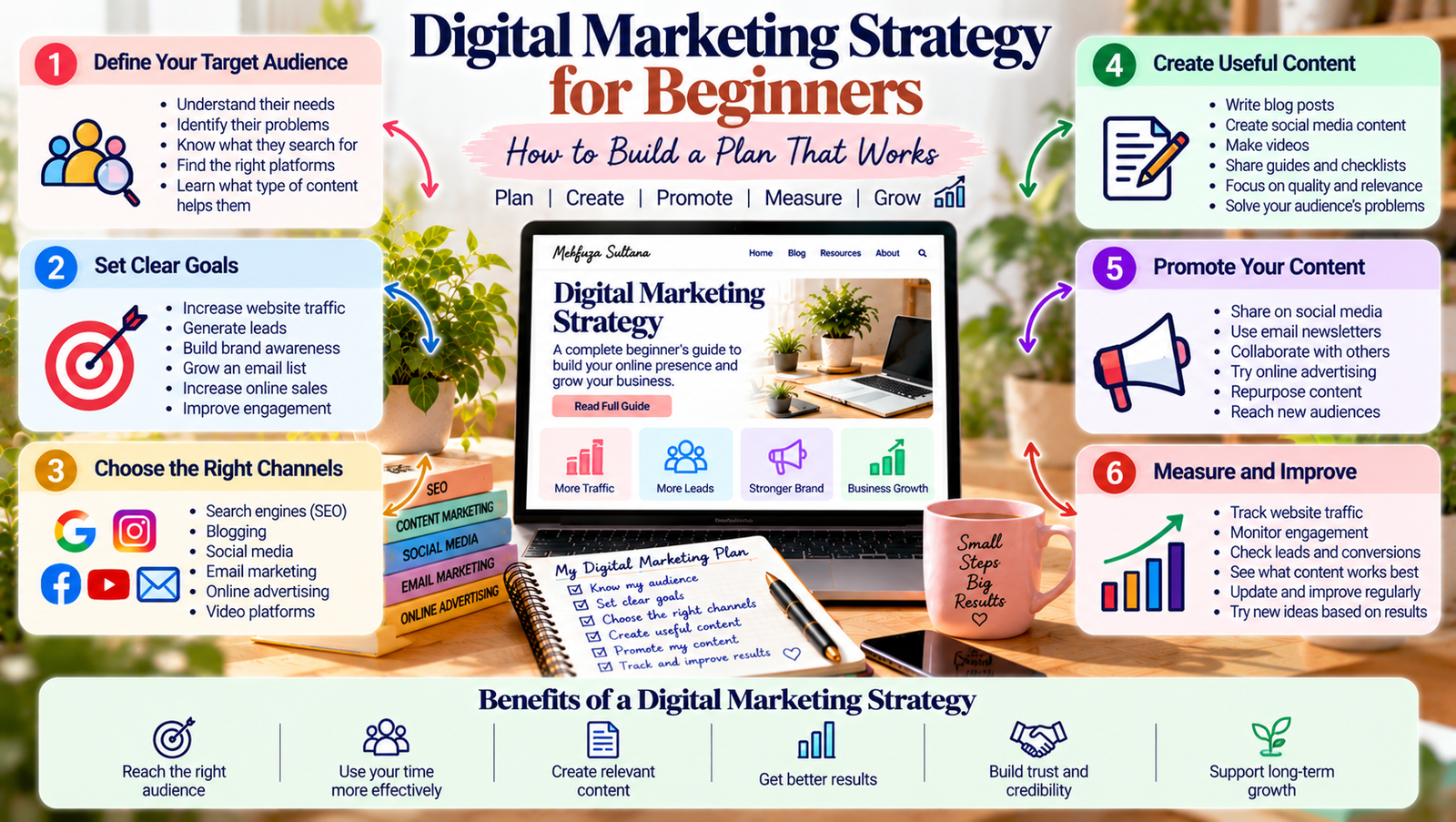
Starting digital marketing can feel confusing. There are many channels, tools, and strategies to choose from. However, you do not need to use everything at once. A clear digital marketing strategy for beginners can help you choose the right audience, set useful goals, create content, and measure your progress.
Instead of posting randomly or trying every new platform, start with a simple plan. First, understand your audience. Then, choose your goals, select suitable channels, create useful content, and track the results.
This guide explains how to build a practical digital marketing strategy from the ground up. It is designed for beginners, freelancers, bloggers, creators, and small business owners who want to build a stronger online presence.
What Is a Digital Marketing Strategy?
A digital marketing strategy is a planned approach to promoting a business, website, service, product, or personal brand through online channels.
These channels can include:
- Search engines
- Blogs
- Social media
- Online advertising
- Websites
- Video platforms
The goal is not simply to be present on every platform.
Instead, your strategy should connect your business goals with the people you want to reach.
For example, a small business may want to attract local customers. A blogger may want more organic traffic. Meanwhile, a freelancer may want to generate leads and build a professional reputation.
Each goal needs a slightly different approach.
Why Do You Need a Digital Marketing Strategy?
Without a plan, digital marketing can become a list of unrelated activities.
You may publish social media posts without knowing why. You may write blog articles without checking what people search for. Similarly, you may run advertisements without knowing whether they bring useful results.
A strategy gives these activities a clear direction.
It can help you:
- Understand your audience
- Choose suitable marketing channels
- Create relevant content
- Use your time more effectively
- Track useful results
- Improve your marketing over time
For example, if your main goal is website traffic, SEO and content marketing may become important parts of your plan. On the other hand, if you want direct customer enquiries, landing pages, social media, email, or paid advertising may have a larger role.
Therefore, begin with the result you want rather than the platform you want to use.
Define Your Target Audience
The first part of a strong digital marketing strategy is knowing who you want to reach.
Your target audience is the group of people most likely to need or value your product, service, content, or expertise.
You can start by asking:
- Who needs what I offer?
- What problem are they trying to solve?
- What information do they search for?
- Which platforms do they use?
- What prevents them from taking action?
- What type of content helps them?
For example, a freelance content writer may target small businesses that need blog articles. A fitness creator may target beginners who want simple workout guidance.
The clearer your audience is, the easier it becomes to choose topics, messages, and channels.
Create a Simple Audience Profile
You do not need complicated research at the beginning.
Write down:
Audience: Who are you trying to reach?
Problem: What problem do they have?
Need: What solution are they looking for?
Search: What might they type into Google?
Platform: Where do they spend time online?
Action: What do you want them to do after seeing your content?
For a deeper guide, read How to Define Your Target Audience for Digital Marketing.
Set Clear Digital Marketing Goals
Once you understand your audience, decide what you want your marketing to achieve.
A goal gives your strategy a clear direction.
Common goals include:
- Increase website traffic
- Generate leads
- Get more enquiries
- Build brand awareness
- Grow an email list
- Increase online sales
- Build a social media audience
- Improve customer engagement
Try to make your goal specific.
Instead of saying:
“I want more traffic.”
You could define a clearer goal:
“I want to increase organic traffic to my website over the next few months.”
This makes it easier to choose suitable actions and measure progress.
Match Goals With Actions
Your marketing activities should support your goal.
For example:
| Goal | Possible Actions |
|---|---|
| More organic traffic | SEO and blogging |
| More leads | Landing pages and useful content |
| More social engagement | Social media content |
| More sales | Product content and paid campaigns |
| More email subscribers | Lead magnets and email marketing |
| Stronger brand awareness | Social media and video content |
The exact approach will depend on your business, audience, budget, and resources.
Choose the Right Digital Marketing Channels
You do not need to use every online channel.
Instead, choose platforms that match your audience and goals.
SEO
Search engine optimization helps your website become easier to discover through search engines.
SEO can include:
- Keyword research
- Useful content
- On-page optimization
- Internal linking
- Technical improvements
- Content updates
If you are building a website, SEO can become part of your long-term traffic strategy.
Content Marketing
Content marketing focuses on creating useful information for your audience.
This can include:
- Blog posts
- Guides
- Videos
- Social posts
- Newsletters
- Case studies
- Tutorials
Good content can answer questions, build trust, and support other marketing activities.
For example, one detailed blog post can later become several social media posts, an email, a video idea, or a checklist.
Social Media Marketing
Social media can help you communicate directly with your audience.
Depending on your audience, you might use platforms such as Instagram, Facebook, LinkedIn, YouTube, or Pinterest.
However, the goal should not be to post everywhere.
Choose the platforms where your audience is most likely to engage with your content.
Email Marketing
Email marketing allows you to communicate directly with people who choose to hear from you.
You can use email to share:
- New blog posts
- Helpful tips
- Product information
- Offers
- News
- Educational content
Over time, an email list can become a useful part of your digital marketing system.
Paid Advertising
Paid advertising can help you reach a specific audience through platforms such as search engines and social networks.
However, paid campaigns need clear goals and tracking.
Before spending money, understand what action you want users to take and how you will measure the result.
Create a Digital Marketing Content Plan
Once you know your audience, goals, and channels, plan the content you will create.
A content plan helps you avoid random publishing.
Start by listing the questions and problems your audience has.
For example, if you help small businesses with SEO, your content topics could include:
- SEO basics
- Keyword research
- On-page SEO
- Website content
- Internal linking
- Local SEO
- Common SEO mistakes
Then, organize these topics into groups.
You can also connect related articles with internal links. This makes it easier for readers to discover more useful information.
For a detailed process, read How to Create a Digital Marketing Content Plan.
Create Content for Different Stages
Not every person in your audience is ready to buy immediately.
Some people are still learning. Others are comparing solutions. A smaller group may already be ready to take action.
Therefore, create different types of content.
Awareness content can introduce a topic or problem.
Consideration content can explain solutions and compare options.
Action-focused content can help readers take the next step.
This approach creates a more complete content journey.
Build and Publish Useful Content
After planning your topics, create content that answers real audience needs.
Start with a clear headline. Then, explain the problem early.
Use headings to organize the article. Add examples where they make an idea easier to understand.
Also, avoid adding information simply to make the article longer.
Instead, ask:
Does this section help the reader?
If the answer is no, remove it or improve it.
For blog content, keyword research can help you discover topics people search for. However, keywords should support the content rather than control every sentence.
Keep Your Brand Message Consistent
Your website, blog, social media pages, and emails should communicate a similar overall message.
This does not mean every post needs to look or sound exactly the same.
Instead, keep your main ideas consistent.
For example, if your brand focuses on simple digital marketing for beginners, your content should continue to reflect that purpose.
Consistency can help people understand what you offer and why they should follow your work.
Track Your Digital Marketing Metrics
Creating content is only one part of digital marketing.
You also need to understand what happens after publishing.
Useful metrics may include:
- Website traffic
- Organic search traffic
- Engagement
- Clicks
- Leads
- Email sign-ups
- Conversion rate
- Sales
- Cost per lead
The right metric depends on your goal.
For example, if your goal is brand awareness, reach and engagement may provide useful information. If your goal is sales, conversions and revenue may matter more.
Therefore, do not track every number just because a platform provides it.
Focus on measurements that help you understand whether your marketing is moving toward your goal.
For a more detailed guide, read How to Measure Digital Marketing Performance: Key Metrics to Track.
Review and Improve Your Strategy
Digital marketing is not a one-time task.
Your audience may change. Search behaviour can change. Platforms can introduce new features. Your business goals may also change.
Because of this, review your strategy regularly.
Look at:
- Which content gets attention?
- Which pages attract visitors?
- Which channels bring useful traffic?
- Which topics generate enquiries?
- Which content receives little response?
- Where do people leave your website?
Then, use what you learn to make changes.
For example, if one topic consistently attracts readers, you can create related content around it. Similarly, if a page receives traffic but few people take action, you may need to improve its content or call to action.
Common Digital Marketing Mistakes to Avoid
Beginners often make a few simple mistakes.
Trying Every Platform
Being active everywhere can become difficult to manage.
Instead, start with one or two channels that fit your audience.
Posting Without a Goal
Content should have a purpose.
Before publishing, know whether you want to educate, attract traffic, build trust, generate leads, or encourage another action.
Ignoring Your Audience
A strategy built around what you want to say may not match what your audience wants to know.
Therefore, research their questions and problems regularly.
Focusing Only on Quantity
More content does not always mean better results.
Useful, focused content can be more valuable than publishing many weak posts.
Not Measuring Results
Without tracking, it becomes difficult to know what is working.
Even basic measurements can help you make better decisions.
A Simple Digital Marketing Strategy Workflow
You can use this simple process when building your own plan:
Understand → Set Goals → Choose Channels → Plan Content → Publish → Measure → Improve
First, understand your audience and their needs.
Next, set clear marketing goals.
Then, choose the channels that fit those goals.
After that, create a practical content plan.
Publish useful content consistently. Once you have enough data, review the results.
Finally, improve your strategy based on what you learn.
This creates a repeatable system instead of a random list of marketing tasks.
A digital marketing strategy for beginners does not need to be complicated.
Start by understanding your audience. Then, choose clear goals and select the channels that support those goals.
After that, create useful content and publish it consistently. Track the results as your website, social media accounts, or business grows.
Most importantly, do not try to master every digital marketing channel at the same time.
Start small, learn from your results, and improve your strategy as you go.
With a clear plan, digital marketing can become a more organized way to attract the right audience, build trust, and grow your online presence.
Add a Comment