

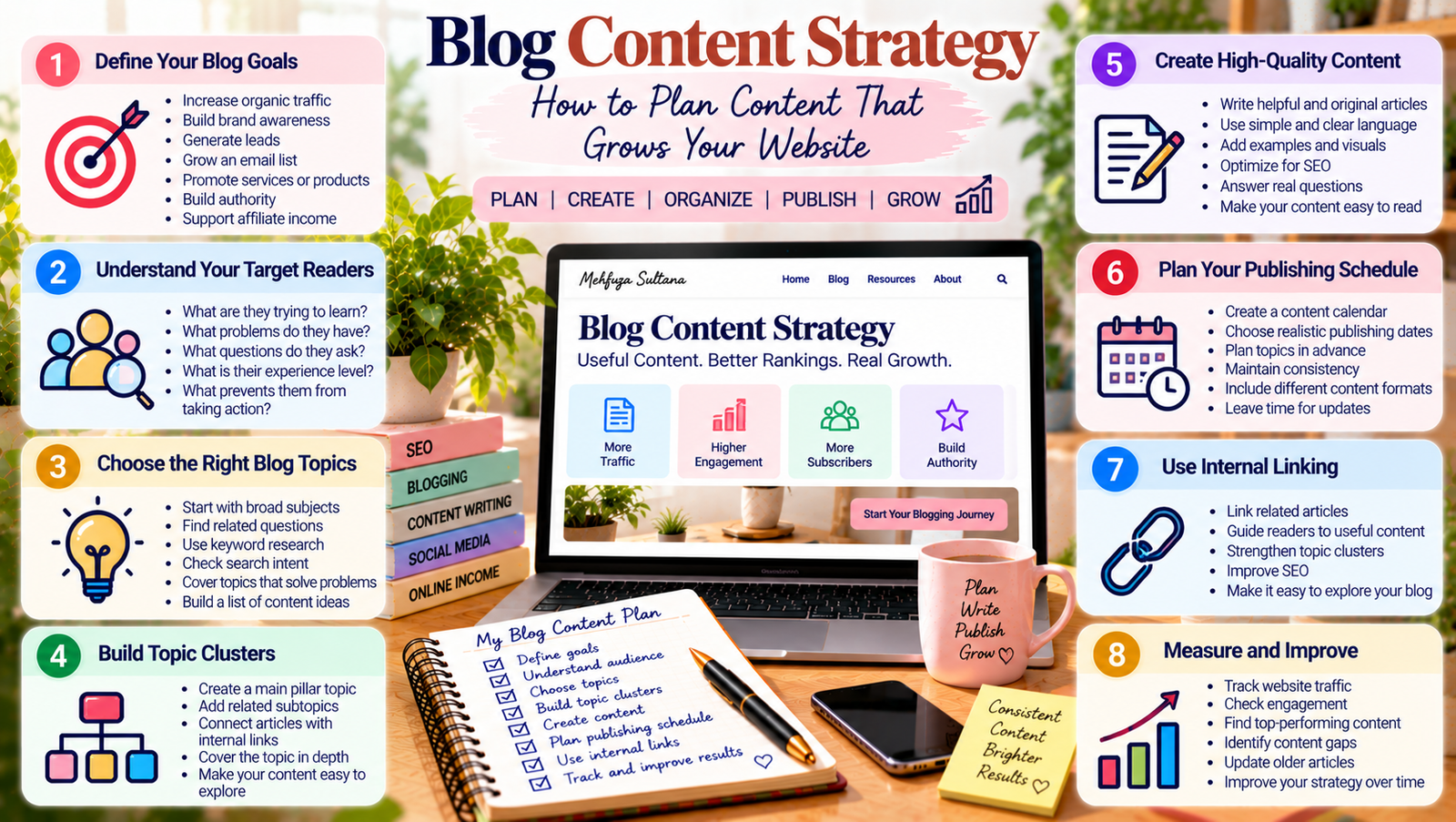
Publishing blog posts without a clear plan can make blogging feel difficult. You may have many ideas, yet still struggle to decide what to write next. A strong blog content strategy gives your website a clear direction.
Instead of choosing random topics, you can plan content around your audience, business goals, keywords, and search intent. As a result, your posts can work together instead of competing with each other.
A good strategy also helps you stay consistent. You can decide which topics to cover, how articles should connect, and when older content needs an update.
In this guide, you will learn how to create a practical blog content strategy. You will also learn how to choose topics, build topic clusters, create content briefs, plan your publishing schedule, use internal links, and measure results.
What Is a Blog Content Strategy?
A blog content strategy is a plan for creating, publishing, organizing, and improving blog content.
It answers important questions such as:
- Who are you writing for?
- What problems do your readers have?
- Which topics should you cover?
- What keywords do people search for?
- What type of content should you create?
- How should your articles connect?
- How will you measure results?
For example, a digital marketing blog may cover SEO, content writing, social media, blogging, and online income.
Rather than publishing unrelated articles, you can organize these subjects into clear content groups. This makes the website easier to understand for both readers and search engines.
Why Your Blog Needs a Content Strategy
Without a plan, it is easy to publish whatever idea comes to mind. However, random publishing can create gaps, repeated topics, and weak connections between articles.
A clear blog content strategy helps you:
- Choose useful topics
- Understand your readers
- Target relevant searches
- Organize related articles
- Build internal links
- Maintain a publishing schedule
- Find content gaps
- Update older articles
- Measure your progress
Most importantly, your blog starts working toward a larger goal.
For example, one article can introduce a topic while another explains it in more detail. A third article can then answer a related question. Together, these posts create a stronger content system.
Define Your Blog Goals
Before choosing topics, decide what you want your blog to achieve.
Your goal could be to:
- Increase organic traffic
- Build brand awareness
- Generate leads
- Promote services
- Grow an email list
- Build authority
- Support affiliate income
- Attract freelance clients
Your goal affects the type of content you create.
For instance, a blog focused on organic traffic may need more informational articles. On the other hand, a service-based website may also need comparison, solution-based, and commercial content.
Therefore, define one or two main goals before building your content plan.
Understand Your Target Readers
Your content should start with your readers, not just keywords.
Think about the people you want to attract. Ask yourself:
- What are they trying to learn?
- What problems are they facing?
- What questions do they ask?
- What level of knowledge do they have?
- What prevents them from taking action?
- What information would help them make a decision?
For example, beginners may search for simple explanations such as “what is SEO?” Later, they may search for more specific topics such as keyword research, internal linking, or technical SEO.
Understanding this journey helps you create content for different stages.
You can also use your audience research to decide how simple or detailed your articles should be.
Choose the Right Blog Topics
Topic selection is one of the most important parts of your blog content strategy.
Start with broad subjects related to your website. Then, break those subjects into smaller questions and problems.
For example:
Main topic: SEO
Possible supporting topics:
- SEO for beginners
- Keyword research
- On-page SEO
- Internal linking
- Technical SEO
- SEO content writing
- Search intent
- Content refresh
This approach gives you a wider content map.
You can then research keywords for each topic and check whether people are actually searching for those subjects.
For a deeper guide, see our keyword research guide.
Build Topic Clusters for Your Blog
Once you have your main topics, organize related articles into topic clusters.
A topic cluster usually has:
- One main topic
- Several supporting articles
- Internal links connecting related pages
For example, an SEO cluster could have a main guide about SEO for beginners. Supporting articles could cover keyword research, on-page SEO, technical SEO, and internal linking.
This structure helps readers move from one useful article to another.
It also gives your website a clearer topical structure.
Learn more in our guide on how to build topic clusters for your blog.
Create a Content Brief Before Writing
A content brief gives you a simple plan before you start writing.
It can include:
- Article title
- Focus keyphrase
- Search intent
- Target audience
- Main points
- H2 and H3 headings
- Internal links
- External sources
- Image ideas
- Call to action
A brief saves time because you know what the article needs before writing the first paragraph.
It also helps prevent unnecessary sections. Instead of adding information just to make an article longer, you can focus on what readers actually need.
If you want a structured approach, see our guide on how to create a content brief before writing a blog post.
Plan Your Content Calendar
A content calendar helps turn your strategy into an actual publishing plan.
You can create a simple monthly calendar with columns such as:
| Date | Topic | Keyword | Search Intent | Content Type | Status |
|---|---|---|---|---|---|
| Week 1 | SEO basics | SEO for beginners | Informational | Guide | Planned |
| Week 2 | Keyword research | keyword research | Informational | Guide | Planned |
| Week 3 | On-page SEO | on-page SEO | Informational | Tutorial | Planned |
| Week 4 | Internal linking | internal linking | Informational | Guide | Planned |
You do not need to publish every day.
Instead, choose a schedule you can maintain. One useful article each week can be better than publishing several rushed posts and then stopping.
Create Content That Meets Search Intent
Search intent explains what a person wants when they search for something.
Common types include:
Informational Intent
The reader wants to learn something.
Example:
“What is keyword research?”
Commercial Intent
The reader is researching options before making a decision.
Example:
“Best SEO tools for bloggers”
Transactional Intent
The reader is ready to take an action.
Example:
“Buy SEO keyword research tool”
Navigational Intent
The reader wants to find a specific website or page.
Example:
“Google Search Console login”
Before writing an article, check the search results for your target query.
Look at the type of pages that appear. Then create content that matches what searchers are actually looking for.
Connect Your Blog Posts With Internal Links
Internal links connect one page of your website to another.
They help readers discover related information. They also create a clearer path through your website.
For example, a beginner reading an article about blogging may want to learn about keyword research next.
You can naturally link to your keyword research article from that section.
When adding internal links:
- Use relevant anchor text
- Link related topics
- Avoid adding too many links
- Connect supporting articles to broader guides
- Link older articles from new posts
- Review important links during content updates
A strong internal linking structure can make your website easier to navigate.
Update Old Content for Better Results
Creating new articles is only one part of blogging.
Older posts may become outdated, lose traffic, or miss important information. Therefore, review your existing content regularly.
Look for:
- Outdated information
- Broken links
- Missing sections
- Old examples
- Weak introductions
- Poor internal linking
- Changes in search intent
- New keyword opportunities
You can also improve titles, headings, images, and examples when needed.
For more guidance, read how to update your blog content for better SEO and traffic.
Measure Your Blog Content Strategy
A strategy needs data.
Use tools such as Google Search Console and Google Analytics to understand how your website performs.
Track useful signals such as:
- Organic clicks
- Impressions
- Search positions
- Organic traffic
- Engagement
- Conversions
- Leads
- Top-performing articles
Do not focus on one number alone.
For example, an article may receive many impressions but few clicks. This could suggest that the title or search result needs improvement.
Similarly, a page may receive less traffic but generate valuable leads. Therefore, always connect your results to your original goal.
Common Content Strategy Mistakes
Even a good plan can fail when the basics are ignored.
Here are some common mistakes:
Publishing Without a Clear Audience
If you do not know who you are writing for, your content may become too broad.
Choosing Topics Only by Search Volume
High search volume does not always mean high value. A smaller topic may attract readers who are more relevant to your goal.
Creating Similar Articles
Several posts targeting the same idea can make your website difficult to organize.
Ignoring Search Intent
Even a well-written article may struggle if it does not answer what searchers actually want.
Forgetting Internal Links
Useful articles should not remain isolated. Connect related pages whenever it makes sense.
Never Updating Older Content
Your content library can become outdated if you only publish new posts.
A Simple Blog Content Strategy Workflow
A simple workflow can make content planning easier.
Start by defining your blog goals and target readers. Next, choose your main topics and research relevant keywords.
After that, group related keywords and questions into topic clusters. Then, select individual article ideas from each group.
Once you have the topics, create a brief for each article. Include the search intent, main points, headings, internal links, and image ideas.
Next, add the articles to your content calendar. Give yourself realistic publishing dates instead of creating a schedule that is difficult to maintain.
After publishing, monitor performance and look for improvement opportunities. Update older content when information changes or a page needs stronger coverage.
Over time, this process creates a connected content library rather than a collection of unrelated posts.
A successful blog does not need hundreds of articles. It needs useful content with a clear purpose.
A strong blog content strategy helps you decide what to publish, who you are writing for, and how each article fits into your website.
Start with your audience and goals. Then research topics, build clusters, create useful briefs, and plan a realistic publishing schedule.
As your blog grows, connect related articles and review older content. Most importantly, use your performance data to improve your decisions.
With a clear plan, your blog can become easier to manage and more useful to the people you want to reach.
Add a Comment