

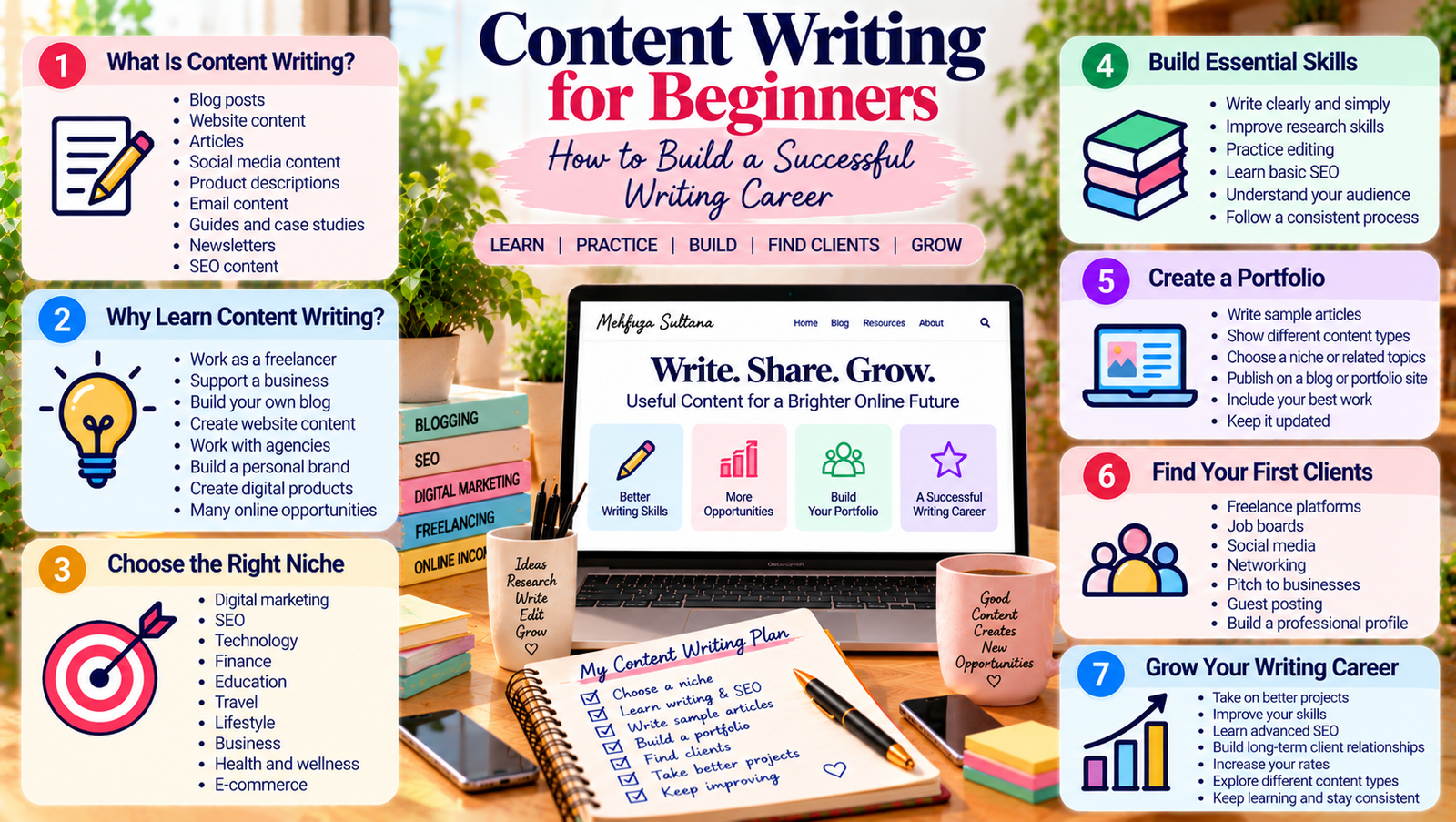
Starting a writing career can feel confusing when you do not know where to begin. You may enjoy writing, but you may not know which skills to learn, what type of content to create, or how to find your first client.
Content writing for beginners becomes easier when you follow a clear plan. You can start with basic writing skills, choose a suitable niche, learn SEO, create sample work, and slowly build your professional profile.
You do not need years of experience to get started. Instead, focus on learning the basics and creating useful content. As your skills improve, you can take on better projects and build stronger client relationships.
This guide explains how to start content writing, develop your skills, create a portfolio, find opportunities, and grow your writing career step by step.
What Is Content Writing?
Content writing means creating written content for a specific audience and purpose.
Content writers may create:
- Blog posts
- Website content
- Articles
- Social media content
- Product descriptions
- Email content
- Guides
- Case studies
- Newsletters
- SEO content
The purpose can vary from one project to another.
For example, a blog post may educate readers. Website content may explain a service. A product description may help customers understand a product.
Good content is not simply about using correct grammar. It should also be clear, useful, relevant, and easy to understand.
If you are completely new to the field, you can also start with our content writing guide to understand the basics.
Why Learn Content Writing?
Content writing can be a useful skill for many different career paths.
You can use writing skills to:
- Work as a freelancer
- Support a business
- Build your own blog
- Create website content
- Work with marketing teams
- Write for agencies
- Create digital products
- Build a personal brand
The skill is also useful beyond freelance work.
For example, entrepreneurs can use writing to explain their services. Marketers can use it to communicate with customers. Bloggers can use it to build an audience.
Therefore, learning to write clearly can support many online career opportunities.
Choose the Right Content Writing Niche
A niche is a specific subject or industry you focus on.
Some common content writing niches include:
- Digital marketing
- SEO
- Technology
- Finance
- Education
- Travel
- Lifestyle
- Business
- Health and wellness
- E-commerce
You do not have to choose a niche immediately. However, having a clear area of interest can make it easier to build relevant experience.
Start by thinking about your existing knowledge and interests.
Ask yourself:
- What subjects do I enjoy?
- What do I already understand?
- What topics can I research easily?
- What type of audience do I want to write for?
You can also test a few topics before making a final decision.
For more guidance, read how to choose a content writing niche as a beginner.
Build Essential Content Writing Skills
Strong writing skills are the foundation of this career.
Learn to Write Clearly
Readers should understand your message without struggling through complicated sentences.
Use simple words when possible. Keep your sentences focused and explain unfamiliar terms when needed.
Improve Your Research Skills
Writers often need to research topics before creating content.
Good research helps you understand:
- The topic
- The target audience
- Common questions
- Reliable sources
- Current information
- Competing content
Do not depend on a single source. Compare useful information and check important facts before using them.
Practice Editing
The first draft does not need to be perfect.
After writing, read your content again. Remove unnecessary words, improve unclear sentences, check grammar, and make the structure easier to follow.
Learn Basic SEO
SEO can help your content reach people through search engines.
You should understand basic concepts such as:
- Keywords
- Search intent
- SEO titles
- Meta descriptions
- Headings
- Internal links
- Image alt text
You do not need to become a technical SEO expert to start writing SEO-friendly content.
Learn Basic SEO for Content Writing
Many businesses need writers who understand both content and search.
When writing an SEO article, begin with the reader’s needs.
First, understand the search query. Then, identify what information the reader expects.
After that, create a useful structure with clear headings.
You can naturally include relevant keywords in:
- The title
- Introduction
- Headings
- Body content
- Image alt text
- Meta description
However, avoid repeating the same keyword unnecessarily.
Search engines are designed to understand topics and meaning. Therefore, focus on useful information rather than keyword stuffing.
You can learn more through our SEO for beginners guide.
Create a Content Writing Portfolio
A portfolio shows potential clients what you can do.
You do not need paid clients to create your first portfolio.
Instead, create your own writing samples.
For example, you could write:
- Two blog posts
- One website service page
- One SEO article
- One product description
- A few social media captions
Choose topics that match the type of work you want.
If you want to write for digital marketing companies, create samples about SEO, social media, blogging, or online business.
Keep your best samples easy to find.
You can also read how to build a content writing portfolio with no experience for a detailed process.
Find Your First Content Writing Opportunities
Once you have some writing samples, start looking for opportunities.
You can explore:
- Freelance platforms
- Job websites
- Content agencies
- Small businesses
- Startups
- Direct outreach
- Professional networks
Do not apply for every available project.
Instead, look for opportunities that match your skills and preferred niche.
For example, if you have strong blog-writing samples, search for businesses looking for blog writers.
A focused approach can make your applications more relevant.
How to Build a Content Writing Routine
Writing regularly helps you improve faster.
You do not need to write for several hours every day.
Even 30–60 minutes of focused practice can help.
A simple routine could include:
Writing: Practice one short section or article.
Research: Study a topic and compare reliable sources.
Editing: Improve an older piece of writing.
SEO: Learn one basic SEO concept.
Reading: Read high-quality articles to understand structure and style.
Over time, this routine can improve both your speed and confidence.
Set Your Content Writing Rates
Once you start looking for paid work, you need to decide how you will charge.
Writers may charge:
- Per word
- Per article
- Per project
- Per hour
- Monthly retainer
There is no single rate that works for everyone.
Your pricing can depend on:
- Experience
- Research requirements
- Content length
- Topic difficulty
- SEO requirements
- Project deadline
- Client expectations
As a beginner, focus on building useful experience without accepting work that is unrealistic or poorly defined.
As your skills and portfolio grow, you can review your rates and take on more valuable projects.
Build Long-Term Client Relationships
Getting one client is useful. Building a long-term relationship can be even more valuable.
Good communication matters.
Before starting a project, clarify:
- The topic
- Word count
- Deadline
- Content format
- Target audience
- SEO requirements
- Number of revisions
- Payment terms
During the project, keep the client updated when needed.
After delivery, respond professionally to feedback.
Reliable communication and consistent quality can help turn one project into ongoing work.
Common Content Writing Mistakes to Avoid
Beginners often make mistakes while learning.
Writing Without Knowing the Audience
Content should have a clear reader in mind. Otherwise, the message may become too broad.
Focusing Too Much on Keywords
SEO matters, but readers come first. Avoid forcing keywords into every sentence.
Skipping Research
Even simple topics may need research. Check important facts before publishing.
Trying to Sound Too Professional
Complex words do not automatically make content better. Clear writing is often more effective.
Publishing Without Editing
Always review your draft before sending or publishing it.
Creating a Weak Portfolio
A portfolio should show the type of work you want to get. Choose relevant and polished samples.
Applying Without Reading the Brief
Read the project requirements carefully before sending a proposal.
How to Grow Your Content Writing Career
Once you have basic experience, you can gradually expand your skills.
For example, you can learn:
- SEO content writing
- Copywriting
- Content strategy
- Email marketing
- Social media writing
- Technical writing
- Content editing
- Content management
You can also create your own blog.
Writing on your own website gives you a place to practice, publish samples, build search visibility, and demonstrate your knowledge.
Over time, your blog can become part of your professional portfolio.
A Simple Content Writing Career Plan
You do not need to master everything at once.
Start by learning the basics of writing and research. Then choose one or two areas where you want to develop your skills.
Next, create several strong writing samples. After that, organize them into a simple portfolio.
Once your portfolio is ready, start applying for suitable projects and contacting potential clients.
As you gain experience, improve your writing, learn more about SEO, and expand your services.
Finally, review your progress regularly. Look at the type of work you enjoy, the clients you want to attract, and the skills that can help you move forward.
This approach keeps the process manageable.
Starting a writing career does not require you to know everything from day one.
The best approach is to learn one skill at a time and practice regularly. Begin with clear writing, research, editing, and basic SEO. Then choose a suitable niche and create useful samples.
Once you have a portfolio, look for relevant opportunities and communicate professionally with clients.
Most importantly, keep improving.
Content writing for beginners is not only about learning how to write. It is about understanding readers, solving problems, researching information, and communicating ideas clearly.
With consistent practice and a simple plan, you can turn writing into a valuable professional skill and gradually build a sustainable career.
Add a Comment