

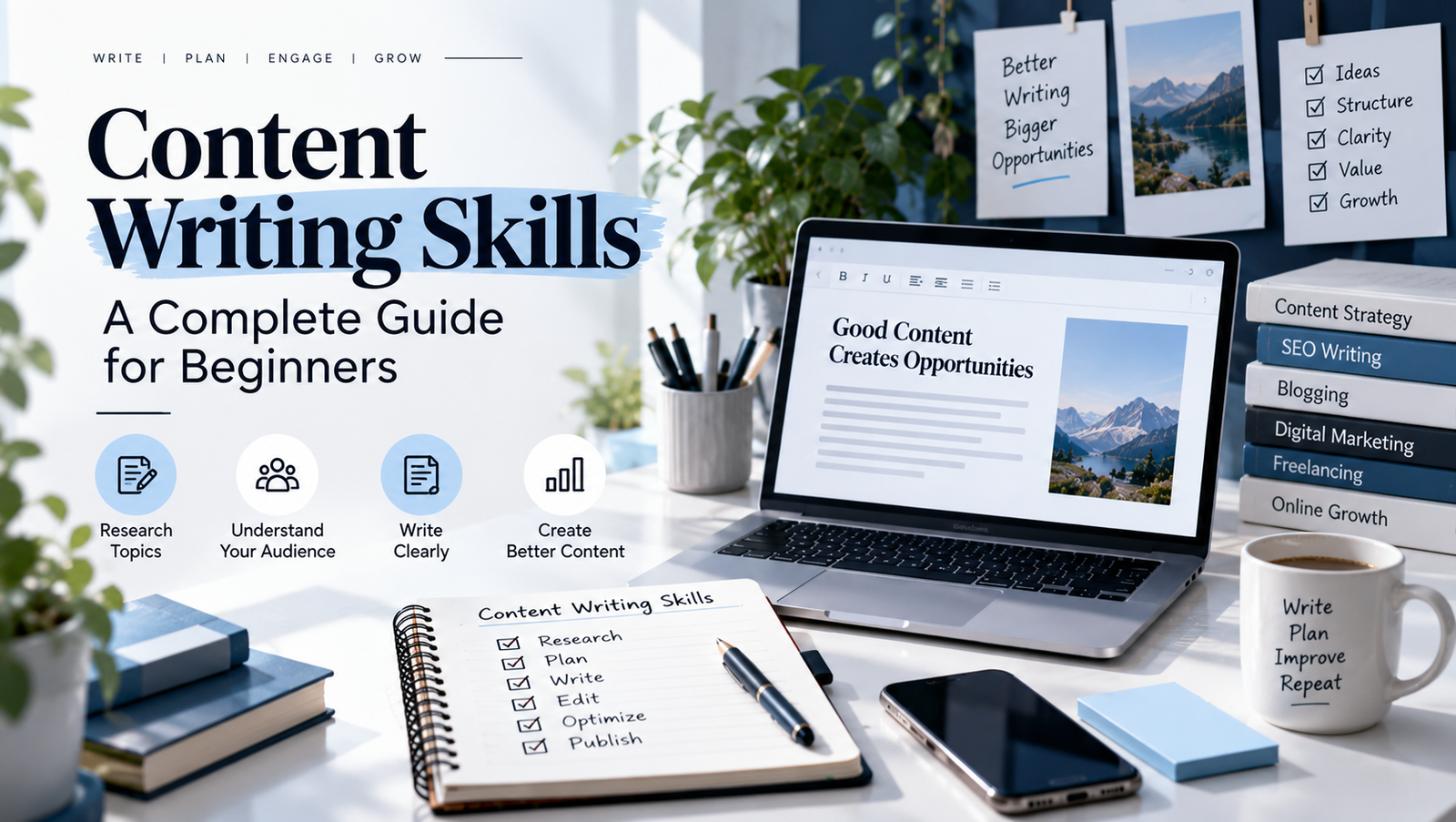
Good content does more than fill a page. It answers questions, solves problems, and helps readers make informed decisions. However, creating useful content takes more than knowing how to write sentences. You also need to understand your audience, research topics, organize ideas, and edit your work.
The good news is that you can develop these abilities with regular practice. You do not need to be a professional writer to begin.
In this guide, you will learn the essential content writing skills every beginner should develop. You will also discover practical ways to improve your writing and create content that readers find useful.
What Are Content Writing Skills?
Content writing skills are the abilities you use to plan, research, write, and improve content for a specific audience. These skills help you communicate information clearly and achieve a purpose.
For example, a blog writer may explain a topic in detail. A website writer may describe a service. Meanwhile, a social media writer may create a short post that encourages people to take action.
Although these formats are different, they share several basic skills. Writers need clear communication, good research habits, an understanding of readers, and attention to detail.
Content writing can also support different career goals. You may use these skills to start a blog, work as a freelance writer, create website content, or promote a business online.
Why Are Content Writing Skills Important?
Strong writing makes information easier to understand. It also helps readers decide whether your content deserves their time.
Here are some important benefits.
1. Better communication: Clear writing helps you explain ideas without confusing your audience.
2. Improved reader engagement: Useful information and relatable examples encourage people to keep reading.
3. Stronger SEO: Well-organized content helps search engines understand your page. It also helps readers find answers to their questions.
4. More career opportunities: Businesses need blog posts, website pages, email newsletters, product descriptions, and social media content.
5. Greater trust: Accurate information, honest explanations, and consistent quality help you build credibility.
However, good writing is not only about ranking on Google or attracting clients. Your first priority should be helping the reader.
8 Essential Content Writing Skills Every Beginner Needs
You do not need to master everything at once. Start with the following eight skills and improve them step by step.
1. Research and Fact-Checking
Research is the foundation of useful content. Before writing, you need to understand the topic and identify reliable information.
Begin by reviewing trustworthy websites, official documents, expert publications, and relevant studies. Compare information from more than one source when necessary.
Next, check important facts, statistics, dates, and claims. Do not repeat a statement simply because several websites mention it. Look for the original source whenever possible.
For example, if you are writing about SEO, consult Google’s official Search Central documentation. It provides guidance on how Google Search works and how website owners can improve their content.
Keep your research notes organized. Record useful facts, source links, and questions that need further checking.
2. Understanding Your Audience
Every piece of content should have a clear target reader. Without this understanding, your writing may become too general or difficult to follow.
First, identify who will read your article. Consider their knowledge level, interests, challenges, and goals.
For example, beginners searching for blogging advice may need simple explanations and step-by-step instructions. Experienced marketers, on the other hand, may prefer detailed examples and advanced strategies.
Ask yourself three questions before writing:
- What problem does my reader want to solve?
- What information do they already know?
- What should they be able to do after reading?
These questions help you choose the right tone, examples, and level of detail.
3. Clear and Simple Writing
Clear writing makes your message easy to understand. You do not need complicated vocabulary to sound professional.
Use familiar words whenever possible. Keep sentences focused on one main idea. If a sentence feels difficult to read, divide it into two shorter sentences.
For example:
Difficult: The implementation of an effective content development strategy facilitates the systematic production of audience-focused material.
Simpler: A good content strategy helps you create useful content for your audience.
The second version communicates the same general idea more directly.
Also, avoid repeating the same point in different words. Each paragraph should add something valuable.
Simple writing does not mean shallow writing. You can explain complex ideas in detail while keeping your language accessible.
4. Grammar, Spelling, and Punctuation
Grammar helps readers understand the relationship between your ideas. Spelling and punctuation also make your content look professional.
Common mistakes include missing commas, incorrect verb forms, repeated words, and inconsistent capitalization.
Fortunately, you can improve accuracy through regular practice. Read your sentences slowly and check whether they sound natural.
You can also use grammar-checking tools to identify possible errors. However, do not accept every suggestion automatically. Review each change to make sure it preserves your meaning.
For additional guidance, explore the Purdue Online Writing Lab. It offers writing resources covering grammar, punctuation, and academic writing.
Remember that editing tools support your judgment. They do not replace it.
5. SEO Writing Basics
Search engine optimization (SEO) helps your content become easier to discover through search engines. Writers do not need to be technical experts, but they should understand a few basic principles.
Start by identifying the main search query your article answers. Then, understand the reader’s search intent. Are they looking for an explanation, a comparison, a tutorial, or a product?
Use your primary keyword naturally in the title, introduction, URL slug, and relevant headings. Add related terms when they fit the topic.
You should also focus on:
- Writing descriptive titles and meta descriptions.
- Using clear headings to organize information.
- Adding relevant internal links to related articles.
- Including helpful images with descriptive alt text.
- Answering the reader’s main question directly.
Avoid repeating keywords unnecessarily. Search engines aim to serve useful content, not pages filled with repeated phrases.
For a practical next step, read this guide on finding the right keywords for your blog posts.
6. Content Structure and Organization
Even useful information can lose readers when it is poorly organized. A clear structure helps people find what they need without reading every sentence.
Before writing, create a simple outline. Decide what the introduction should explain and which main points belong in the body.
Use headings to separate different topics. Place related ideas together and arrange sections in a logical order.
For example, a beginner’s guide might follow this structure:
- Introduce the topic and explain why it matters.
- Define important terms.
- Explain the main steps.
- Provide examples and practical tips.
- Summarize the key lessons.
Use short paragraphs and bullet points when they make information easier to scan. However, avoid turning every sentence into a separate bullet.
A good structure guides readers from their initial question to a useful answer.
7. Storytelling and Examples
Facts explain information, but examples show readers how to apply it. Storytelling can make your content more relatable and memorable.
Imagine you are writing about starting a blog. Instead of saying, “Create a consistent publishing schedule,” explain how a beginner might publish one useful article every week.
You could describe the process of choosing a topic, researching keywords, writing a draft, and publishing the finished post.
This example turns general advice into an action readers can follow.
You can use short case studies, realistic situations, comparisons, and personal experiences when they are relevant. Always be honest about your experience. Never invent a customer story or claim that an example represents real results when it does not.
For more practical writing techniques, explore how to write a blog post readers want to read.
8. Editing and Proofreading
Writing the first draft is only one part of the process. Editing helps you improve the message, while proofreading catches smaller errors before publication.
Start by reviewing the article’s overall structure. Does it answer the main question? Are any sections unnecessary? Have you explained important ideas clearly?
Next, improve individual sentences. Remove repeated words, simplify confusing phrases, and check transitions between paragraphs.
Finally, proofread for spelling, grammar, punctuation, links, and formatting.
If possible, take a short break before editing. Returning with fresh eyes can help you notice mistakes you missed earlier.
You can also read the article aloud. Awkward sentences often become easier to identify when you hear them.
How to Improve Your Content Writing Skills Step by Step
Knowing the main skills is useful, but improvement comes from applying them consistently. Follow this simple process to build your confidence.
Step 1: Read High-Quality Content
Read articles from reliable websites in your chosen niche. Notice how writers introduce topics, organize sections, explain difficult ideas, and support their claims.
Do not copy their work. Instead, study the techniques they use and learn how those techniques serve readers.
Step 2: Write a Little Every Day
Set aside 20 to 30 minutes for writing practice. You can write a short blog introduction, summarize an article, explain a concept, or draft a social media post.
Regular practice helps you become more comfortable expressing ideas. It also makes it easier to identify your common mistakes.
Step 3: Create an Outline Before Drafting
Write down your main topic and the questions your article needs to answer. Turn those questions into headings.
Then, add a few notes under each heading. This approach gives your article direction and reduces the chance of repeating information.
Step 4: Edit Every Draft
Do not publish your first draft without reviewing it. Check clarity, accuracy, structure, and grammar.
You can use a checklist to make the process easier. Over time, you will notice patterns in your mistakes and learn how to avoid them.
Step 5: Ask for Feedback
Share your work with a trusted reader, writing group, or experienced editor when possible.
Ask specific questions. For example, was the introduction clear? Did any section feel confusing? Did the article answer the main question?
Use feedback to improve your next draft instead of treating every correction as criticism.
Step 6: Build a Writing Portfolio
Save your best work in an organized portfolio. Include different formats when relevant, such as blog posts, website copy, product descriptions, and email content.
If you are new to writing, create sample articles on topics you understand. Clearly identify them as samples rather than published client work.
A portfolio helps potential clients or employers assess your writing style and subject knowledge.
Common Content Writing Mistakes to Avoid
Beginners often make a few avoidable mistakes. Recognizing them early can improve the quality of your work.
Writing without research: Start with reliable information instead of relying only on memory or assumptions.
Using complicated language: Choose words your target audience understands. Explain technical terms when needed.
Ignoring search intent: Make sure your article answers the question readers are actually asking.
Repeating keywords too often: Use your focus keyphrase naturally and include related terms only when they add meaning.
Writing long, unstructured paragraphs: Break complex ideas into manageable sections.
Skipping editing: Review your work before publishing, even when you feel confident about the draft.
Publishing without a clear purpose: Decide what readers should learn, understand, or do after reading.
Avoiding these mistakes will not make every article perfect. However, it will give you a stronger foundation for consistent improvement.
Your 7-Day Content Writing Practice Plan
You can begin developing your skills with a simple weekly plan. Spend around 20 to 30 minutes on each daily activity.
| Day | Practice activity |
|---|---|
| Day 1 | Read two useful articles in your chosen niche and study their structure. |
| Day 2 | Research one topic and collect reliable sources. |
| Day 3 | Create an outline with clear headings and supporting points. |
| Day 4 | Write a complete first draft without worrying about perfection. |
| Day 5 | Edit the draft for clarity, structure, and readability. |
| Day 6 | Check facts, grammar, links, and basic SEO elements. |
| Day 7 | Review the finished article and note three things to improve next time. |
Repeat the process with a new topic each week. As you gain experience, you can increase the complexity of your projects and explore different content formats.
Final Thoughts
Developing strong content writing skills takes time, practice, and patience. You do not need to master every technique before publishing your first article.
Instead, focus on understanding your audience, researching carefully, writing clearly, organizing information, and editing your work. These habits will help you create content that serves readers and supports your long-term goals.
Start with one topic you understand. Write a useful article, review it carefully, and learn from the process. With consistent effort, you can become a more confident writer and open new opportunities in blogging, freelancing, and digital marketing.
Keep learning, keep practising, and let every new piece of content help you improve.
Add a Comment