

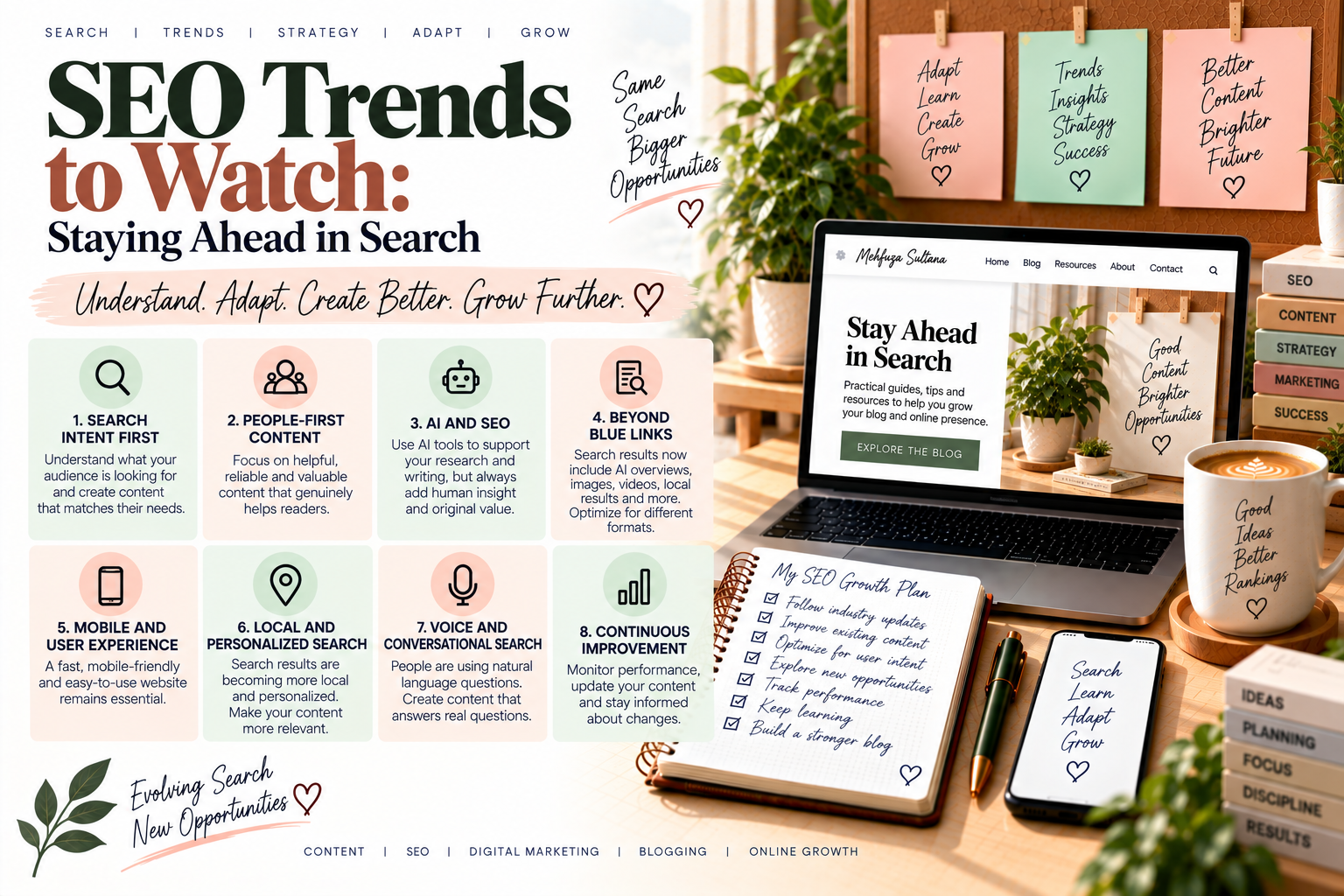
SEO trends continue to change as search engines become more sophisticated, users change how they search, and new technologies influence the way people discover information online. For bloggers and website owners, keeping up with these changes can help you make better content decisions instead of relying on outdated SEO tactics.
SEO is no longer only about adding keywords to a page and building backlinks. Modern search increasingly considers the usefulness of content, the experience a website provides, technical accessibility, search intent, and how well a page satisfies a user’s need.
Google’s current Search Central documentation continues to emphasize technical requirements, helpful content, search appearance, Search Console, and other areas that website owners should understand.
This guide explores the major SEO trends bloggers should understand and, more importantly, how you can adapt your content strategy without chasing every new SEO headline.
What Are SEO Trends?
SEO trends are important changes or developing practices that can influence how websites are discovered, crawled, indexed, displayed, and found through search.
Some changes happen because search engines improve their systems. Others happen because people change the way they search.
For example, users may search through:
- Traditional search results
- Mobile devices
- Voice interfaces
- Images
- Videos
- AI-powered search experiences
- Local search
- Product searches
This means bloggers need to think beyond simply ranking one page for one keyword.
A stronger approach is to create useful content that clearly satisfies a specific search need.
SEO Trends to Watch: Search Is Becoming More Intent-Focused
One of the most important SEO trends is the continued importance of understanding search intent.
Search intent means the reason behind a search.
Someone searching:
“What is keyword research?”
is probably looking for an explanation.
Someone searching:
“best keyword research tools”
may be comparing options.
Someone searching:
“buy SEO software”
has a different intent again.
The same topic can therefore require different content depending on what the searcher wants.
How to Adapt
Before writing an article, ask:
- What is the reader trying to accomplish?
- What information do they need?
- What type of content would solve their problem?
- Are they looking for information, comparison, instructions, or a product?
This should influence your title, structure, examples, and CTA.
For more guidance, start with your Keyword Research Guide and make search intent part of your content planning process.
Helpful, People-First Content Remains Important
Another major SEO trend is the continuing focus on content that genuinely helps people.
Google’s Search Central documentation provides guidance around creating helpful, reliable, people-first content and maintaining content that provides value rather than being produced simply to manipulate rankings.
This matters because publishing more articles does not automatically create a stronger website.
For example, imagine two blogs.
Blog A publishes 50 short articles that repeat information already available everywhere.
Blog B publishes 20 carefully researched articles with examples, practical steps, original insights, useful internal links, and clear explanations.
More content does not automatically mean better content.
How to Adapt
Before publishing, ask:
“What will the reader understand or be able to do after reading this?”
If you cannot answer that clearly, the article may need a stronger purpose.
AI and SEO Are Changing Content Creation
AI is one of the most visible SEO trends in recent years. Today, many creators use AI tools to support different parts of the content process.
For example, these tools can help with:
- Finding content ideas
- Creating article outlines
- Grouping related topics
- Improving readability
- Finding content gaps
- Reviewing existing content
However, AI should support your content process rather than replace human input. Your own experience, examples, opinions, and editing can make the final content more useful and original.
As a result, the best approach is to use AI as a helpful tool while keeping people and their needs at the center of your content strategy.
But using AI does not remove the need for human judgment.
Google’s current guidance also distinguishes useful content from scaled content created primarily to manipulate search rankings. Its spam policies specifically warn against producing large amounts of unoriginal content with little value, regardless of whether automation or AI was used.
How to Adapt
Use AI as a productivity tool rather than a replacement for expertise.
Add value through:
- Personal experience
- Original examples
- Practical workflows
- First-hand observations
- Expert commentary
- Data
- Case studies
- Clear explanations
Your goal should be to make the final article more useful, not simply faster to produce.
Search Is Expanding Beyond Traditional Blue Links
Modern search experiences include more than traditional organic listings.
Google currently documents search features including AI features, featured snippets, images, videos, Discover, sitelinks, and other search appearances.
This means your content may be discovered in different ways depending on the query and search experience.
How to Adapt
Create content that is easy to understand and extract information from.
Use:
- Clear headings
- Short paragraphs
- Descriptive titles
- Lists
- Tables where useful
- Direct explanations
- Relevant images
- Original examples
Do not write solely for a particular search feature.
Focus first on creating a page that is genuinely useful.
SEO Trends Include More Visual and Multimedia Content
Search is not limited to text.
Images, videos, and other visual formats can help users understand topics more quickly.
For example, a tutorial about creating a content calendar could include:
- A sample calendar
- A planning workflow
- A screenshot
- A downloadable template
- A short explanatory video
Visual content can make complex information easier to understand.
Google’s Search documentation also includes image-related search guidance and recommendations for how websites can influence image presentation in search.
How to Adapt
Add relevant visuals when they genuinely improve the article.
Do not add stock images simply because an SEO plugin says a page should contain images.
Every image should have a purpose.
Technical SEO Still Matters
With all the attention on AI and content trends, it is easy to forget that technical SEO remains important.
Search engines need to be able to access and understand your website.
Important technical areas include:
- Crawling
- Indexing
- Mobile usability
- Page experience
- Site structure
- Internal links
- HTTPS
- Canonical URLs
- Structured data where appropriate
- Website performance
Google Search Central provides technical requirements and documentation covering how websites can be crawled and included in Search.
How to Adapt
You do not need to become a developer to understand basic technical SEO.
Start by checking:
- Can search engines access your important pages?
- Are important pages indexed?
- Are internal links working?
- Does your website work well on mobile?
- Are there unnecessary broken pages?
- Is your website structure easy to understand?
Internal Linking Is Becoming More Valuable for Content Organization
A growing website can quickly become difficult to navigate if every article exists independently.
Internal links connect related pages and help readers discover additional information.
For example:
Keyword Research
→ Low-Competition Keywords
→ Long-Tail Keywords
→ Choosing the Right Keywords
→ Keyword Mapping
This creates a connected content journey.
Your Internal Linking Guide can then become part of the same SEO learning path.
How to Adapt
Whenever you publish a new article, identify:
- Relevant older articles to link to
- Newer articles that could eventually link back
- The broader topic cluster
- The next logical article for the reader
Internal linking should feel useful and natural rather than forced.
Topical Authority Is an Important SEO Strategy
Another useful SEO trend is the movement toward deeper topic coverage.
Instead of publishing unrelated articles across dozens of subjects, you can build a group of connected resources around your core topics.
For example, if your website focuses on SEO, you might build a cluster around:
SEO for Beginners
→ Keyword Research
→ Low-Competition Keywords
→ Long-Tail Keywords
→ On-Page SEO
→ Technical SEO
→ Internal Linking
→ Topical Authority
This gives readers multiple ways to explore the subject.
It also creates a more organized website structure.
You can learn more through your Topical Authority Guide and use content clusters when planning future articles.
Search Console Data Should Guide Your SEO Decisions
SEO should not be based entirely on assumptions.
Google Search Console can help website owners monitor how their pages perform in Google Search. Google specifically provides Search Console as a resource for understanding search performance and indexing.
You can use performance data to identify:
- Pages receiving impressions
- Queries bringing traffic
- Pages gaining visibility
- Pages losing visibility
- Opportunities for content updates
- Queries where your page is appearing but receiving few clicks
For example, if an article receives many impressions but relatively few clicks, you might review its title and description.
If an article ranks for related queries that you did not originally target, those queries may suggest useful additions or future content ideas.
SEO Trends Are Moving Toward Better User Experience
A good SEO strategy should also consider the experience people have after clicking your result.
Imagine a user finds your article but encounters:
- Huge blocks of text
- Difficult navigation
- Slow-loading pages
- Intrusive pop-ups
- Poor mobile formatting
- Unclear headings
- Too many advertisements
Even if the topic is relevant, the experience can make the content harder to use.
How to Adapt
Make your pages easy to scan.
Use:
- Short paragraphs
- Clear headings
- Helpful lists
- Relevant images
- Descriptive links
- Logical navigation
- Mobile-friendly formatting
Good UX does not mean adding unnecessary design elements.
It means helping the reader find and understand the information they came for.
Content Freshness Matters, but Do Not Change Dates Just for SEO
Another area bloggers often misunderstand is content freshness.
Updating an article can be useful when:
- Information has changed
- Examples are outdated
- Links are broken
- New evidence is available
- Search intent has changed
- The article can answer the topic better
But changing the publication date without making meaningful improvements does not automatically make an article better.
A content update should improve the page for the reader.
A Simple Content Refresh Checklist
Review:
- Facts
- Statistics
- Examples
- Screenshots
- Links
- Keywords
- Search intent
- Internal links
- Introduction
- Headings
- CTA
Then make genuine improvements.
How Bloggers Can Adapt to Changing SEO Trends
You do not need to react to every SEO announcement.
Instead, build a flexible process.
Step 1: Focus on Your Audience
Know who you are creating content for.
Step 2: Research Search Intent
Understand what users actually want.
Step 3: Create Useful Content
Answer the problem clearly and completely.
Step 4: Build Topic Clusters
Connect related articles around important subjects.
Step 5: Strengthen Internal Links
Help readers move naturally between related pages.
Step 6: Improve Technical SEO
Make your site accessible, crawlable, and easy to use.
Step 7: Add Useful Visuals
Use images, diagrams, screenshots, or videos when they improve understanding.
Step 8: Measure Performance
Use Search Console and your analytics data to understand what is happening.
Step 9: Update Important Content
Improve existing articles instead of focusing only on new posts.
Step 10: Keep Learning
Search continues to evolve, so your SEO strategy should evolve with it.
Google maintains an official documentation update log where it publishes changes to its Search documentation, making it a useful resource for staying informed about official guidance.
SEO Trends to Watch in Your Own Blog
Instead of trying to follow every trend, monitor a few areas that directly affect your website.
Create a simple monthly checklist:
| Area | What to Check |
|---|---|
| Content | Are articles genuinely useful? |
| Keywords | Are topics aligned with search intent? |
| Internal Links | Are related articles connected? |
| Technical SEO | Can important pages be crawled and indexed? |
| Images | Are visuals useful and properly described? |
| Performance | Which pages are gaining or losing visibility? |
| Updates | Which older articles need improvement? |
| Content Clusters | Are important topics covered comprehensively? |
This gives you a practical way to respond to changing SEO trends without constantly changing your entire strategy.
Common SEO Trend Mistakes to Avoid
Chasing every new trend
Not every SEO development is relevant to every website.
Changing your strategy too frequently
Constantly switching tactics can make it difficult to understand what is actually working.
Publishing large amounts of low-value content
More pages do not automatically mean more useful content. Google’s spam policies specifically address scaled content created primarily to manipulate search rankings.
Ignoring your existing content
Sometimes improving an existing article is more useful than creating another similar page.
Focusing only on rankings
Look at the bigger picture, including impressions, clicks, engagement, conversions, and whether the content actually helps your audience.
The most important SEO trends are not simply about chasing the newest algorithm change or technology.
They point toward a broader approach to website growth:
Understand your audience → Research search intent → Create useful content → Build topic depth → Connect your pages → Improve technical SEO → Measure → Update
AI, new search experiences, visual search, and changing user behavior will continue to influence SEO. But the fundamentals of creating useful, accessible, well-organized content remain important.
For your blog, the best approach is to build a system that can adapt.
Start with strong keyword research, create focused content, use internal linking, develop topical authority, maintain your technical SEO, and regularly review your performance data.
That way, you are not simply reacting to SEO trends.
You are building a website that can continue to grow as search evolves.
[…] can also use your blog content calendar guide to plan future content and linking […]
You can also use a content calendar to plan future articles and identify opportunities to connect related content.