

Publishing one blog post every week sounds like a good plan until you sit down and decide what to write about.
You may have ten ideas one day and absolutely none the next. Worse, you might spend hours writing an article only to discover that it gets little traffic, does not connect with your other content, or does not support your actual business goals.
The problem is not always the quality of your writing.
Often, the bigger problem is the strategy behind the writing.
A successful blog needs more than individual articles. Instead, your posts should work together to answer audience questions, target relevant search topics, build authority, attract the right visitors, and guide readers toward the next useful step.
That is where a practical content strategy becomes important.
Whether you are blogging for beginners, building a personal brand as a freelancer, creating a content writing portfolio, or growing a small business through organic traffic, you do not need a complicated marketing system.
Instead, you need a repeatable process.
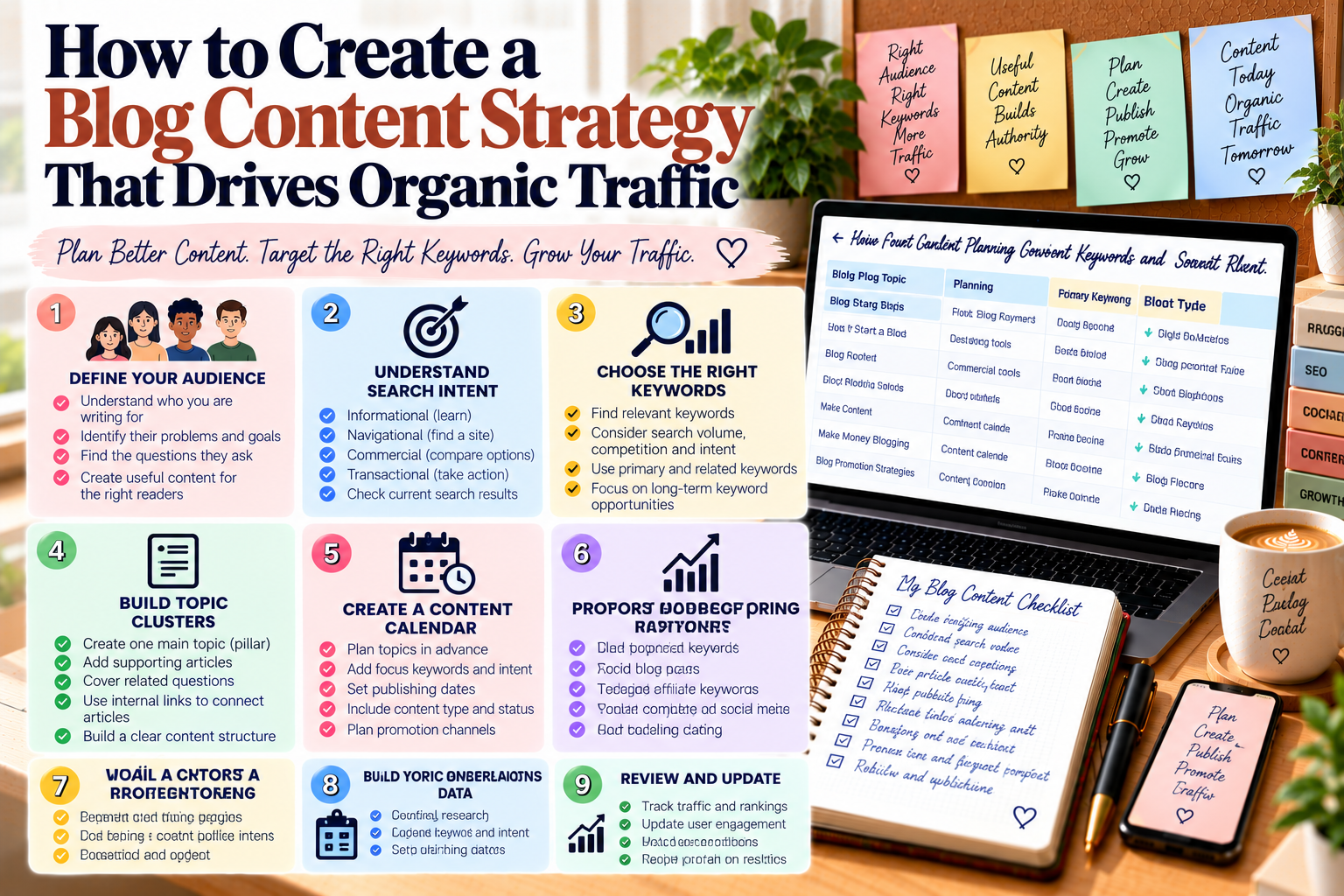
In this guide, you will learn how to create a blog content strategy from the ground up. We will cover audience research, content pillars, topic research, search intent, topic clusters, content calendars, SEO, internal linking, content promotion, and performance measurement.
What Is a Content Strategy for a Blog?
A blog content strategy is a plan that determines:
- Who you are creating content for
- What problems you will solve
- Which topics your website will cover
- What keywords and questions you will target
- How your articles will connect
- When you will publish
- How you will promote your content
- How you will measure and improve performance
In simple terms:
Content strategy is the plan behind your content.
It answers an important question:
“Why are we creating this article, who is it for, and how does it support the rest of the website?”
This is different from simply keeping a list of blog ideas.
A content idea is one possible article.
A content calendar tells you when you will publish that article.
On the other hand, a content strategy explains why the article exists, what audience need it addresses, where it fits within your website, and what you want it to accomplish.
As a result, this distinction can completely change the way you approach blogging.
Why Random Blogging Often Doesn’t Work
Imagine two bloggers.
Blogger A
They publish:
- 10 Instagram tips
- 3 recipes
- 2 freelance articles
- 4 random AI articles
- 1 blogging guide
Each article might be useful individually. However, there is no clear relationship between the topics.
Blogger B
This blogger decides to build authority around content writing.
They create:
Main topic: Content Writing & Blogging
Then publish:
- What Is Content Writing?
- How to Write a Blog Post
- Content Writing Tips
- Copywriting vs Content Writing
- Keyword Research for Writers
- How to Become a Freelance Content Writer
- How to Find Content Writing Jobs
Now, the articles have a clear purpose.
They can link to one another where relevant. In addition, they can support a broader pillar page and guide readers from learning the basics to applying the skills professionally.
That is the difference between publishing content and building a content system.
The 5C Framework for a Better Blog Content Strategy
If you are starting from scratch, use this simple framework.
1. Customer
Who are you trying to help?
2. Core Topics
What subjects should your website become known for?
3. Content
What questions and problems should you solve?
4. Connections
How will your articles relate to and internally link to one another?
5. Conversion
What useful next step should readers take after reading?
Together, these five areas give your blog a clear direction.
More importantly, this framework prevents you from treating every blog post as an isolated piece of content.
Step 1: Define Your Blog’s Main Goal
Before researching keywords or creating blog content ideas, decide what you want your website to achieve.
First, ask:
“What should my blog help me accomplish?”
Your answer might be:
- Build professional authority
- Generate organic traffic
- Attract freelance clients
- Build an email audience
- Promote a service
- Sell digital products
- Generate affiliate income
- Build a personal brand
- Educate a specific audience
You can have several goals. However, choose one primary goal for your content strategy.
Example
Suppose you are a freelance content writer.
Your goal might be:
Build organic traffic around content writing and blogging while attracting potential freelance clients.
That goal immediately influences your content choices.
For example, you would prioritize articles that demonstrate your expertise and answer questions potential clients or aspiring writers are already asking.
Therefore, your goal becomes a filter for future content decisions.
Step 2: Understand Exactly Who You’re Writing For
A strong content strategy starts with people—not keywords.
Before choosing topics, create a simple audience profile.
For example, ask:
- Who is my ideal reader?
- What are they trying to accomplish?
- What problems are they facing?
- What do they already know?
- What are they confused about?
- What mistakes are they making?
- What questions are they searching for?
- What would make their work easier?
For example:
Audience
Beginner bloggers
Goal
Get their first consistent website visitors
Problems
- Do not know what to write
- Struggle to find topics
- Do not understand SEO
- Publish inconsistently
- Do not know how articles should connect
Preferred content
- Simple explanations
- Step-by-step tutorials
- Examples
- Checklists
- Templates
- Practical workflows
Now, you are not creating content for “everyone.”
Instead, you are solving specific problems for a specific reader.
As a result, your topics become more focused and useful.
Step 3: Choose 3–5 Core Content Pillars
One of the easiest ways to make a blog unfocused is trying to cover everything.
Instead, choose a small number of broad topics that are closely connected to your expertise and audience.
These become your content pillars.
For a website focused on digital growth, for example, you could have:
- Content Writing & Blogging
- SEO & Website Growth
- Digital Marketing & Social Media
- Online Income & Freelancing
Each pillar can then be divided into narrower subjects.
For example:
SEO & Website Growth
→ Keyword Research
→ On-Page SEO
→ Technical SEO
→ Internal Linking
→ Topical Authority
→ Google Ranking
This gives you a clear answer whenever you are wondering:
“What should I write next?”
If a new idea does not fit any of your core topics, ask whether it genuinely serves your audience before adding it to your editorial plan.
Step 4: Find Topics Your Audience Actually Wants
Once you have your content pillars, turn them into specific article ideas.
This is where keyword research and audience research become important.
A keyword is simply a phrase someone enters into a search engine.
Examples include:
- content writing tips
- how to write a blog post
- blogging for beginners
- keyword research for beginners
- how to monetize a blog
However, do not make the mistake of choosing topics based only on search volume.
A topic can have thousands of searches and still be a poor fit for your website.
For this reason, evaluate each topic using four questions.
Is it relevant?
Does it belong to your website’s core subject?
Is it useful?
Does it solve a genuine reader problem?
Is it searchable?
Are people likely to search for information about it?
Does it support another page?
Can it connect naturally to your existing content?
The strongest topics usually sit at the intersection of all four.
You can also explore this guide on creating SEO-friendly blog topics that attract readers for additional topic ideas.
Step 5: Match the Topic With Search Intent
Finding a keyword is not enough.
You also need to understand why someone is searching for it.
For example:
“What is content writing?”
The searcher wants to learn.
Intent: Informational
“Best content writing tools”
The searcher may be comparing options.
Intent: Commercial investigation
“Hire a content writer”
The searcher is closer to taking action.
Intent: Transactional
Therefore, your content should match the searcher’s expectation.
If someone searches for a beginner guide and your page immediately tries to sell a service, they may leave.
For an informational article, teach first.
Then, provide a relevant next step.
Step 6: Build Topic Clusters Instead of Isolated Articles
This is where your content strategy becomes much more powerful.
A topic cluster consists of a broad pillar page supported by narrower articles covering specific aspects of that topic.
For example:
Pillar
Content Writing & Blogging: A Complete Beginner’s Guide
Supporting articles
- What Is Content Writing?
- How to Write a Blog Post
- How to Start a Blog
- How to Find Blog Topics
- Copywriting vs Content Writing
- How to Make Money Blogging
The supporting articles should link back to the main pillar where relevant.
Similarly, the pillar should link to useful supporting articles.
Related cluster articles should also link to one another when the connection is genuinely useful.
You can learn more from this guide on how to build topic clusters for your blog.
Example
How to Write a Blog Post
could link to:
→ Keyword Research
→ On-Page SEO
→ Internal Linking
→ Content Strategy
Meanwhile:
Keyword Research for Beginners
could link back to:
→ Content Strategy
→ How to Find Blog Topics
→ How to Write a Blog Post
As a result, your website becomes a connected resource rather than a collection of disconnected pages.
Step 7: Use the “One Topic, Multiple Questions” Method
Here is a simple way to find deeper content ideas.
First, take one broad topic and ask:
What would a beginner want to know before, during, and after solving this problem?
For example, your main topic is:
Content Writing
A beginner might ask:
- What is content writing?
- What does a content writer do?
- How do I write good content?
- How do I write a blog post?
- What is SEO writing?
- How do I find content ideas?
- How do I build a writing portfolio?
- Where can I find content writing jobs?
- How much can a freelance content writer earn?
- How can I improve my writing?
Now you have the foundation of a content cluster.
Instead of sitting down every Monday and trying to invent a completely new blog idea, you can build several articles from one broader topic.
This method also makes your content planning easier.
Step 8: Create a Simple Content Brief Before Writing
Before writing an article, spend a few minutes creating a basic content brief.
You do not need a complicated document.
Instead, write down:
Target audience:
Who is reading?
Primary keyword:
What is the main search query?
Search intent:
What does the reader want?
Main question:
What problem are you solving?
Secondary topics:
What related questions should the article answer?
Internal links:
Which existing pages should you link to?
Next step:
What should the reader do after finishing?
This small step can prevent an article from becoming unfocused.
Moreover, it gives you a clear writing direction before you start the first draft.
Step 9: Create a Content Calendar You Can Actually Maintain
A content calendar turns your strategy into an execution plan.
You do not need to publish every day.
Instead, start with a schedule you can realistically maintain.
If you can consistently produce one useful article per week, start there.
Here is a simple example:
| Week | Article | Main Topic | Intent | Status |
|---|---|---|---|---|
| 1 | What Is Content Writing? | Content Writing | Informational | Planned |
| 2 | How to Write a Blog Post | Blogging | Informational | Planned |
| 3 | Keyword Research for Beginners | SEO | Informational | Planned |
| 4 | How to Find Blog Topics | Content Strategy | Informational | Planned |
As your system develops, add columns for:
- Primary keyword
- Secondary keywords
- Content pillar
- Internal links
- Meta title
- Publication date
- Update date
- Performance
- Conversion goal
The best content calendar is not necessarily the most complicated one.
Instead, it is the one you will actually use.
Step 10: Turn One Idea Into Multiple Pieces of Content
Creating content does not have to mean starting from zero every time.
In fact, one useful blog post can become several smaller pieces of content.
For example, imagine you publish:
How to Create a Content Strategy That Actually Works for Your Blog
You could turn it into:
- An Instagram carousel: “5 Steps to Build a Blog Content Strategy”
- A LinkedIn post: “Why Random Blogging Doesn’t Work”
- A short video: “Content Strategy Explained in 30 Seconds”
- A checklist: “Blog Content Strategy Checklist”
- An email: “How to Stop Running Out of Blog Ideas”
- Several social posts based on individual sections
This process is called content repurposing.
You can also learn more about how to turn one blog post into multiple pieces of content.
As a result, you can extend the life of your original content without rewriting the entire piece from scratch.
Step 11: Optimize Your Content for SEO—Without Writing for Robots
SEO should support your content strategy, not control every sentence.
For each article, focus on the following areas.
Use a clear primary topic
First, make sure readers understand what the article is about.
The main topic should be clear from the title, introduction, and headings.
Create descriptive headings
Clear headings make an article easier to scan.
They also help readers understand the structure before reading every section.
Use related terminology naturally
For a blog content strategy article, related concepts might include:
- content calendar
- search intent
- keyword research
- content planning
- topic clusters
- content brief
- internal linking
- content distribution
- organic traffic
Answer related questions
Think beyond one keyword.
Ask yourself:
What else would someone need to know to solve this problem completely?
For example, someone searching for content strategy may also need information about keyword research, search intent, content calendars, and internal linking.
Add internal links
Connect the article to relevant pages on your website.
These links should help readers find the next useful resource.
Keep the writing natural
Do not repeat a keyword simply because an SEO tool tells you to.
If a phrase sounds unnatural, leave it out.
Ultimately, good SEO should make content more useful, not harder to read.
Step 12: Create a Simple Internal-Linking System
Internal linking is one of the easiest things to overlook when publishing new content.
Every time you publish an article, ask:
Which existing pages would help this reader next?
Then add useful contextual links.
For example:
How to Write a Blog Post
could link to:
- Keyword Research for Beginners
- On-Page SEO
- Internal Linking
- Content Strategy
At the same time, those related articles can link back to the broader content pillar.
Think of internal links as roads between related pages.
However, the goal is not to add links everywhere.
Instead, make it easy for readers to continue learning.
You can also use your keyword mapping guide to plan connections between related pages.
A Complete Content Strategy Example
Let’s put everything together.
Imagine you are building a blog for beginner freelance writers.
Audience
Students, beginners, and aspiring freelance writers.
Main goal
Build organic traffic and eventually attract freelance writing clients.
Core pillar
Content Writing & Blogging
Supporting cluster
| Article | Primary Topic | Search Intent |
|---|---|---|
| What Is Content Writing? | Content writing basics | Informational |
| How to Write a Blog Post | Blog writing | Informational |
| Content Writing vs Copywriting | Writing specialties | Informational |
| SEO Writing for Beginners | SEO content | Informational |
| How to Build a Writing Portfolio | Freelance career | Informational |
| How to Find Content Writing Jobs | Writing jobs | Transactional |
Now connect them.
Content Writing & Blogging Pillar
↓
What Is Content Writing?
↓
How to Write a Blog Post
↓
SEO Writing for Beginners
↓
How to Build a Writing Portfolio
↓
How to Find Content Writing Jobs
Notice what happened.
The content now follows the reader’s journey:
Learn → Practice → Improve → Build → Earn
Therefore, the blog is no longer just a collection of articles. It becomes a learning path.
That is what a strong content strategy should do.
Build Your First Content Strategy in 30 Minutes
You do not need to spend an entire weekend planning your blog.
Instead, set a timer for 30 minutes and answer these questions.
| Question | Your Answer |
|---|---|
| Who is my ideal reader? | |
| What problem do I help them solve? | |
| What is my main blog goal? | |
| What are my 3–5 core content pillars? | |
| What questions does my audience ask? | |
| Which topics have search potential? | |
| What should my main pillar page cover? | |
| Which supporting articles should I create? | |
| How will the articles internally link? | |
| How often can I realistically publish? | |
| How will I measure success? | |
| What should readers do next? |
By the end of this exercise, you should have the foundation of an actual content plan.
More importantly, you will have a practical starting point instead of a long list of disconnected ideas.
What Should You Measure?
Publishing is not the finish line.
Once your articles are live, look at how they are performing.
Visibility
Are your pages appearing in search results?
Organic traffic
Are people actually visiting from search engines?
Click-through rate
Are people clicking when your page appears?
Engagement
Are readers staying long enough to consume the content?
Conversions
Are readers signing up, contacting you, purchasing something, or taking another meaningful action?
Internal-link performance
Are readers moving from one relevant article to another?
However, do not judge every article by traffic alone.
For example, a page with modest traffic can still be valuable if it attracts the right audience and generates meaningful results.
Therefore, look at several metrics instead of relying on one number.
When Should You Update Old Blog Posts?
Your content strategy should not end after publication.
Over time, some articles become outdated because:
- Search behavior changes
- Tools change
- Platforms update their features
- Statistics become old
- Examples stop being relevant
- Better information becomes available
- Your website gains new related content
For this reason, review important articles periodically.
Ask:
Is the information still accurate?
Does the article completely answer the reader’s question?
Are there newer pages I should link to?
Can the introduction be improved?
Is the search intent still being satisfied?
Updating an existing useful article can often be more productive than constantly creating something completely new.
Common Content Strategy Mistakes to Avoid
Publishing Whatever Comes to Mind
Having an idea is not enough.
First, ask whether it supports your audience and overall website structure.
Chasing Search Volume Alone
A high-volume keyword is not automatically valuable if it attracts the wrong audience.
Instead, consider relevance, search intent, competition, and usefulness.
Ignoring Search Intent
A keyword can look perfect on paper.
However, your article may still perform poorly if it does not match what searchers expect.
Therefore, check the search results and understand the purpose behind the query before writing.
Creating Too Many Similar Articles
Five articles answering essentially the same question can create unnecessary overlap.
Before creating a new post, check what you already have.
Then decide whether the new article provides a genuinely different purpose.
Forgetting Internal Links
Do not let useful articles become dead ends.
Instead, give readers a natural next step through relevant internal links.
You can also use your blog content calendar guide to plan future content and linking opportunities.
Publishing Too Frequently
A sustainable publishing schedule is better than an ambitious schedule that you abandon after a month.
Therefore, choose a pace you can maintain.
Never Reviewing Performance
Your first content plan is not permanent.
Instead, use what you learn from your audience and search performance to improve the next version.
What Should You Do After Creating Your Content Strategy?
Once your strategy is ready, do not wait for the perfect plan.
First, start with your most important pillar.
Then, create a few strong supporting articles around it.
For each article, follow this simple process:
Research → Plan → Write → Optimize → Internally Link → Publish → Promote → Measure → Improve
This becomes your repeatable content workflow.
Over time, your website can develop a library of connected resources rather than a collection of random blog posts.
Frequently Asked Questions
What is a content strategy in blogging?
A content strategy is a plan for deciding what content to create, who it is for, what goals it supports, how different articles connect, how content will be distributed, and how performance will be measured.
How do I create a content strategy for my blog?
Start by defining your goal and audience.
Then choose your core content pillars, research relevant topics and keywords, understand search intent, create topic clusters, plan a publishing calendar, build internal links, promote your content, and measure results.
What is the difference between a content strategy and a content calendar?
A content strategy explains the overall purpose, audience, topics, structure, and goals of your content.
A content calendar organizes the specific content you plan to publish and when you plan to publish it.
Therefore, the calendar is part of the larger strategy.
How many blog posts should I publish per week?
There is no universal number.
For many beginners, one useful article per week is a realistic starting point. More importantly, choose a schedule you can maintain consistently.
Should every blog post target a keyword?
Every article should have a clear topic and purpose.
However, you should not force keywords into your writing.
Instead, focus on the reader’s problem, search intent, and broader topic.
How long should a content strategy last?
A content strategy can guide your blog for months or years.
Still, review it regularly because your audience, search behavior, business goals, and content performance can change over time.
Conclusion
A successful blog is not built simply by publishing more articles.
Instead, it grows through the right content for the right audience, connected into a useful system.
Before writing your next article, do not only ask:
“What should I write about?”
Instead, ask:
“Who am I helping, what problem am I solving, where does this article fit, and what should the reader do next?”
That small change in thinking can transform the way you approach blogging.
Start with one clear goal.
Next, choose a few core topics and research the questions your audience actually cares about.
Then, build topic clusters and connect your articles with useful internal links.
After that, create a realistic content calendar and publish consistently.
Finally, measure what works and improve your strategy as you learn.
You do not need hundreds of articles to build a useful website.
You need connected, purposeful, helpful content that gets better over time.
If you are building your knowledge from the ground up, the next step is to learn how to create individual articles that readers actually want to finish and how to structure them for both people and search engines.
Add a Comment