

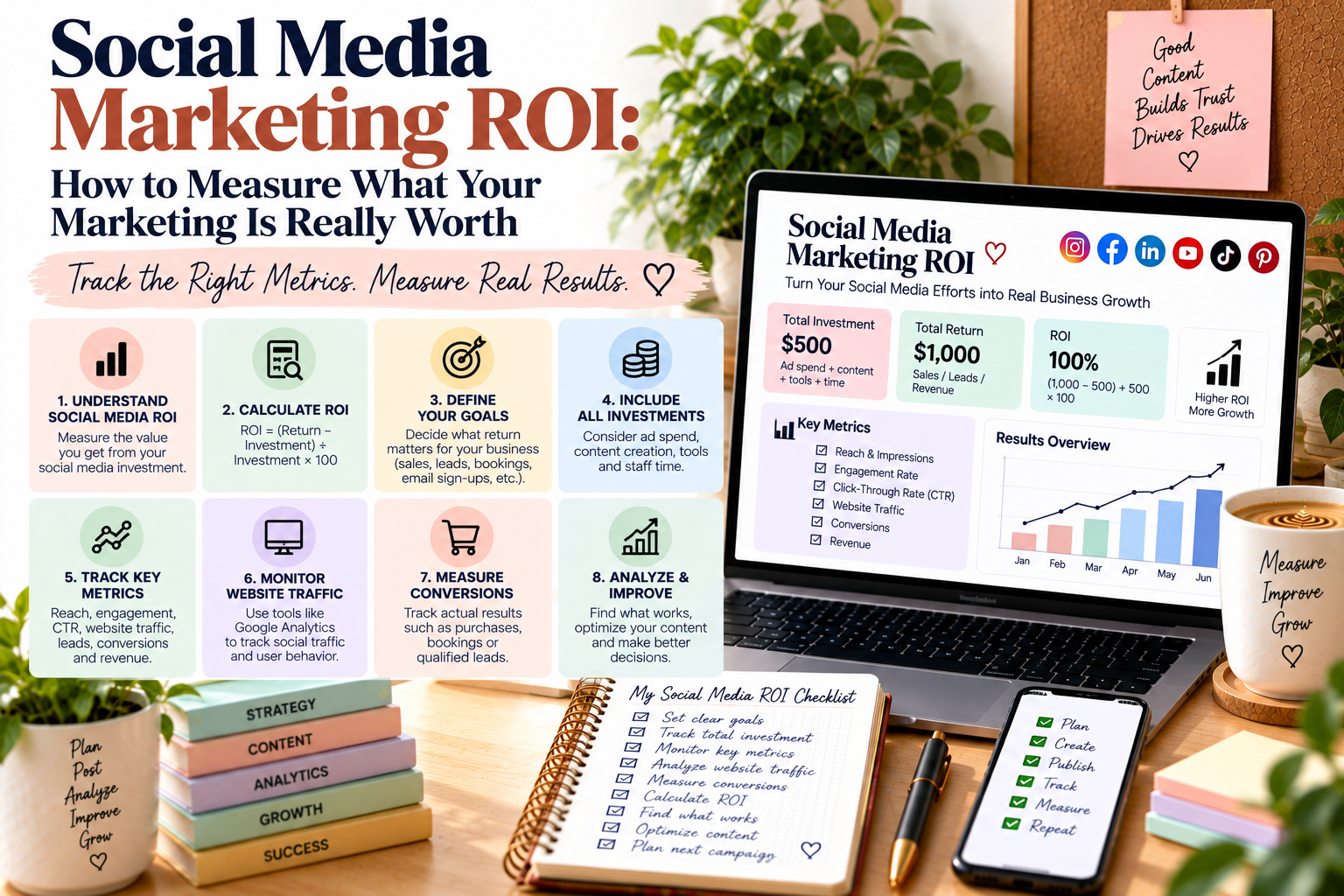
Posting on social media can help a business reach new people, build trust, and generate sales. However, likes and followers do not always show whether your marketing is creating real business value. This is where social media marketing ROI becomes important.
Social media marketing ROI helps you compare what you spend on social media with the value your marketing creates. Once you understand this relationship, you can make better decisions about your content, advertising, time, and budget.
What Is Social Media Marketing ROI?
Social media marketing ROI measures the return a business receives from its social media investment.
The basic idea is simple:
ROI = (Return − Investment) ÷ Investment × 100
For example, imagine you spend $500 on social media marketing and generate $1,000 in revenue that you can reasonably attribute to that activity.
Your calculation would be:
($1,000 − $500) ÷ $500 × 100 = 100% ROI
A positive ROI means the return was greater than the investment. However, the calculation is only useful when you define your costs and returns clearly.
Why Social Media Marketing ROI Matters
Social media can take both money and time.
You may spend money on:
- Social media advertising
- Content creation
- Design
- Video production
- Influencer partnerships
- Social media tools
You may also spend hours creating posts, answering comments, managing campaigns, and analyzing results.
Therefore, measuring ROI helps you understand which activities are contributing to your business goals.
For example, a post with 5,000 views may look impressive. However, if another post with 1,000 views generates several qualified leads, the second post may have greater business value.
This is why social media marketing ROI should not be measured through engagement alone.
Decide What Return You Want to Measure
Before calculating ROI, decide what “return” means for your business.
Different businesses may measure different outcomes.
Your return could include:
- Product sales
- Service bookings
- Qualified leads
- Website purchases
- App downloads
- Email sign-ups
- New customers
- Subscription revenue
For example, an online store may focus on purchases. A consulting business may focus on qualified leads and booked calls.
Your measurement system should match your business model.
Calculate Your Total Social Media Investment
The investment side of the equation includes more than your advertising budget.
Consider all major costs connected to the campaign.
These may include:
Advertising Costs
Include the money spent on paid campaigns across platforms such as Instagram, Facebook, LinkedIn, TikTok, or YouTube.
Content Production Costs
Consider the cost of photography, video production, graphic design, editing, or freelance content creation.
Tools and Software
You may use scheduling platforms, analytics tools, design software, or other subscriptions.
Staff or Freelancer Time
If employees or freelancers spend significant time managing social media, their working time can also be part of the investment.
You do not need to make the calculation unnecessarily complicated. Start with the costs that are directly connected to the activity you are measuring.
Measure the Right Social Media Metrics
Metrics help you understand what is happening before you calculate the final return.
Some useful metrics include:
- Reach
- Impressions
- Engagement rate
- Click-through rate
- Website traffic
- Leads
- Conversions
- Conversion rate
- Cost per lead
- Cost per acquisition
- Revenue
However, not every metric matters equally for every business.
For example, reach can help you understand awareness, while conversions can show whether your campaign is producing a specific business outcome.
For a deeper look at useful metrics, continue with Social Media Metrics That Actually Matter for Business Growth.
Track Website Traffic From Social Media
Your website is often where social media attention turns into a measurable action.
Someone may discover your Instagram post, visit your website, read a blog post, and later become a customer.
Therefore, tracking social traffic can help you understand what happens after someone clicks your content.
You can use analytics tools to monitor:
- Sessions from social platforms
- Landing pages
- Pages viewed
- Engagement
- Conversions
- Revenue from tracked traffic
Google Analytics can be used to analyze website traffic and user behavior. You can also use campaign tracking parameters to identify traffic from specific campaigns.
Track Conversions, Not Just Clicks
A click is not always a business result.
For example, suppose 1,000 people click your social media advertisement. If only five people submit a lead form, the campaign may need further analysis.
This is why conversion tracking is important.
A conversion could be:
Social post → Website visit → Product page → Purchase
Or:
Social ad → Landing page → Lead form → Sales call
Tracking this journey helps you understand where people take action and where they leave.
For more detail, read How to Track Social Media Conversions and Leads.
Understand the Difference Between Revenue and ROI
Revenue and ROI are not the same thing.
Revenue tells you how much money was generated.
ROI considers both the return and the investment.
For example:
Campaign A
Revenue: $2,000
Investment: $1,500
Campaign B
Revenue: $1,500
Investment: $500
Campaign A generated more revenue. However, Campaign B generated a higher return compared with its investment.
Therefore, looking only at revenue can give you an incomplete picture.
Use Attribution Carefully
One of the biggest challenges in measuring social media marketing ROI is attribution.
A customer may discover your business through Instagram, visit your website later through Google, and finally purchase after receiving an email.
So which channel deserves credit?
The answer depends on your attribution model and measurement setup.
Social media may influence a customer without being the final source of the purchase. Therefore, avoid assuming that every conversion can be explained by one channel alone.
Instead, look at customer journeys across multiple touchpoints where your data allows it.
Compare Organic and Paid Social Media
Organic and paid social media should not always be evaluated in exactly the same way.
Organic content may help build:
- Brand awareness
- Trust
- Community
- Long-term audience growth
- Website traffic
Paid campaigns may focus more directly on:
- Leads
- Sales
- Website conversions
- Product promotion
- Audience acquisition
You can measure both, but their goals may be different.
For example, an educational Instagram post may not generate immediate sales but could help build an audience that later converts through another campaign.
Measure ROI by Campaign
Instead of combining every social media activity into one number, consider measuring individual campaigns.
For example:
| Campaign | Investment | Return | ROI |
|---|---|---|---|
| Product Promotion | $500 | $1,000 | 100% |
| Lead Generation | $400 | $800 | 100% |
| Brand Awareness | $300 | — | — |
Not every campaign will have an immediate financial return.
Brand awareness campaigns may require different measurements, such as reach, website visits, branded searches, or audience growth.
The important point is to define the campaign goal before judging the result.
Improve Social Media Marketing ROI
Once you start measuring your results, use the data to improve future campaigns.
You can test:
- Different content formats
- New audiences
- Different offers
- New headlines
- Landing pages
- Calls to action
- Posting times
- Ad creatives
For example, if one type of post consistently generates qualified leads, you could create more content around that topic.
Similarly, if an advertisement receives many clicks but few conversions, review the landing page, offer, audience, or message.
The goal is not simply to collect data. Use the data to make better marketing decisions.
Avoid These Social Media ROI Mistakes
Several common mistakes can make your measurement less useful.
Measuring Likes as the Main Result
Likes can show engagement, but they do not automatically represent revenue or leads.
Ignoring Time Costs
Content creation and social media management require time. If you ignore that investment, your ROI calculation may look better than it really is.
Using the Same Goal for Every Campaign
A brand-awareness campaign and a sales campaign should not be judged by exactly the same metric.
Not Tracking Conversions
Without conversion tracking, it can be difficult to connect social activity with business outcomes.
Looking at One Campaign in Isolation
A single campaign may perform differently because of seasonality, audience changes, competition, or the offer.
Reviewing results over time can provide more useful context.
Create a Simple Social Media ROI Dashboard
You do not need an advanced dashboard to get started.
A simple spreadsheet can track:
| Metric | Result |
|---|---|
| Social media spend | $500 |
| Website visits | 2,000 |
| Leads | 80 |
| Customers | 20 |
| Revenue | $1,500 |
| ROI | 200% |
You can update this information weekly or monthly.
Over time, the data can help you identify patterns and compare campaigns.
How Often Should You Measure Social Media ROI?
The right frequency depends on your campaign and business.
For an active paid campaign, you may review performance regularly. For organic content, monthly reviews may provide more useful patterns than checking every post several times a day.
A simple routine could be:
Weekly: Check campaign performance and major changes.
Monthly: Compare campaigns, conversions, and revenue.
Quarterly: Review your broader social media strategy and budget.
This approach gives you enough information without turning measurement into a daily distraction.
Build a Better Social Media Measurement Process
A practical measurement process starts with a clear business goal. Next, choose the metrics that match that goal instead of tracking every available number.
After that, track your social media investment, including the main costs linked to your campaigns. Then, set up website and conversion tracking so you can see what happens after people interact with your content.
Once the data is available, measure revenue or another useful return. Where the data supports it, calculate your social media ROI and compare the results across campaigns and channels.
Finally, use these findings to improve future campaigns. This approach helps you focus on useful data and make better decisions over time.
This process gives you a clearer view of what your social media activity is actually contributing.
Social media marketing ROI gives businesses a practical way to connect social media activity with business results.
Start by defining what you want social media to achieve. Then track your investment, choose meaningful metrics, monitor conversions, and review revenue where appropriate.
Remember that not every social media activity will produce an immediate financial return. Some content supports awareness, trust, or future conversions.
The most useful approach is to measure results based on the goal of each campaign and use the information to improve your next decision.
When you consistently connect social media activity with measurable business outcomes, your marketing becomes easier to understand, manage, and improve.
Add a Comment