

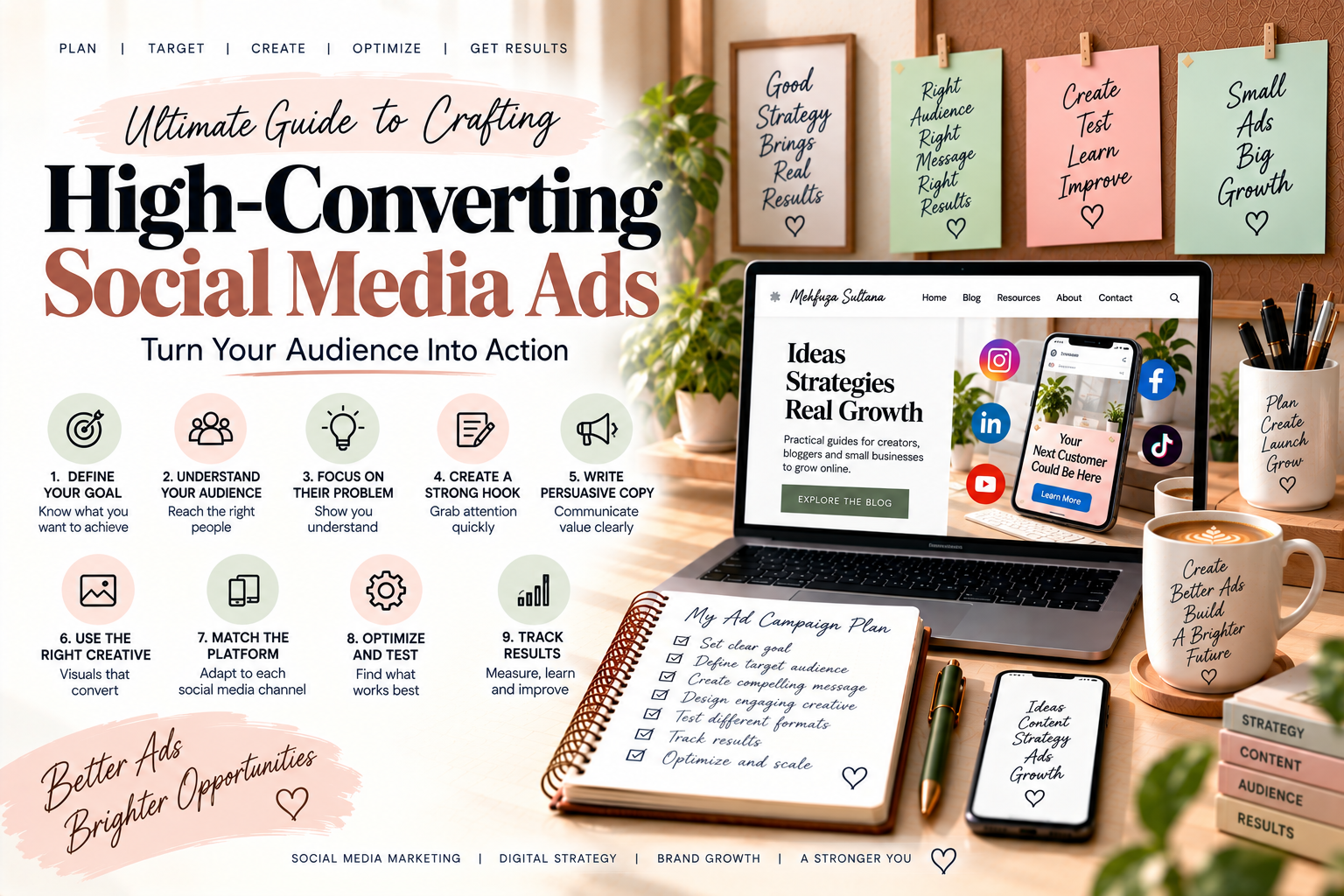
Social media ads can put your business in front of thousands of potential customers, but simply paying to promote a post does not guarantee results.
A successful social media ad needs more than an attractive image or a catchy headline. It needs the right audience, offer, message, creative, landing page, and call to action.
Whether you are promoting a product, service, website, app, or personal brand, understanding how these elements work together can help you create more effective advertising campaigns.
This guide explains how to create social media ads designed to attract attention, generate interest, and encourage meaningful action.
What Makes a Social Media Ad High-Converting?
A high-converting ad connects five important elements:
Right Audience + Strong Message + Relevant Creative + Clear Offer + Easy Action
If even one element is weak, the campaign can struggle.
For example, you may have an excellent product, but if your ad reaches people who do not need it, the campaign is unlikely to perform well.
That is why effective social media advertising starts before you create the ad itself.
1. Define Your Advertising Goal
Start by deciding what you want the campaign to achieve.
Common objectives include:
- Brand awareness
- Website traffic
- Lead generation
- App installs
- Product sales
- Event registrations
- Service inquiries
- Engagement
Your objective determines how you should structure your campaign.
For example, an ad designed to generate leads may need a stronger offer and lead form, while an awareness campaign may focus more on introducing your brand.
Avoid trying to achieve every objective with one advertisement.
2. Understand Your Target Audience
The more clearly you understand your audience, the easier it becomes to create relevant advertising.
Identify:
- Who they are
- What they want
- What problem they have
- What prevents them from taking action
- What motivates them
- What objections they may have
For example, a business selling an SEO tool to beginners might target:
Bloggers, freelancers, creators, and small business owners who want to improve their website traffic but find SEO difficult to understand.
This information can influence the ad’s language, creative, offer, and CTA.
3. Focus on the Customer’s Problem
People are rarely interested in a product simply because the product exists.
They care about what the product can help them achieve.
Instead of:
“Our platform has advanced analytics.”
Try:
“Stop guessing which content brings you traffic. See what is working and where your next opportunity is.”
The second message focuses on the customer’s problem and desired outcome.
A useful formula is:
Problem → Solution → Benefit → Action
4. Create a Strong Hook
Social media users scroll quickly.
Your ad needs to communicate its value quickly enough to earn attention.
Examples:
- “Still struggling to turn Instagram followers into customers?”
- “Your website gets traffic, but are visitors actually converting?”
- “Create professional social media content without starting from scratch.”
- “Stop wasting your ad budget on the wrong audience.”
A good hook should be relevant to the audience and supported by the rest of the advertisement.
Avoid misleading clickbait.
5. Write Persuasive Ad Copy
Effective ad copy does not need to be complicated.
A simple structure is:
Hook
Get attention with a relevant problem or benefit.
Problem
Show that you understand the audience’s challenge.
Solution
Introduce your product, service, or offer.
Benefit
Explain what the audience can gain.
Proof
Add evidence where available.
CTA
Tell them what to do next.
For example:
Your social media posts get views but no leads?
Turn your best content into targeted campaigns designed to reach people who are more likely to take action.
Explore the strategy →
The exact wording should match your audience and offer.
6. Use the Right Creative
Your visual is often the first thing people notice.
Depending on the platform and campaign, you can use:
- Static images
- Carousels
- Short videos
- Product demonstrations
- Testimonials
- Before-and-after visuals
- UGC-style content
The creative should support the message rather than distract from it.
For example, if the ad promises a simple solution, the visual should make that solution easy to understand.
7. Match the Ad to the Platform
Different social platforms have different content environments.
For example:
Instagram: Visual storytelling, Reels, carousels, lifestyle creatives
Facebook: Video, images, offers, lead-generation campaigns
LinkedIn: Professional content, B2B offers, reports, software, services
YouTube: Video demonstrations, tutorials, product storytelling
Do not automatically use exactly the same creative and copy everywhere.
Adapt the presentation to the platform and audience.
8. Create an Offer People Understand
Even a well-written advertisement can struggle if the offer is unclear.
Your audience should quickly understand:
- What are you offering?
- Who is it for?
- What problem does it solve?
- What do they get?
- What should they do next?
Possible offers include:
- Free consultation
- Free trial
- Discount
- Downloadable guide
- Demo
- Product bundle
- Limited-time promotion
- Webinar registration
A strong offer gives the audience a clear reason to take action.
9. Use Social Proof
People may hesitate to trust an unfamiliar business.
Social proof can reduce uncertainty when it is genuine and relevant.
Examples include:
- Customer testimonials
- Reviews
- Case studies
- Ratings
- Client logos
- Results
- User-generated content
For example:
“Used by 500+ small businesses”
is more meaningful when the claim is accurate and can be supported.
Never create fake reviews, results, or customer claims.
10. Create a Clear Call to Action
Your CTA should tell people exactly what to do.
Examples:
- Shop Now
- Get Started
- Book a Consultation
- Download the Guide
- Start Your Free Trial
- Learn More
- Request a Demo
Match the CTA to the user’s stage in the buying journey.
Someone discovering your brand for the first time may be more comfortable with Learn More, while someone comparing products may be ready for Start Your Free Trial.
11. Match the Landing Page With the Ad
One of the most overlooked parts of social media advertising is what happens after the click.
Imagine your ad says:
“Get a free SEO audit.”
But the landing page simply takes visitors to your homepage.
The message does not match.
Instead, the landing page should continue the same promise:
Ad → Relevant Landing Page → Clear Information → CTA
Keep the page focused on the action you want visitors to take.
12. Test Different Versions
Do not assume your first ad is automatically your best ad.
Test different elements such as:
- Headlines
- Images
- Videos
- Hooks
- Offers
- CTAs
- Audience segments
- Landing pages
For example:
Version A: Problem-focused headline
Version B: Benefit-focused headline
Then compare the results using the metrics relevant to your campaign objective.
Change one major variable at a time when possible so you have a clearer understanding of what influenced the result.
13. Understand Important Ad Metrics
Different campaigns require different measurements.
Useful metrics include:
Impressions
How many times your ad was displayed.
Reach
How many unique people saw the ad.
CTR
The percentage of people who clicked after seeing the ad.
CPC
The average cost for a click.
Conversion Rate
The percentage of visitors who completed the desired action.
CPA
The average cost of acquiring a desired action or customer.
ROAS
Revenue generated compared with advertising spend, when revenue tracking is available.
Do not judge a campaign using one metric alone.
A high CTR does not automatically mean the campaign is profitable if the landing page or offer fails to convert.
14. Avoid Common Social Media Ad Mistakes
Targeting Everyone
A broad audience is not always a better audience.
Using Weak Creatives
An unclear or uninteresting visual can reduce attention.
Writing Too Much
Your ad should communicate the key message without unnecessary information.
Making Unsupported Claims
Avoid exaggerated promises that cannot be demonstrated.
Sending Everyone to the Homepage
The destination should match the advertisement.
Changing Everything at Once
If you change the audience, creative, offer, and CTA simultaneously, it becomes harder to understand what affected performance.
Ignoring Mobile Users
Many social media interactions happen on mobile devices. Make sure the creative, text, and landing page are easy to use on smaller screens.
A Simple High-Converting Ad Framework
You can use this framework when creating your next campaign:
1. Audience: Who are you targeting?
2. Problem: What are they struggling with?
3. Hook: What will make them stop scrolling?
4. Solution: How does your product or service help?
5. Benefit: What outcome can they expect?
6. Proof: What evidence supports your claim?
7. Offer: What are you giving them?
8. CTA: What should they do next?
9. Landing Page: Does the page continue the same message?
10. Measurement: Which metric determines success?
This framework helps you think about the complete customer journey rather than only the advertisement.
Social Media Ads and Content Marketing
Paid advertising and organic content can work together.
For example:
Organic content → Identify strong topic → Create paid ad → Reach targeted audience → Landing page → Conversion
Your organic content can also help you understand which messages and topics attract attention before investing more heavily in advertising.
This is where content writing and blogging can support paid social campaigns.
A useful blog post can provide deeper information, while an advertisement can introduce the article to a relevant audience. High-converting social media ads are not created by simply adding money behind a post.
They are built around a clear audience, relevant problem, strong message, compelling creative, useful offer, focused landing page, and measurable objective.
Start with the customer rather than the advertisement.
Understand what your audience needs, communicate the value clearly, test different approaches, and use campaign data to improve your next version.
The strongest social media advertising strategy connects content, audience, creative, landing pages, and conversion into one customer journey.
Add a Comment