

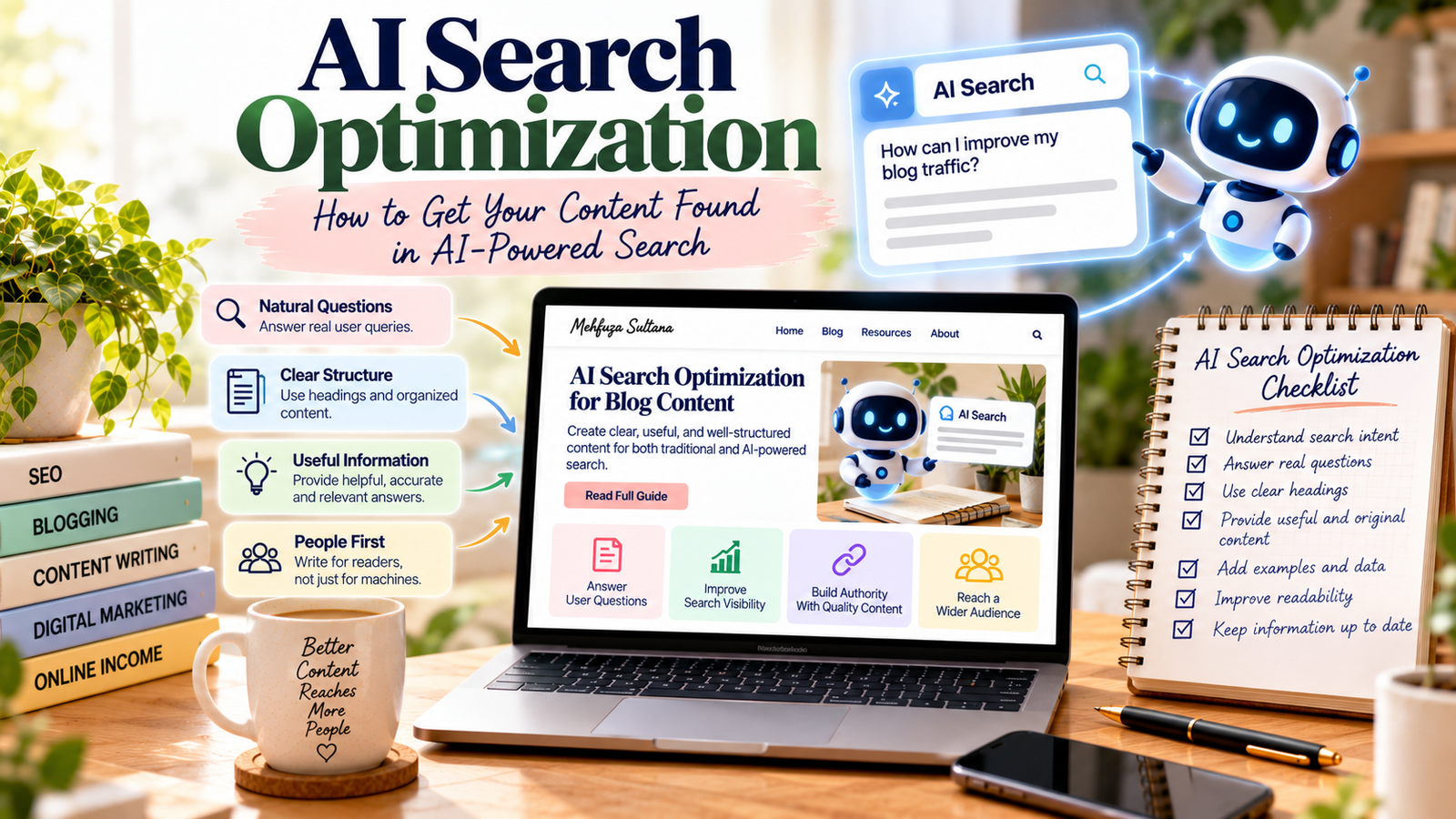
Search is changing. People are no longer using search engines only to find a list of website links. They are also asking questions and getting direct answers from AI-powered search features.
Because of this change, AI search optimization is becoming an important part of modern content planning. Bloggers and website owners need to think about how their content can provide clear, useful answers that search systems can understand.
Traditional SEO still matters. However, content now needs to work well for both traditional search results and newer AI-powered experiences.
This guide explains what AI search optimization means, why it matters, and how you can prepare your blog for the changing search landscape.
What Is AI Search Optimization?
AI search optimization is the process of creating and improving content so that AI-powered search systems can understand, use, and potentially surface it when answering user questions.
Traditional SEO often focuses on helping pages appear in search results. AI search adds another layer because systems may use information from multiple sources to create an answer.
That means your content needs to be:
- Clear
- Useful
- Well organized
- Easy to understand
- Relevant to the search
- Supported by trustworthy information
For example, instead of creating an article only around the keyword “keyword research,” you could answer related questions such as what keyword research is, why it matters, how to do it, and what mistakes beginners should avoid.
This gives the topic more depth.
Why AI Search Optimization Matters for Bloggers
Search behavior is becoming more conversational. People can ask longer questions and expect useful answers without visiting several pages first.
For bloggers, this creates both challenges and opportunities.
A short article that only repeats a keyword may provide little value. In contrast, a well-structured article can answer several related questions in a clear way.
Search Is Becoming More Conversational
Users can now search using natural questions instead of short keyword phrases.
For example, someone might search:
“How can I improve my blog traffic without spending money on ads?”
A useful article should address the actual problem behind that question.
Therefore, understanding search intent is becoming even more important.
Clear Answers Are Easier to Understand
AI systems need to process information from web pages. Clear headings, short paragraphs, direct explanations, and useful examples can make your content easier to understand.
Good structure also helps human readers.
So, writing for AI search should not mean writing only for machines. Your primary goal should still be helping people.


How AI Search Optimization Differs From Traditional SEO
Traditional SEO and AI search optimization are closely connected, but they are not exactly the same.
Traditional SEO focuses heavily on factors such as:
- Search intent
- Keywords
- Page structure
- Internal links
- Technical SEO
- Backlinks
- Search visibility
AI-powered search adds more focus on how clearly a page answers a question and how useful its information is within a broader answer.
This does not mean that traditional SEO is no longer useful.
Instead, you can think of AI search optimization as an additional layer of your existing SEO strategy.
Your existing SEO guide for beginners can help you build the basic foundation before adding these newer practices.
Create Content Around Real Questions
One of the simplest ways to prepare your blog for AI-powered search is to answer real questions.
Start by identifying what your audience wants to know.
For example, a beginner blogging audience may ask:
- How do I start a blog?
- How often should I publish?
- How do I find blog topics?
- Why is my blog not getting traffic?
- How can I improve my blog SEO?
Each question can become an article or a section within a larger guide.
Use Natural Language
Do not write questions only because they contain a keyword.
Instead, understand the problem behind the search.
A reader searching for “how to start a blog with no experience” probably needs practical guidance, not a paragraph filled with the same keyword several times.
Write as if you are explaining the answer to a real beginner.
This approach improves readability and gives your content a natural flow.
Build Helpful and Complete Content
A strong article should answer the main question without forcing the reader to search for basic information elsewhere.
That does not mean every article needs to be extremely long.
The right length depends on the topic.
Instead, focus on covering the important parts of the subject.
For example, an article about keyword research could explain:
- What keyword research means
- Why it matters
- How to find keywords
- How to check search intent
- How to choose keywords
- Common mistakes
- How to use keywords naturally
This creates a useful resource without adding unnecessary information.
You can also connect the article to your detailed keyword research guide when readers need deeper information.
Organize Your Content With Clear Headings
Content structure matters for both readers and search systems.
Use one clear H1 for the article title. Then divide the content into relevant H2 sections.
When a section needs more detail, use H3 headings underneath the relevant H2.
For example:
| Heading Level | Heading |
|---|---|
| H1 | AI Search Optimization: How to Get Your Content Found in AI-Powered Search |
| H2 | What Is AI Search Optimization? |
| H2 | Why AI Search Optimization Matters |
| H2 | Create Content Around Real Questions |
| H3 | Use Natural Language |
| H2 | Build Helpful and Complete Content |


Use Topic Depth Instead of Keyword Repetition
Repeating one keyword again and again does not make an article more useful.
Instead, build depth around the main subject.
For example, if your main topic is blog SEO, related areas may include:
- Keyword research
- Search intent
- Internal linking
- Content structure
- Technical SEO
- Content updates
- Organic traffic
These related topics help you explain the main subject naturally.
Your keyword mapping guide can also help you decide which keywords belong to which pages.


Make Important Answers Easy to Find
Readers should not have to search through several paragraphs to understand your main point.
When answering a question, give the direct answer first. Then explain it with examples or supporting details.
For example:
What is search intent?
Search intent is the reason behind a user’s search. It helps you understand what type of information the person expects to find.
After the direct answer, you can explain different types of search intent and provide examples.
This format improves readability.
It also makes your content easier to scan.
Support Important Claims With Reliable Sources
Trust matters when creating content for search.
If you make a factual claim about search, SEO, technology, or industry changes, support it with a reliable source when appropriate.
Google’s documentation provides guidance about how search works and how website owners can create useful content. Google Search Central
For performance data, Google Search Console can help you review queries, clicks, impressions, and other search information. Google Search Console
These sources can also help you keep your information current.
Strengthen Internal Links Between Related Pages
Internal links connect pages on your website.
They help readers discover related information and create a clearer website structure.
For example, an article about AI search can link to:
- Your SEO beginner guide
- Your keyword research guide
- Your content strategy article
- Your internal linking guide
- Your content refresh guide
Use descriptive anchor text that tells readers what they will find after clicking.
Avoid forcing links into every paragraph.
Instead, add them where they genuinely help the reader.
Keep Your Content Easy to Read
AI search optimization should not make your writing complicated.
Use simple language whenever possible.
Short paragraphs can make long articles easier to scan. Clear examples can explain difficult ideas faster.
You should also vary your sentence openings. Avoid writing several sentences that begin with the same word.
For example, instead of:
AI can analyze content.
AI can understand questions.
AI can identify topics.
AI can generate answers.
Write:
AI systems can analyze different types of content. They can also process questions and identify related topics. In some cases, these systems use information from several sources to create an answer.
The second version sounds more natural and avoids repetitive sentence openings.
Keep Your Content Updated
Search technology changes quickly.
New search features can appear. User behavior can change. Your own content can also become outdated.
For that reason, review important articles regularly.
Check:
- Old statistics
- Outdated examples
- Broken links
- Missing information
- New related topics
- Changes in search behavior
Your content refresh strategy can help you create a regular update process.


Measure How Your Content Performs
Publishing content is only the beginning.
You also need to understand how people find and use it.
Search Console can show useful search performance data. Website analytics can help you understand visitor behavior.
Look at metrics such as:
- Organic clicks
- Impressions
- Search queries
- Engagement
- Page views
- Conversions
Do not focus on one number alone.
For example, more impressions do not always mean that visitors are taking useful actions. Look at several signals together.
Over time, these insights can help you improve your content strategy.
Avoid Common AI Search Optimization Mistakes
Some common mistakes can reduce the value of your content.
Writing Only for Search Engines
Content should help people first.
Avoid awkward keyword placement or sentences that sound unnatural.
Publishing Low-Value AI Content
AI tools can help with research, outlines, and editing. However, automatically generated text may still need human review, examples, fact-checking, and useful experience.
Ignoring Search Intent
A keyword does not tell the complete story.
Always consider what the person wants to accomplish with the search.
Making Every Article Too Broad
One article does not need to answer every question about a subject.
Keep the main topic focused and connect it to related articles through internal links.
Forgetting Existing Content
New content is not always the answer.
Sometimes an older article can perform better after you improve its structure, examples, links, and outdated information.
A Simple AI Search Optimization Workflow
You do not need a complicated process to prepare your blog.
Start by choosing a topic that matters to your audience. Next, research the questions people ask around that subject.
Then, check the search intent and review the type of content already appearing in search.
After that, create a clear outline with useful H2 and H3 sections. Write direct answers and support them with examples where helpful.
Next, add relevant internal links, reliable external sources, useful images, and descriptive alt text.
Before publishing, check the article for accuracy, readability, and outdated information.
Finally, monitor the page after publication. Use the results to improve the article and guide future content decisions.
This process combines traditional SEO with the needs of modern search.
AI Search Optimization
AI search optimization is not about finding a trick to appear in every AI-generated answer.
Instead, it is about creating content that clearly answers real questions, provides useful information, follows a logical structure, and gives readers a reason to trust your website.
Traditional SEO still provides the foundation. At the same time, AI-powered search makes clear answers, topic depth, helpful structure, and reliable information increasingly important.
Start with the basics. Understand your audience, create useful content, connect related pages, keep important information updated, and measure your results.
As search continues to change, a people-first approach gives your blog a stronger foundation for both traditional and AI-powered search experiences.
Add a Comment