

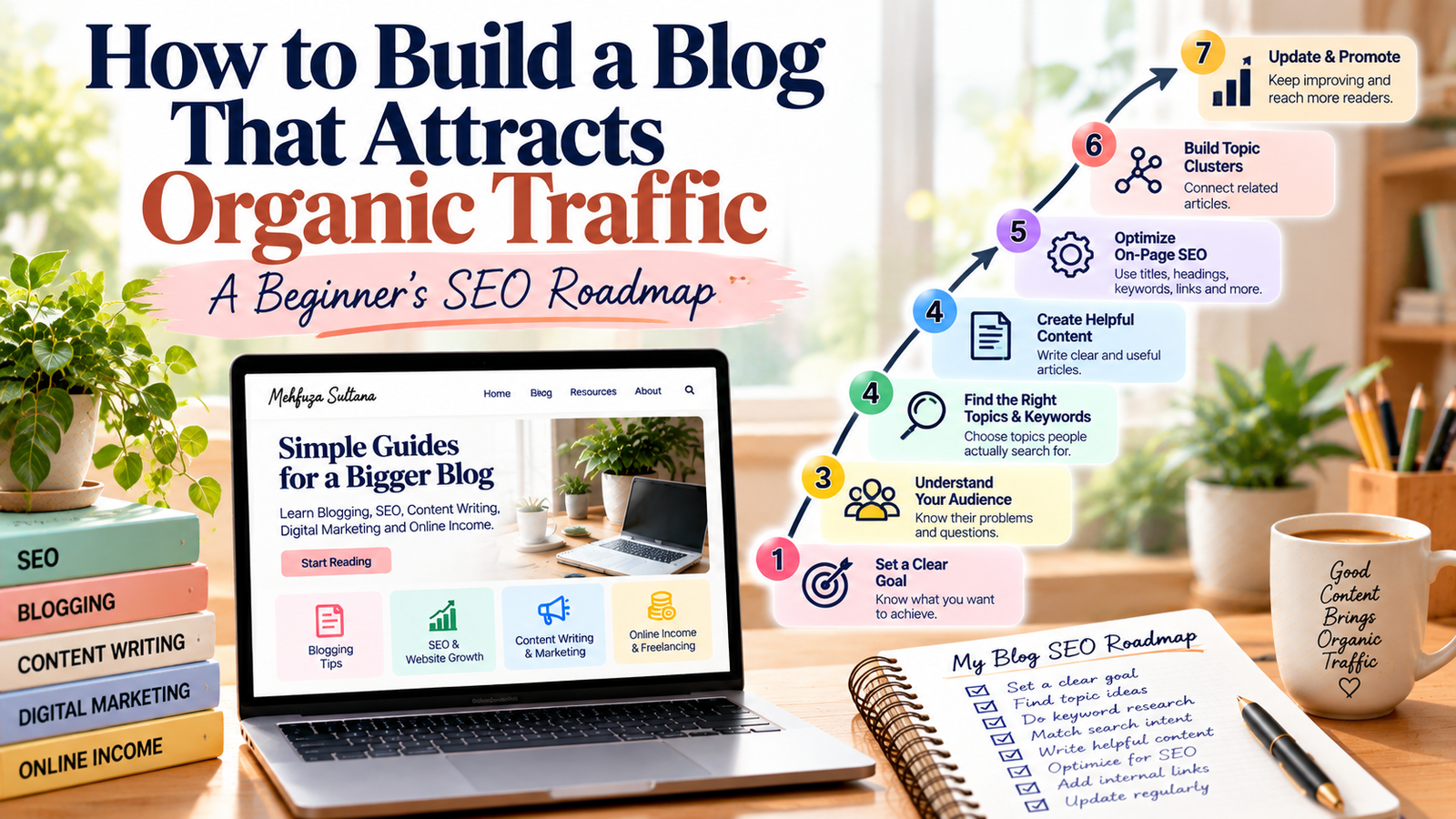
Starting a blog is simple, but getting regular visitors takes time. Therefore, you need a clear plan to reach the right readers. A strong blog SEO strategy can help you choose useful topics, target relevant searches, and grow your website through organic traffic.
However, you do not need to publish hundreds of articles at once. Instead, start with helpful content and focus on topics your readers need. As a result, your blog can build a strong base for long-term growth.
In this guide, you will learn how to build a blog SEO strategy step by step. For example, you will learn how to choose topics, research keywords, understand search intent, connect related articles, and improve your content over time.
Start Your Blog SEO Strategy With a Clear Goal
Before you create content, decide what you want your blog to achieve.
For example, your goal may be to:
- Get more organic traffic
- Build an audience
- Get leads
- Grow an email list
- Promote your services
- Build trust
- Earn money from your website
A clear goal makes content planning easier. For instance, a beginner blog may focus on simple guides. On the other hand, a business blog may also need product guides, comparison posts, and service content.
As a result, your goal can guide the type of content you create.
Define Your Target Reader
After setting your goal, think about your readers.
Ask yourself:
- Who are they?
- What do they want to learn?
- What problems do they have?
- What questions do they ask?
- How much do they already know?
For example, a blog for new writers should use simple language. It should also explain each step clearly.
Therefore, knowing your readers should come before choosing your topics.
You can learn more from our guide to defining your blog audience.
Build Your Blog SEO Strategy Around Main Topics
A strong blog needs a clear topic structure.
First, choose the main subjects that matter to your audience. Then, break each subject into smaller topics.
For a digital marketing blog, these topics could include:
- SEO
- Blogging
- Content writing
- Social media marketing
- Freelancing
- Online income
Next, take one broad topic and go deeper.
For example, SEO can include:
- Keyword research
- On-page SEO
- Technical SEO
- Internal linking
- Search intent
- Content optimization
This structure makes content planning easier. It also helps you avoid publishing random articles.
Choose Topics That Solve Real Problems
A good topic should solve a clear problem.
For example:
Too broad:
SEO Tips
More useful:
How to Improve Blog Rankings With On-Page SEO
The second topic gives readers a clear reason to click. It also tells them what they can learn.
Therefore, focused topics are often easier to plan and write.
Use Keyword Research in Your Blog SEO Strategy
Keywords show what people type into search engines.
However, keywords are not just phrases that you add to an article. They can also show what people want to learn.
For example, the broad topic blogging can lead to searches such as:
- How to start a blog
- How to write a blog post
- How to find blog topics
- How to create a content calendar
- How to make money blogging
These searches can become separate content ideas.
In addition, keyword research can help you find questions that your audience may have.
Therefore, use keywords to understand your readers instead of simply adding phrases to your content.
For a complete process, read our keyword research guide for bloggers.
Choose One Main Keyword
Each article should have one main keyword.
That keyword should match the main topic of the page.
You can use it naturally in:
- SEO title
- H1
- Introduction
- Relevant H2 or H3 headings
- Body text
- URL
- Meta description
- Image alt text when suitable
However, do not repeat the phrase just to increase keyword density.
Instead, write naturally and make the topic clear. Then, check whether search engines can understand the page.
Match Your Blog SEO Strategy With Search Intent
Search intent means the reason behind a search.
Before writing, think about what the reader expects to find.
For example:
“What is content writing?”
The reader wants a simple explanation.
“How to become a content writer?”
The reader wants steps and practical advice.
“Best content writing tools”
The reader may want to compare different tools.
These searches have different goals.
So, your article should match the reason behind the search.
Check Search Results Before Writing
Before creating your final outline, search your main keyword.
Then, look at the pages that appear.
Pay attention to:
- The type of content that ranks
- Questions the pages answer
- Article structure
- Common topics
- Useful information that may be missing
You do not need to copy these pages.
Instead, use them to understand the search.
After that, create your own article with a clear structure and useful information.
Create Topic Clusters for Your Blog SEO Strategy
Topic clusters connect several related articles.
A simple cluster has:
- One broad topic
- Several focused articles
- Links between related pages
For example, a blogging cluster could include:
Main topic: Blogging
Supporting articles:
- How to Start a Blog
- How to Write a Blog Post
- How to Find Blog Topics
- How to Create a Content Calendar
- How to Make Money Blogging
Each article answers a different question. Together, these pages create a useful learning path.
As a result, readers can move from one article to another as they learn.
Avoid Similar Articles
Before creating a new post, check your existing content.
Ask yourself:
- Have I already covered this topic?
- Does the new article answer a different question?
- Is the search intent different?
- Can I update an older article instead?
This quick check can reduce content overlap.
It can also make your website easier to manage.
Plan Your Content Before You Start Writing
Once you have your topics and keywords, create a simple content plan.
A content calendar can help you track:
- Topic
- Main keyword
- Search intent
- Article status
- Publish date
- Internal links
- Update date
For example:
| Topic | Main Keyword | Search Intent | Status |
|---|---|---|---|
| Blog SEO | blog SEO strategy | Informational | Planned |
| Keyword Research | keyword research for blog | Informational | Writing |
| Topic Clusters | topic clusters for blog | Informational | Planned |
A simple plan can save time.
Moreover, it can make your publishing process more consistent.
For more help, read our blog content calendar guide.
Write Helpful Content for Real Readers
SEO should support useful content. It should not replace it.
Your article should answer the question promised by the title.
To make your content more useful, add:
- Simple examples
- Step-by-step instructions
- Practical tips
- Checklists
- Common mistakes
- Clear explanations
At the same time, remove sections that do not help the reader.
Every paragraph should have a clear purpose.
Keep Your Blog Content Easy to Read
Simple writing helps more people understand your content.
For this reason, use short sentences where possible. Also, keep paragraphs short.
For example:
Hard to read:
Implementing a comprehensive optimization process can facilitate improved visibility across search engine results.
Easier:
A simple SEO process can help your blog appear in search results.
The second version is shorter and clearer.
Therefore, choose common words when they can explain the same idea.
Use a Clear On-Page SEO Structure
After writing your article, check the main page elements.
Review your:
- SEO title
- H1
- H2 headings
- H3 headings
- Main keyword
- Related terms
- URL
- Meta description
- Internal links
- Images
- Alt text
Your main keyword should appear naturally.
However, you do not need to add it to every heading.
Instead, use related words and clear descriptions where they fit.
A clean structure helps both readers and search engines understand the page.
For a detailed guide, read how to optimize blog posts for Google Search.
Improve Blog Rankings With Strong On-Page SEO
On-page SEO helps search engines understand your content.
It also helps readers scan your article more easily.
For example, a clear heading tells readers what the next section is about. Similarly, a useful internal link can guide them to another helpful page.
In addition, a clear title can tell readers what they will get from the article.
You can also learn more from our guide on improving blog rankings with on-page SEO.
Build Internal Links Between Related Articles
Internal links connect pages on your own website.
They help readers discover more information. They also create a clear path between related topics.
For example, an article about blog SEO can link to:
- Keyword research
- Search intent
- Content planning
- Topic clusters
- On-page SEO
Use clear and natural anchor text.
For example:
Learn more about planning content around keywords and search intent.
However, avoid using your focus keyphrase as the anchor text for internal links.
This can help prevent competing-link warnings in Yoast.
In addition, useful internal links can encourage readers to explore more of your website.
For more guidance, read our internal linking guide.
Make Your Blog Easy to Navigate
A good blog should feel organized.
Readers should be able to move from one topic to another without getting lost.
For example:
SEO
→ Keyword Research
→ On-Page SEO
→ Technical SEO
→ Internal Linking
Blogging
→ Starting a Blog
→ Blog Writing
→ Content Planning
→ Blog Monetization
This structure makes your website easier to explore.
It also helps you see which topics still need more content.
Add Useful Images to Your Blog
Images can make an article easier to understand.
However, every image should have a purpose.
You can use:
- Diagrams
- Screenshots
- Charts
- Process graphics
- Checklists
- Relevant feature images
Also, add clear alt text to your images.
For example:
Good alt text:blog SEO strategy roadmap for organic traffic
Another option:blog SEO strategy content planning workflow
Avoid adding the keyphrase when it does not describe the image.
Suggested Images
| Image | Image idea | Alt Text |
|---|---|---|
| 1 | SEO roadmap / step-by-step SEO journey | blog SEO strategy roadmap for organic traffic |
| 2 | Keyword research screen or keyword planning graphic | blog SEO strategy keyword research process |
| 3 | Main topic connected to several supporting topics | blog SEO strategy topic cluster structure |
| 4 | Website pages connected with internal links | blog SEO strategy internal linking structure |
| 5 | Organic traffic growth / analytics dashboard | blog SEO strategy organic traffic report |
Update Your Blog SEO Strategy Over Time
SEO is not a one-time task.
Search results change. Your audience changes too. Meanwhile, your website keeps growing.
For this reason, review your important articles from time to time.
Check for:
- Old information
- Broken links
- Missing sections
- Weak introductions
- Poor internal links
- Old examples
- Changes in search intent
When needed, update the article.
You can also add links from older articles to newer ones.
As a result, your content can stay useful for a longer time.
Promote Your Blog Content
SEO can bring search traffic. However, promotion can help more people discover your content.
You can share your articles on:
- Email newsletters
- Relevant online communities
Do not only share the link.
Instead, tell people what they will learn.
For example:
Want to find better blog topics? This guide shows you how to use keywords and reader questions to plan useful content.
That short explanation gives readers a reason to click.
Measure Your Blog SEO Strategy Performance
You need data to understand how your blog performs.
Useful metrics include:
- Organic clicks
- Search impressions
- Click-through rate
- Search positions
- Organic traffic
- Leads
- Email sign-ups
Google Search Console can help you check how your pages perform in Google Search.
Similarly, Google Analytics can help you understand what visitors do after they reach your website.
You can also use Google Search Central to learn more about Google’s search guidance.
However, do not focus only on rankings.
A page can still be useful if it brings the right readers, leads, or email subscribers.
Improve Your Blog SEO Strategy With Regular Changes
SEO improves through testing and updates.
For example, a page may get many impressions but few clicks. In that case, review the title and description.
Similarly, if readers visit one page but do not open another article, add useful internal links.
If the information is old, update it. If search intent has changed, adjust the content.
As a result, small changes can make your articles more useful.
Avoid Common Blog SEO Mistakes
Publishing Without a Plan
Random publishing can make your blog difficult to organize.
Instead, create a simple topic plan before writing.
Targeting Only Broad Keywords
Broad keywords can be difficult to target.
Therefore, also look for specific searches that match your readers’ needs.
Ignoring Search Intent
A keyword alone does not tell you what to write.
Instead, check what searchers expect to find before you create the article.
Creating Similar Articles
Check your existing content before creating a new page.
This simple step can help reduce overlap.
Forgetting Internal Links
Connect related articles so readers can continue learning.
In addition, internal links can help create a clear site structure.
Using Difficult Words
Complex words do not always make content better.
Instead, use simple words when they explain the idea clearly.
Never Updating Old Posts
Important articles should not be forgotten after publishing.
Therefore, review them and make changes when needed.
Follow a Simple Blog SEO Strategy Workflow
A simple workflow can make your SEO work easier. Start by defining your audience and choosing a useful topic. After that, research the main keywords and check the search intent.
Next, review the search results before creating your outline. Once the outline is ready, write helpful content with clear headings and simple language.
The next stage is page optimization. Add internal links, external links, useful images, and suitable alt text. Also, write a clear SEO title and meta description.
Before publishing, check the whole article once more. Make sure the links work and the content matches the search intent.
After publishing, share the article on suitable platforms. Then, check its search performance over time.
Finally, update the article when you find old information, missing details, or new opportunities.
This simple process keeps your SEO work organized. It also gives you a clear path from topic research to publishing and future updates.
Final Thoughts on Your Blog SEO Strategy
A strong blog SEO strategy starts with useful content and a clear audience.
First, choose topics that solve real problems. Then, use keyword research to understand what people search for. Next, match your content with search intent.
After that, connect related articles with internal links. Also, optimize important page elements and add useful images.
Finally, track your results and improve your content over time.
You do not need to learn every SEO method at once.
Instead, start with the basics. Build a simple process. Then, keep improving it.
Over time, a clear blog SEO strategy can help you create a stronger website, reach more readers, and build a better base for organic traffic.
[…] For broader guidance, you can also read our blog SEO strategy guide. […]
Thank you for the helpful suggestion! A blog SEO strategy guide can definitely help readers understand how to plan and improve their SEO efforts. I appreciate you sharing this!