

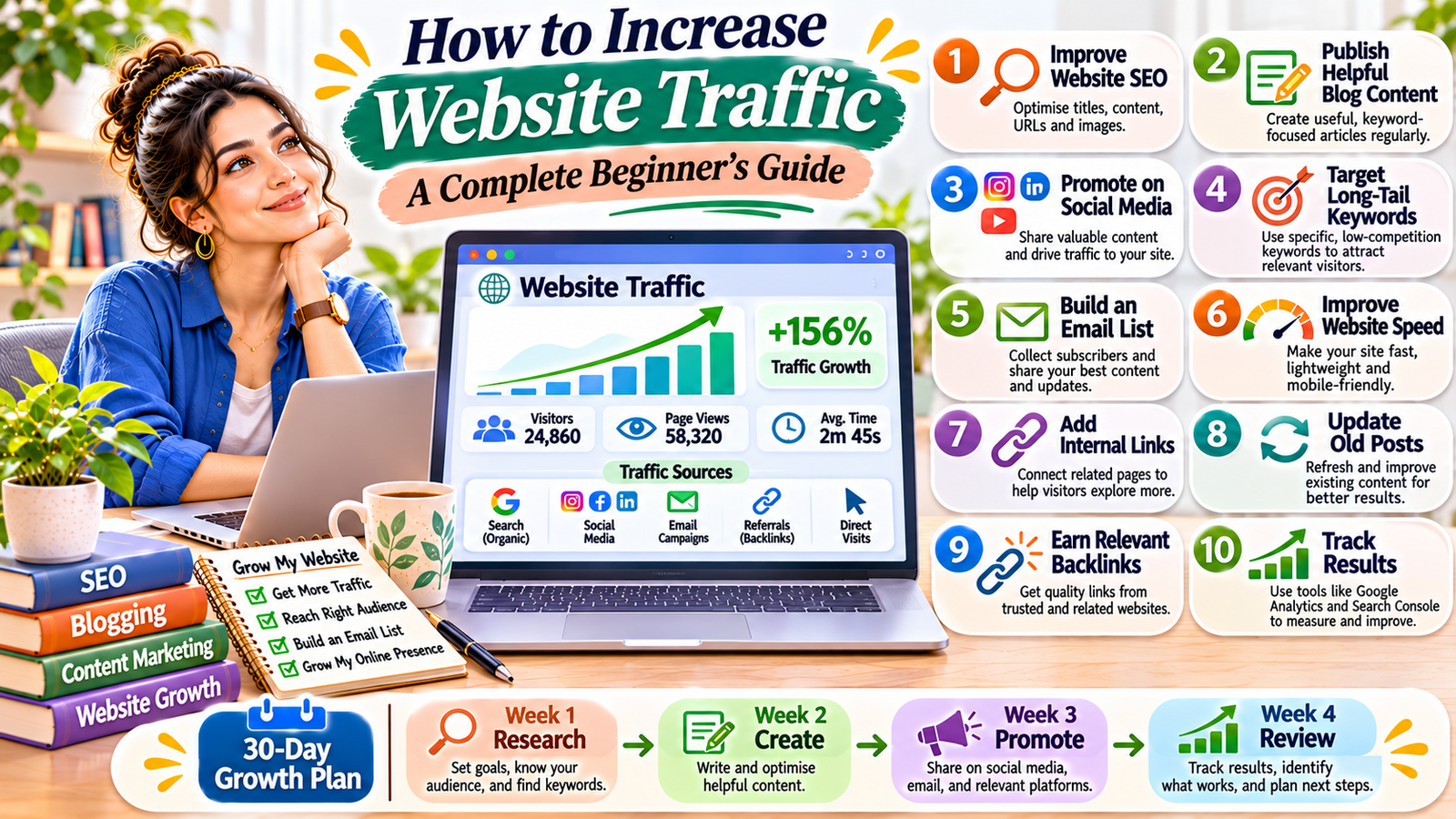
Building a website is an important first step towards growing your online presence. However, publishing a website does not automatically bring visitors. You also need to help people discover your pages and give them useful reasons to return.
If you are a blogger, freelancer, content creator, or small business owner, website traffic can help you reach more people. It can also create opportunities to build an audience, generate leads, and grow your online business.
The good news is that you do not always need paid advertising to attract visitors. You can use search engine optimisation, content marketing, social media, and email marketing to improve your website visibility.
In this guide, you will learn how to increase website traffic with simple and practical strategies. These methods are suitable for beginners who want to grow their websites gradually.
What Is Website Traffic?
Website traffic refers to the number of visits people make to your website. Each visit represents a session, while one visitor may make several visits over time.
For example, if someone finds your blog through Google and reads an article, that visit contributes to your website traffic.
Website traffic can come from different sources, including:
- Search engines such as Google.
- Social media platforms.
- Direct visits.
- Email newsletters.
- Links from other websites.
- Paid advertisements.
Understanding where your visitors come from helps you identify which marketing activities are working.
Why Is Website Traffic Important?
Website traffic matters because it connects your content, products, or services with potential audiences.
Here are some important benefits.
1. Increases Brand Awareness
More relevant visitors can help more people discover your website and understand what you offer.
2. Helps You Build an Audience
Useful articles and resources can encourage visitors to explore more pages and return for future content.
3. Creates Business Opportunities
For businesses and freelancers, relevant website visitors may become customers, clients, or leads.
4. Supports Content Growth
Traffic data helps you understand which topics attract attention. You can use this information to plan future articles.
5. Helps You Understand Your Audience
Website analytics can show which pages people visit, where they come from, and how they interact with your content.
Remember, traffic quality matters. A smaller audience interested in your topic may be more valuable than a large number of visitors who leave without finding what they need.
How to Increase Website Traffic: 10 Practical Strategies
You do not need to use every marketing channel at once. Start with the strategies that match your website and audience.
1. Improve Your Website SEO
Search engine optimisation is one of the most useful ways to attract organic traffic.
When people search for information related to your website, well-organised and helpful pages have an opportunity to appear in search results.
Start with these SEO practices:
- Research relevant keywords.
- Write clear SEO titles.
- Create useful meta descriptions.
- Organise articles with headings.
- Use descriptive URLs.
- Add relevant internal links.
- Optimise images.
- Make your website mobile-friendly.
For example, if you write about digital marketing, create helpful guides around topics your audience searches for.
You can also read our guide on SEO for Beginners to understand the basic optimisation process.
2. Publish Helpful and Consistent Blog Content
Blogging can help your website attract visitors who are looking for answers, ideas, and practical guidance.
However, publishing many articles without a clear purpose may not produce useful results.
Instead, focus on creating content that solves real problems.
Follow these steps:
- Understand your target audience.
- Research topics they want to learn about.
- Choose a relevant primary keyword.
- Create a clear article structure.
- Write useful and original information.
- Add relevant examples and resources.
- Review and update the article when needed.
For example, a website about blogging can publish articles about content planning, blog writing, keyword research, and website growth.
You can also connect related articles through internal links. This encourages readers to explore more of your website.
3. Use Social Media to Promote Your Website
Choose platforms that match your audience and content style.
For example:
- Instagram: Share educational posts, carousels, and visual tips.
- Facebook: Participate in relevant communities and share useful resources.
- LinkedIn: Publish professional insights and industry-related articles.
- Pinterest: Share visual content that links to relevant blog posts.
Do not simply post a website link without context. Give people a reason to click.
For example, if you publish an article about keyword research, create a short post explaining one useful keyword research tip. Then invite readers to visit the full guide.
For more ideas, read our upcoming guide on Driving Website Traffic Using Social Media.
4. Focus on Long-Tail Keywords
Long-tail keywords are specific search phrases that usually contain more detail than broad keywords.
For example:
- Broad keyword: Website traffic.
- Long-tail keyword: How to increase website traffic for a new blog.
Specific search phrases can help you understand what information people want.
Use keyword research tools and Google search suggestions to discover relevant topics.
When selecting keywords, check their relevance, search intent, and competition. Then create content that answers the searcher’s question.
Our guide on how keyword research works explains this process in more detail.
5. Build an Email Subscriber List
Email marketing gives you a direct way to communicate with people who choose to receive updates from your website.
You can use email newsletters to share:
- New blog articles.
- Useful resources.
- Practical tips.
- Website updates.
- Helpful guides.
Start by adding a simple newsletter subscription form to your website.
Offer a useful resource, such as a checklist or beginner’s guide, if it genuinely helps your audience.
Always obtain permission before sending marketing emails. Include a clear unsubscribe option and follow applicable email privacy rules.
6. Improve Your Website Loading Speed
A website that loads slowly can create a poor browsing experience.
Visitors may leave before they find the information they need.
You can improve website performance by:
- Compressing images.
- Using reliable hosting.
- Choosing a lightweight theme.
- Removing unnecessary plugins.
- Enabling suitable caching.
- Reducing unnecessary scripts and animations.
Use Google PageSpeed Insights to check your website and explore improvement suggestions.
A faster website supports a smoother user experience, although speed improvements alone do not guarantee higher search rankings.
7. Use Internal Linking
Internal links connect different pages on your website.
They help visitors discover related content and make your website easier to navigate.
For example, an article about website traffic can link to:
- SEO for beginners.
- Keyword research.
- On-page SEO.
- Content marketing strategies.
Use descriptive anchor text so readers understand what the linked page covers.
Do not add links randomly. Each internal link should provide useful additional information.
8. Update Old Blog Posts
You do not always need to publish a new article to improve your website.
Sometimes, updating existing content can be a useful way to maintain quality and relevance.
Review older articles and check:
- Are the facts still correct?
- Are any links broken?
- Can you add more useful examples?
- Are the images still relevant?
- Does the article answer the searcher’s question?
- Can you improve the title or introduction?
Use Google Search Console to identify pages that receive search impressions or clicks. Prioritise updates based on relevance and performance.
Do not change dates or rewrite content without making meaningful improvements.
9. Build Relevant Backlinks
A backlink is a link from another website to your website.
Relevant backlinks can help people discover your content and may contribute to your website’s reputation.
You can work towards earning backlinks by:
- Publishing original research.
- Creating useful guides.
- Writing guest articles for relevant websites.
- Building relationships with other creators.
- Sharing helpful resources with industry websites.
Focus on relevance and quality. Avoid buying spammy links or participating in link schemes.
10. Track Website Traffic and Improve Your Strategy
You cannot improve your marketing strategy effectively if you never review the results.
Use analytics tools to understand how people discover and use your website.
Two useful tools are:
Google Search Console: Shows search queries, clicks, impressions, and information about how your website performs in Google Search.
Google Analytics 4: Helps you understand website visitors, traffic sources, and user activity.
Review your results regularly.
Look for:
- Pages attracting organic traffic.
- Articles receiving search impressions.
- Social platforms sending visitors.
- Pages that need improvement.
- Content topics that interest your audience.
Use these insights to decide what to create or update next.
Best Free Tools to Increase Website Traffic
You can start improving your website without purchasing expensive marketing tools.
| Tool | How It Helps |
|---|---|
| Google Search Console | Monitors organic search performance |
| Google Analytics 4 | Tracks website visitors and traffic sources |
| Google Trends | Explores interest in different topics |
| Google Keyword Planner | Finds keyword ideas |
| Google PageSpeed Insights | Checks website performance |
| Canva | Helps create social media graphics |
| Mailchimp | Supports email marketing and newsletters |
Some tools offer paid plans or limited free features. Choose tools based on your actual requirements.
Common Mistakes That Can Limit Website Traffic
While trying to grow a website, beginners often make mistakes that waste time and effort.
1. Publishing Without Keyword Research
Writing about random topics may make it difficult to reach your intended audience.
Research relevant topics before creating new articles.
2. Ignoring Social Media Promotion
Publishing a blog post is only one part of content marketing. Share useful content through channels where your audience spends time.
3. Focusing Only on Traffic Numbers
A high number of visits does not always mean success. Pay attention to relevant visitors, engagement, leads, and other goals.
4. Expecting Instant Results
SEO and content marketing usually require consistent effort. Rankings and traffic can change over time.
5. Ignoring Website Performance
A difficult-to-use website may discourage visitors from exploring more pages.
Check mobile usability, loading performance, and navigation regularly.
A Simple 30-Day Website Traffic Growth Plan
If you are a beginner, follow this simple plan to organise your first month of work.
| Time | Tasks |
|---|---|
| Week 1 | Review your website, understand your audience, and research keywords |
| Week 2 | Publish useful content and improve existing blog posts |
| Week 3 | Share articles on relevant social media platforms and add internal links |
| Week 4 | Review Google Search Console and Analytics data, then plan improvements |
You do not need to complete every task perfectly. The important thing is to build a consistent routine.
Growing website traffic takes time, planning, and regular improvement. You need to help people discover your website and provide information that is worth reading.
Start with SEO and useful blog content. Then promote your articles through social media, build an email audience, improve website performance, and track your results.
Most importantly, focus on attracting the right visitors rather than chasing traffic numbers alone.
Every website grows differently. Test your strategies, learn from your analytics, and improve your content based on what your audience needs.
Start today by choosing one important article on your website and improving its SEO, content, and internal links.
Add a Comment