

Social media has changed how businesses connect with customers. Today, people do not only follow brands. They also follow creators who share useful information, product reviews, recommendations, and everyday experiences.
This has created new opportunities for businesses to reach their target audiences.
One popular strategy is influencer marketing. It allows brands to work with social media creators who have built an audience around a particular interest or topic.
For example, a skincare brand may collaborate with a beauty creator to introduce a new product. Similarly, a digital marketing company may work with a content creator who shares marketing tips.
Influencer marketing is not only for large companies. Small businesses, freelancers, startups, and online creators can also use it.
In this beginner-friendly guide, you will learn what influencer marketing is, how it works, its benefits, different types of influencers, and how to create an effective strategy.
What Is Influencer Marketing?
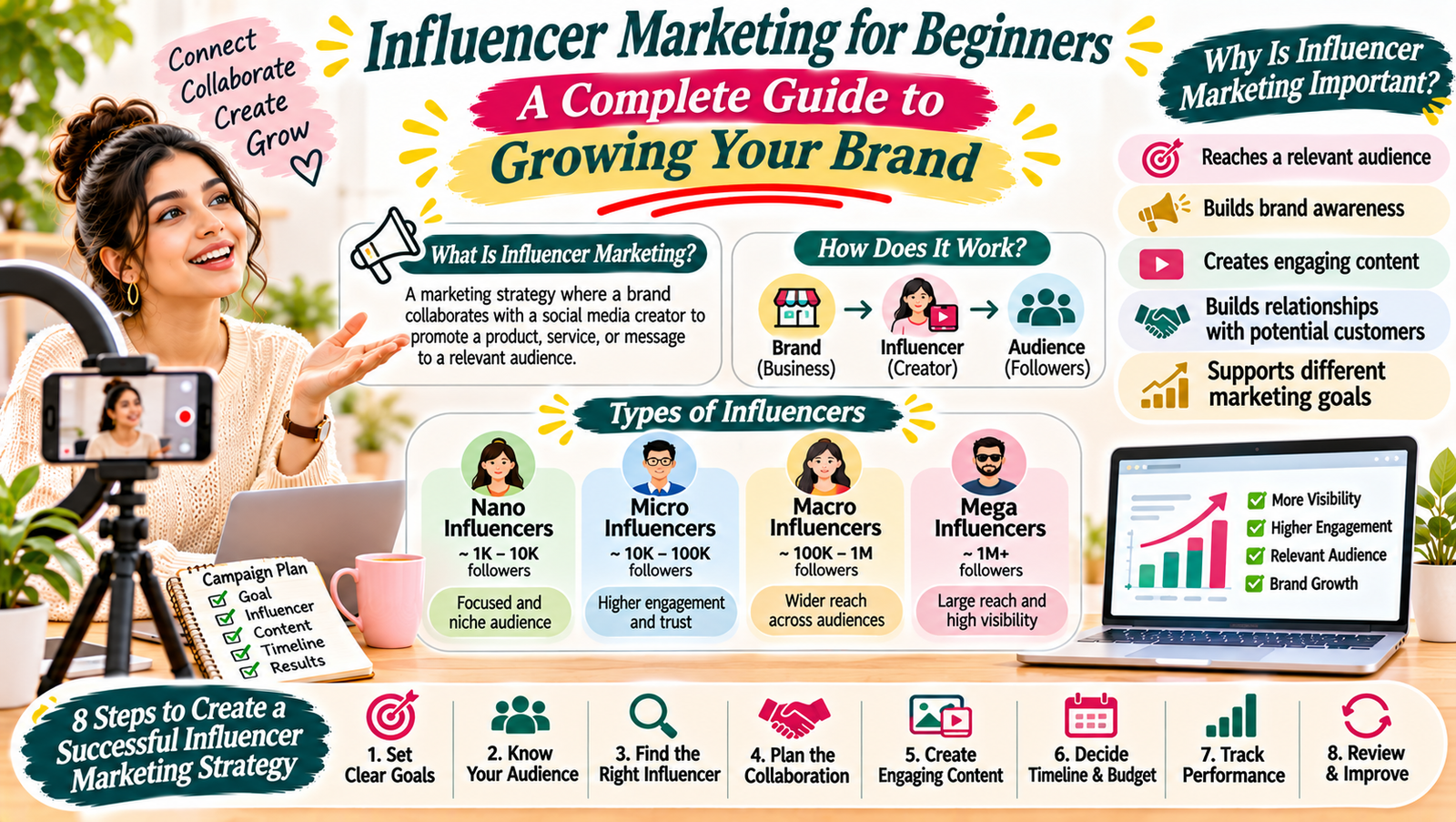
Influencer marketing is a digital marketing strategy in which a brand collaborates with a social media creator to promote a product, service, or message.
Influencers usually create content around topics such as:
- Beauty and skincare.
- Fashion and lifestyle.
- Technology and gadgets.
- Travel and food.
- Fitness and wellness.
- Education and digital marketing.
- Personal finance and business.
These creators build relationships with their audiences through regular content and conversations.
When a brand works with an influencer, it can introduce its products or services to people who are already interested in that topic.
For example, a small clothing business may collaborate with a fashion creator. The creator can show how the clothes look, share styling ideas, and introduce the brand to their followers.
The main goal is to reach relevant people and encourage genuine interest.
How Does Influencer Marketing Work?
Influencer marketing usually involves three main parties:
- The brand: The business that wants to promote its product or service.
- The influencer: The creator who produces content and connects with an audience.
- The audience: People who watch, read, or interact with the creator’s content.
The process starts when a brand identifies a suitable creator.
Both parties then discuss the campaign goals, content requirements, timeline, payment, and other conditions.
The influencer creates content according to the agreed plan. After publishing, the brand reviews the campaign performance.
For example, a restaurant may collaborate with a local food creator to introduce its new menu. The creator shares photographs, a short video, and an honest experience with their audience.
This helps the restaurant reach people who are interested in food and local dining experiences.
Why Is Influencer Marketing Important?
Here are some important benefits.
1. Reaches a Relevant Audience
Influencers often create content for a specific group of people.
For example, a fitness creator may have an audience interested in exercise, healthy routines, and sports products.
A fitness brand can collaborate with that creator to reach people who are already interested in its industry.
2. Builds Brand Awareness
Working with creators can introduce your business to people who may not know about it.
When an influencer shares your product or service, their audience gets an opportunity to discover your brand.
This can help increase brand visibility.
3. Creates Engaging Content
Influencers understand the content formats that their audiences enjoy.
They may create product demonstrations, tutorials, reviews, photographs, or short videos.
Brands can use these creative ideas to communicate their messages in an interesting way.
4. Builds Relationships With Potential Customers
People often follow creators because they enjoy their content and opinions.
A relevant collaboration can help a brand start conversations with potential customers.
However, trust depends on honest communication. Influencers should clearly disclose paid partnerships and share genuine experiences.
5. Supports Different Marketing Goals
Influencer campaigns can support several business goals, including:
- Introducing a new product.
- Increasing brand awareness.
- Promoting an event.
- Generating website visits.
- Encouraging product enquiries.
- Supporting a product launch.
- Creating user-generated content.
Choose a goal before starting your campaign. It will help you select the right influencer and measure the results.
Types of Influencers You Should Know
Not every influencer has the same audience size or content style.
Influencers are commonly grouped by their follower count. The exact ranges can vary between platforms and marketing agencies.
1. Nano Influencers
Nano influencers generally have smaller audiences, often around 1,000 to 10,000 followers.
They may focus on a local area, personal interest, or specific community.
Small businesses can consider working with nano influencers when they want to reach a focused audience.
2. Micro Influencers
Micro influencers commonly have around 10,000 to 100,000 followers.
They often focus on a particular subject, such as beauty, technology, travel, or education.
They can be useful for brands that want to reach a specific audience rather than a very broad group.
3. Macro Influencers
Macro influencers generally have around 100,000 to 1 million followers.
They often have wider reach and may create content for larger communities.
Businesses with bigger campaign budgets may consider working with these creators.
4. Mega Influencers
Mega influencers usually have more than 1 million followers.
They may include celebrities, well-known public figures, and major online creators.
These partnerships can provide broad visibility, but they may require larger budgets.
Remember, follower count alone does not determine an influencer’s value. Audience relevance, engagement quality, content style, and credibility also matter.
How to Create an Influencer Marketing Strategy
A successful campaign needs planning. Follow these steps to build a practical influencer marketing strategy.
Step 1. Define Your Marketing Goals
Start by deciding what you want to achieve.
Do you want to increase brand awareness, promote a product, attract website visitors, or generate sales?
Write down one main goal and a few supporting objectives.
For example, a new online clothing store may want to introduce its brand to people interested in affordable fashion.
A clear goal makes campaign planning easier.
Step 2. Understand Your Target Audience
Before choosing an influencer, understand the people you want to reach.
Consider their:
- Age group.
- Interests.
- Location.
- Shopping habits.
- Social media preferences.
- Common problems and needs.
For example, a local restaurant may want to reach people living nearby. In this case, a local food creator may be more suitable than a creator with a large international audience.
Step 3. Find the Right Influencers
Look for creators whose content matches your brand.
Check their profiles, recent posts, audience interactions, and previous collaborations.
You can discover influencers through:
- Instagram searches.
- YouTube searches.
- TikTok searches.
- Relevant hashtags.
- Industry communities.
- Creator marketplaces.
- Recommendations from customers.
Do not choose someone only because they have many followers.
Instead, focus on whether their audience is relevant to your business.
Step 4. Review Engagement and Content Quality
Follower count does not tell the complete story.
Review how people interact with the influencer’s content.
Look at:
- Genuine comments.
- Relevant audience questions.
- Video views.
- Shares and saves, where available.
- Content quality.
- Consistency of posting.
Be careful of suspicious follower growth or repeated irrelevant comments.
You can also ask for audience insights when discussing a professional collaboration.
Step 5. Set Your Campaign Budget
Influencer collaboration costs can vary.
The price may depend on the creator’s audience size, platform, content format, production effort, usage rights, and campaign duration.
Possible collaboration arrangements include:
- Paid sponsored posts.
- Product gifting.
- Affiliate partnerships.
- Event collaborations.
- Long-term brand partnerships.
Agree on payment, deliverables, deadlines, usage rights, and disclosure requirements before the campaign begins.
Step 6. Create a Clear Campaign Brief
A campaign brief explains what the influencer needs to know.
Include:
- Brand introduction.
- Campaign objective.
- Target audience.
- Product or service details.
- Required content format.
- Key information to communicate.
- Publishing timeline.
- Payment and deliverables.
- Disclosure instructions.
Give creators enough creative freedom to communicate naturally.
At the same time, make sure they understand important brand information and campaign requirements.
Step 7. Launch the Campaign
Once both parties approve the plan, the influencer can create and publish the agreed content.
Check that the content:
- Represents the brand accurately.
- Follows the agreed brief.
- Uses the correct links or campaign details.
- Includes clear advertising disclosures where required.
- Matches the publishing schedule.
Avoid making unverified product claims or asking creators to give dishonest reviews.
Step 8. Measure the Results
After the campaign goes live, review its performance.
Compare the results with your original goal.
For example, if your goal was brand awareness, review reach, impressions, and relevant engagement.
If your goal was website traffic, track link clicks and visits.
Use these findings to improve future campaigns.
Which Social Media Platforms Are Best for Influencer Marketing?
The right platform depends on your audience and campaign goals.
| Platform | Suitable Content |
|---|---|
| Reels, Stories, photographs, and product features | |
| YouTube | Tutorials, reviews, demonstrations, and detailed videos |
| TikTok | Short videos, trends, and creative storytelling |
| Community content, videos, and local promotions | |
| Professional insights, B2B content, and industry discussions | |
| Visual inspiration, lifestyle ideas, and product discovery |
You do not need to use every platform.
Start where your target audience is most active.
How to Measure Influencer Marketing Performance
Tracking campaign performance helps you understand whether your collaboration is useful.
Here are some important metrics.
Reach and Impressions
Reach shows how many unique accounts saw the content.
Impressions show how many times the content was displayed.
These metrics are useful for measuring campaign visibility.
Engagement Rate
Engagement includes actions such as likes, comments, shares, and saves.
A simple engagement rate calculation is:
Engagement Rate = (Total Engagements ÷ Total Followers) × 100
This is one common calculation method. Other methods use reach or impressions as the base.
Website Traffic
Use trackable links or campaign-specific URLs to understand how many visitors arrive through an influencer’s content.
Conversions
Conversions may include purchases, enquiries, registrations, or newsletter subscriptions.
Choose the conversion that matches your campaign goal.
Return on Investment
Return on investment, or ROI, helps you compare campaign returns with campaign costs.
A simple formula is:
ROI = ((Revenue − Campaign Cost) ÷ Campaign Cost) × 100
For example, if a campaign generates ₹30,000 in revenue and costs ₹10,000, the ROI is 200%.
This example assumes the full ₹30,000 is attributable to the campaign. In real campaigns, use reliable tracking and consider other business costs.
Common Influencer Marketing Mistakes to Avoid
Influencer campaigns can become less effective when brands focus on the wrong things.
Avoid these common mistakes:
- Choosing influencers only by follower count.
- Ignoring audience relevance.
- Starting a campaign without clear goals.
- Failing to agree on deliverables.
- Ignoring advertising disclosures.
- Expecting immediate sales from every collaboration.
- Not tracking campaign performance.
- Working with creators whose values do not match the brand.
Take time to research creators and plan your campaign before spending money.
Influencer marketing gives businesses an opportunity to connect with audiences through creators they already follow.
However, successful collaborations need more than a large follower count. They require relevant audiences, clear goals, honest communication, and proper performance tracking.
Start with a simple campaign. Choose a creator who understands your industry and can communicate your brand message naturally.
Review the results and learn from each collaboration.
With thoughtful planning, influencer marketing can become a useful part of your digital marketing strategy.
Add a Comment