

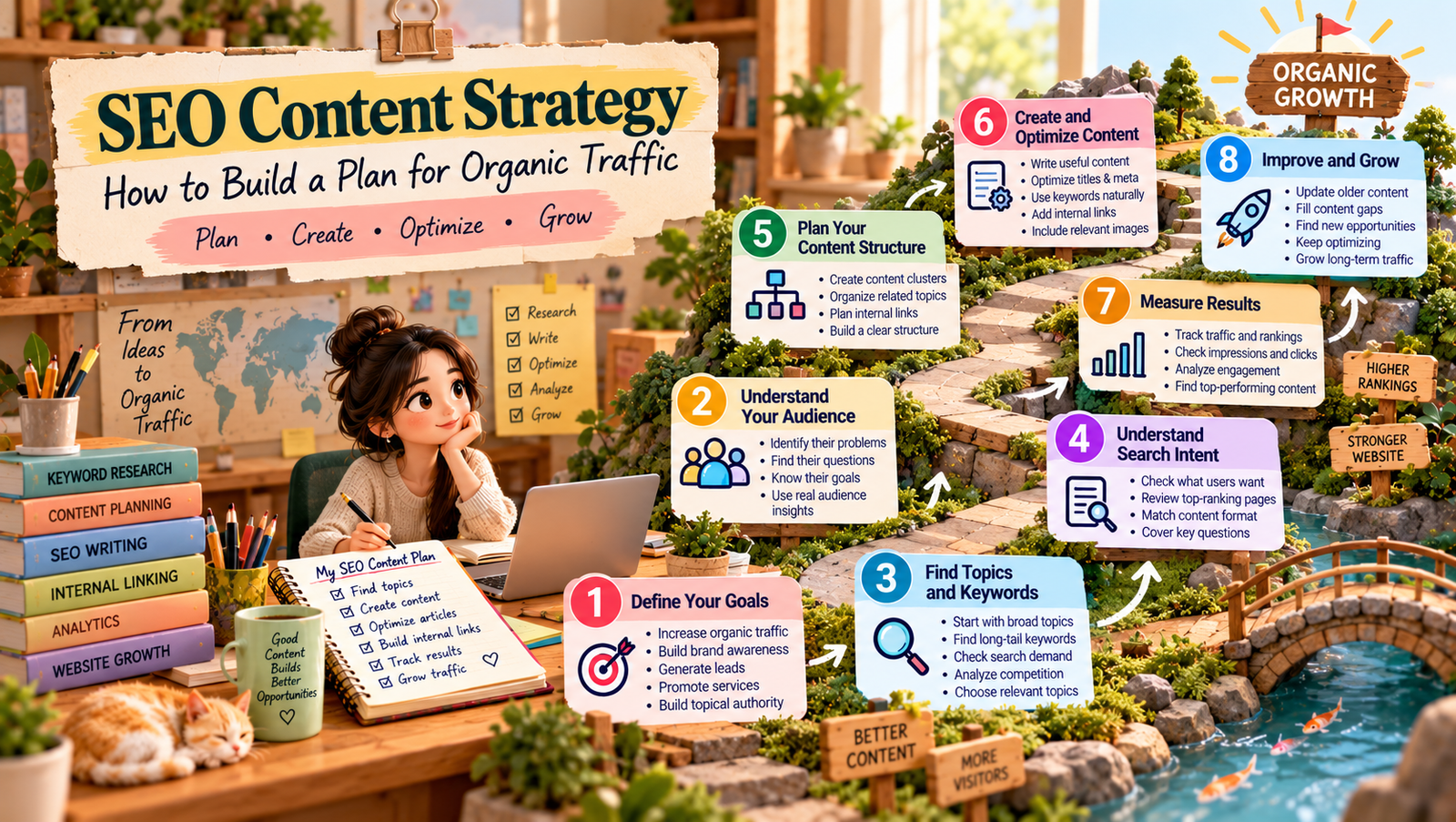
Creating blog content without a clear plan can waste time. You may publish useful articles, but they may not reach the right readers. A strong SEO content strategy helps you choose better topics, understand search intent, organize related content, and build steady organic traffic.
Instead of writing random posts, you can create content around the questions and problems your audience already searches for. You can also connect related articles so readers and search engines can understand your website more easily.
In this guide, you will learn how to build an SEO content strategy from the beginning. You will learn how to set goals, research topics, choose keywords, understand search intent, build content clusters, optimize articles, add internal links, and measure results.
What Is an SEO Content Strategy?
An SEO content strategy is a plan for creating and improving website content so it can reach the right audience through search engines.
It combines SEO research with content planning.
A useful strategy considers:
- Your target audience
- Their problems and questions
- Search keywords
- Search intent
- Content topics
- Content structure
- Internal links
- External sources
- Content performance
- Future updates
For example, a website about blogging could publish articles about starting a blog, keyword research, content planning, SEO, and traffic growth.
However, these articles should not exist as unrelated pages. They can support one another through related topics and internal links.
This creates a more organized content system.
If you are new to SEO, start with SEO for Beginners before building a detailed content plan.
Why Your Blog Needs an SEO Content Strategy
A blog can have great writing and still struggle to attract search traffic.
One reason is poor topic planning.
You might spend several hours writing an article that has little connection to what your audience wants. You may also create several posts that target almost the same search.
An SEO content strategy helps prevent these problems.
It can help you:
- Choose useful topics
- Understand your audience
- Find relevant keywords
- Match search intent
- Build related content
- Improve internal linking
- Avoid duplicate topics
- Update older articles
- Measure content results
Most importantly, it gives your blog a clear direction.
You do not need hundreds of articles. Instead, focus on creating useful content that covers important topics in a clear and connected way.
Define Your SEO Content Goals
Before choosing keywords, decide what you want your content to achieve.
Your goals may include:
- Growing organic traffic
- Building topical authority
- Increasing brand awareness
- Generating leads
- Promoting services
- Growing an email list
- Supporting product sales
- Educating your audience
Your goal affects your content choices.
For example, an informational article can help attract people who are learning about a topic. A comparison article can help readers evaluate different options. A service page can target people who are ready to take action.
Therefore, do not choose keywords only because they have search volume. First, ask whether the topic supports your wider website goal.
Understand Your Target Audience
Your audience should be at the center of your content plan.
Start by understanding what your readers need.
Ask questions such as:
- What problems do they have?
- What questions do they ask?
- What are they trying to achieve?
- What level of knowledge do they have?
- What information are they missing?
- What might stop them from taking action?
For example, a beginner blogger may search for:
- How to start a blog
- How to find blog topics
- How to write a blog post
- How to find keywords
- How to get blog traffic
These searches can become useful content opportunities.
You can also find topic ideas from comments, social media discussions, online communities, customer questions, and emails.
The closer your content is to a real audience problem, the more useful it can become.
Find Topics and Keywords
Keyword research helps you understand what people search for.
Start with broad ideas related to your website. Then expand them into specific search phrases.
For example:
Broad topic: Blogging
Specific topics:
- Blogging for beginners
- How to start a blog
- Blog content ideas
- Blog SEO
- How to write a blog post
- How to increase blog traffic
Next, review each keyword based on:
- Relevance
- Search intent
- Competition
- Search demand
- Business value
Do not focus only on high-volume keywords. A smaller keyword can be valuable if it closely matches your audience and your content can answer the query well.
For a deeper process, see How to Conduct Effective Keyword Research for Your Blog.
Match Content With Search Intent
Search intent is the reason behind a search.
Understanding it helps you decide what type of content to create.
Informational Intent
The reader wants to learn something.
Examples include:
- What is SEO?
- What is content writing?
- How does keyword research work?
A detailed guide is usually suitable for these searches.
Commercial Intent
The reader is researching before making a decision.
Examples include:
- Best SEO tools for bloggers
- SEO tools comparison
- Best blogging platforms
Comparison posts, reviews, and detailed guides may work well.
Transactional Intent
The reader is ready to take action.
Examples include:
- Buy SEO software
- Hire a content writer
- SEO services
A product or service page may be more suitable than a general blog post.
Navigational Intent
The user wants to find a particular website, company, or page.
Before writing, search for your target query. Look at the results and identify the type of content Google is showing.
This can help you understand what searchers expect.
Build Content Clusters
A strong SEO content strategy connects related articles.
This is where content clusters become useful.
A basic content cluster includes:
- One main topic
- Several supporting topics
- Internal links between related pages
For example:
Main topic: SEO Content Strategy
Supporting topics:
- SEO content topics
- SEO content briefs
- SEO content performance
Each supporting article covers a specific part of the wider subject.
Then, the articles link back to the main guide where appropriate.
This structure helps readers discover related information. It also gives your website a clearer content organization.
You can learn more in How to Build Topic Clusters for Your Blog.
Create an SEO Content Brief
Before writing an article, create a simple content brief.
A brief gives you a clear plan before you start drafting.
Include details such as:
- Target audience
- Main topic
- Focus keyphrase
- Related keywords
- Search intent
- Article goal
- Suggested headings
- Questions to answer
- Internal links
- External sources
- Image ideas
For example, if you are writing a beginner SEO guide, your brief should make it clear that the article needs simple explanations and practical examples.
A good brief also helps prevent unnecessary sections.
Read How to Create an SEO Content Brief for a detailed process.
Optimize Your Blog Content
Once your article is ready, optimize it for both readers and search engines.
Start with the basics.
Use:
- A clear SEO title
- A useful meta description
- One H1
- Clear H2 and H3 headings
- Natural keyword use
- Related terms
- Short paragraphs
- Useful images
- Descriptive alt text
- Internal links
- Relevant external sources
Your focus keyphrase should appear naturally in important places.
For example, it can appear in the introduction, SEO title, slug, and some relevant subheadings.
However, do not repeat it in every paragraph.
The article should still sound natural.
For more page-level guidance, read On-Page SEO: A Beginner’s Guide.
Build Internal Links
Internal links connect your pages.
They help readers move from one useful article to another. They can also help search engines understand how your content is connected.
For example, this main article can link to:
- Keyword research
- Topic clusters
- SEO content briefs
- On-page SEO
- Content refresh
- SEO performance
Use natural anchor text that describes the destination page.
Also, do not add links just to increase the number of links. Each link should help the reader.
A good internal-linking system creates a clear path through your website.
Promote Your Content
SEO is a long-term process, so you should not expect every article to rank immediately.
After publishing, you can also promote your content through suitable channels.
Depending on your audience, these may include:
- Email newsletters
- Relevant online communities
- Social media posts
You can also repurpose one article into different formats.
For example, one detailed blog post can become:
- Social media posts
- A short video
- An email
- A checklist
- An infographic
This gives your content more opportunities to reach your audience.
Measure SEO Content Performance
Publishing is not the final step.
You also need to understand how your content performs.
Useful metrics include:
- Organic traffic
- Search impressions
- Clicks
- Click-through rate
- Keyword rankings
- Engagement
- Leads
- Conversions
Google Search Console can show how your pages perform in Google Search. Google Analytics can help you understand website activity and user behavior.
Do not judge an article using only traffic.
For example, one article may attract 5,000 visitors but generate very few leads. Another may attract 1,000 visitors and generate several useful inquiries.
The better result depends on your goal.
You can learn more about this process in How to Measure SEO Content Performance.
Update Old Content
Your SEO content strategy should include content updates.
Information changes. Search results change. Your website also grows.
Therefore, an article that worked well last year may need improvement today.
Review older content for:
- Outdated information
- Broken links
- Missing sections
- Weak examples
- Poor internal links
- Old statistics
- Changes in search intent
- New keyword opportunities
Sometimes, updating an existing article is better than creating another article about the same topic.
For example, you may discover that an older article already ranks for several useful searches. Instead of publishing a duplicate page, improve the existing one.
Read Content Refresh Strategy for more guidance.
Common SEO Content Strategy Mistakes
Publishing Without a Clear Goal
If you do not know what an article should achieve, it can become unfocused.
Choosing Keywords Only by Search Volume
High-volume keywords are not always the best choice. Relevance matters too.
Ignoring Search Intent
A page can target a keyword but still fail to satisfy the searcher’s needs.
Creating Similar Articles
Publishing several pages about almost the same topic can create confusion.
Forgetting Internal Links
Related articles should support one another.
Ignoring Older Content
Not every SEO problem requires a new article. Sometimes an existing page needs an update.
Focusing Only on Rankings
Rankings are useful, but traffic, engagement, leads, and conversions can also matter.
A Simple SEO Content Strategy Workflow
Start by defining your audience and your main content goals.
Next, research topics and keywords that match those goals. Then, check search intent before choosing the content format.
After that, group related topics into content clusters. Create a content brief for each important article and plan its headings, links, questions, and images.
Once the article is written, optimize the page naturally. Add internal links, relevant external sources, useful images, and descriptive alt text.
After publishing, promote the article and monitor its performance.
Finally, update the content when you find new information, missing details, or better opportunities.
This process gives you a clear path from research to publishing, measurement, and improvement.
A successful SEO content strategy is not about publishing as many articles as possible.
It is about creating useful content around topics your audience actually needs.
Start with your readers. Then research keywords, understand search intent, and organize related topics into clear content groups.
After that, create useful briefs, optimize your articles, connect your pages with internal links, and measure what happens after publishing.
Most importantly, keep improving your content.
With a consistent process, your blog can become more organized, more useful to readers, and better prepared for long-term organic growth.
Add a Comment