

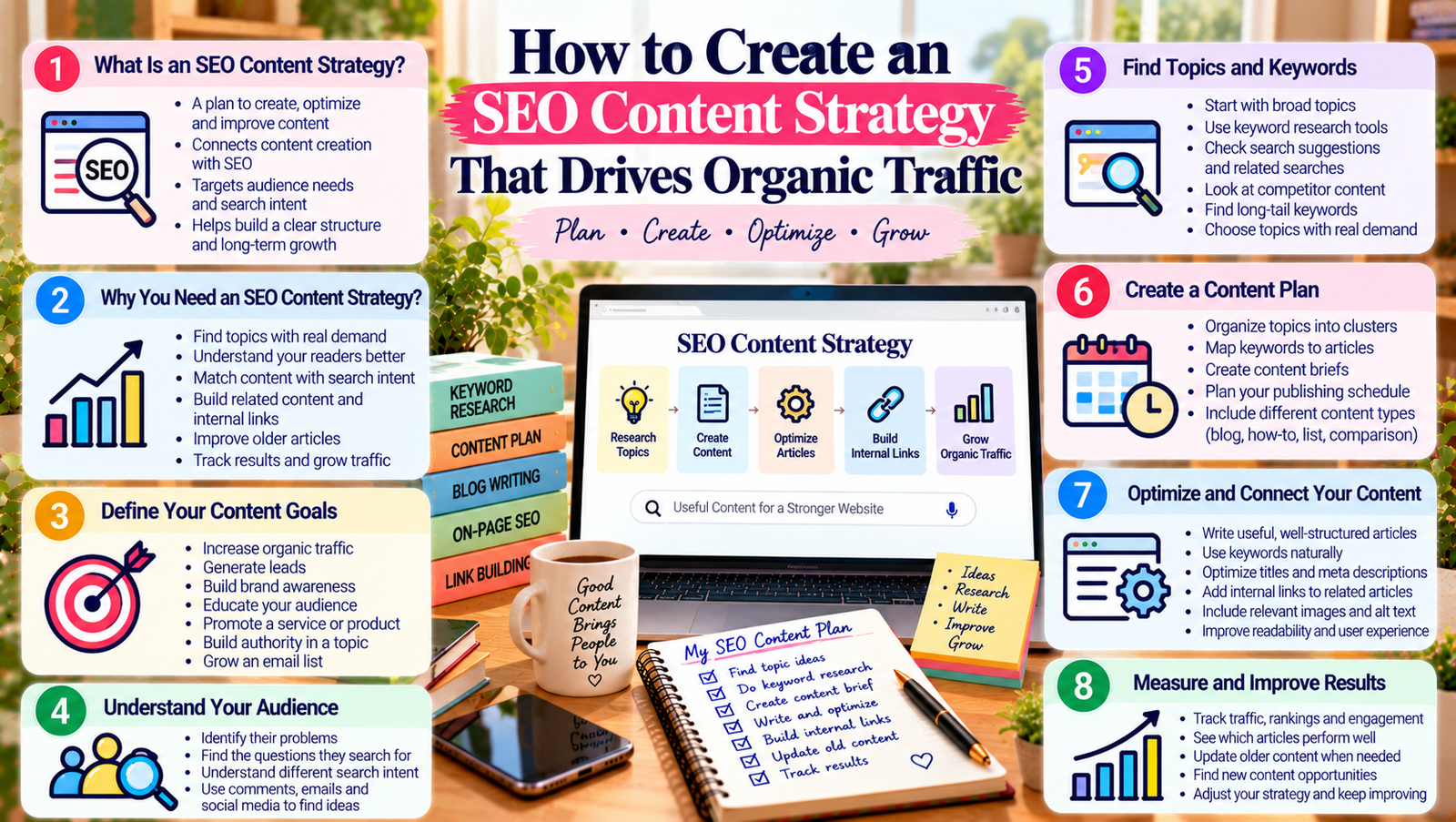
Getting traffic from Google is not only about publishing more blog posts. You need to know what your audience searches for, what those searches mean, and what type of content can answer them well. That is where an SEO content strategy becomes useful.
A clear plan helps you choose better topics, target useful keywords, organize related articles, and improve your website over time. Instead of writing random posts, you can create content that supports your wider website goals.
In this guide, you will learn how to create an SEO content strategy from the ground up. You will also learn how to choose topics, understand search intent, build content clusters, create content briefs, optimize articles, and measure your results.
What Is an SEO Content Strategy?
An SEO content strategy is a plan for creating, optimizing, publishing, and improving content so that it can reach people through search engines.
The process connects content creation with SEO. Instead of asking only, “What should I write about?”, you also ask:
- What does my audience need?
- What are people searching for?
- What problem does the searcher want to solve?
- Which keywords are relevant?
- What type of content should I create?
- How can related pages support each other?
- How will I measure the results?
For example, suppose you have a website about digital marketing. You could publish random articles about social media, SEO, blogging, and email marketing.
However, a better approach is to organize those topics into related groups. This makes your website easier for readers to navigate and gives search engines more context about your content.
You can start with our guide on SEO for Beginners to understand the wider SEO foundation.
Why Your Blog Needs an SEO Content Strategy
Without a plan, it is easy to spend hours writing articles that attract little traffic.
An SEO content strategy gives your blog direction. It helps you decide what to create and why each article matters.
A good strategy can help you:
- Find topics with useful search demand
- Understand your readers better
- Match content with search intent
- Avoid publishing similar articles
- Build related content around important subjects
- Create stronger internal links
- Improve older articles
- Track content performance
- Support long-term organic growth
More importantly, it helps you focus on useful content rather than content volume.
Publishing ten unrelated articles may not be as valuable as publishing five connected articles that answer different questions around one important topic.
Define Your SEO Content Goals
Before researching keywords, decide what you want your content to achieve.
Your goal could be to:
- Increase organic traffic
- Generate leads
- Build brand awareness
- Educate your audience
- Promote a service
- Build authority in a topic
- Support product sales
- Grow an email list
Your goal affects the type of content you should create.
For example, an informational article may be useful for attracting new visitors. A comparison article may help readers make a buying decision. A service page, on the other hand, can target people who are already looking for a solution.
Therefore, do not choose keywords without first understanding the purpose of your content.
Understand What Your Audience Searches For
Your audience should guide your content decisions.
Start by thinking about the problems your readers face. Then consider the questions they might type into Google.
For example, a beginner interested in blogging may search for:
- How to start a blog
- How to find blog topics
- How to write a blog post
- How to get blog traffic
- How to improve Google rankings
These searches reveal different needs.
Some people want to learn. Others may be comparing options. Some may already be ready to take action.
That difference matters because search intent should influence the content you create.
You can also use your existing audience questions, comments, emails, social media discussions, and customer conversations to discover useful topics.
Find Topics and Keywords With Real Search Demand
Keyword research helps you discover the words and phrases people use when searching online.
Start with broad ideas related to your website. These are often called seed keywords.
For example, a digital marketing website could begin with:
- SEO
- blogging
- content marketing
- social media
- email marketing
Next, expand these ideas into more specific searches.
You can use keyword research tools, Google search suggestions, related searches, and competitor research to discover additional opportunities.
For a deeper process, read How to Conduct Effective Keyword Research for Your Blog.
Remember, search volume should not be your only deciding factor. A keyword with lower volume may still be valuable if it closely matches your audience and business goals.
Match Content With Search Intent
Search intent refers to the reason behind a search.
Understanding intent helps you create the right type of page for the searcher.
Common types include:
Informational Intent
The person wants to learn something.
Examples:
- What is SEO?
- How does keyword research work?
- What is content writing?
A detailed guide is usually suitable here.
Commercial Intent
The person is researching options before making a decision.
Examples:
- Best SEO tools for bloggers
- Blogging platforms compared
- Content writing services
Comparison articles, reviews, and detailed guides can work well for these searches.
Transactional Intent
The person is ready to take action.
Examples:
- Buy SEO software
- Hire a content writer
- Subscribe to an email tool
Product, service, or landing pages may be more suitable.
Navigational Intent
The person wants to find a particular website or page.
For example, someone may search for a specific company, brand, or website.
Before writing an article, check the search results. The pages already ranking can give you useful clues about what Google believes searchers want.
Build Content Clusters Around Main Topics
A strong SEO content strategy should not treat every blog post as a separate piece.
Instead, connect related articles into content clusters.
A content cluster usually contains:
- One main topic
- Several supporting topics
- Internal links connecting the pages
For example, a main article about SEO content strategy could connect to supporting articles about:
- SEO content topics
- SEO content briefs
- SEO content performance
This creates a clear relationship between the pages.
It also gives readers a natural path to explore more information.
Our topic cluster guide explains how related articles can work together.
Create an SEO Content Brief
Before writing an article, create a simple content brief.
A brief gives you a clear direction before you start drafting. It can include:
- Target audience
- Main topic
- Focus keyword
- Related keywords
- Search intent
- Article goal
- Suggested headings
- Questions to answer
- Internal links
- External sources
- Image ideas
- Call to action
This process can save time because you know what the article needs before you begin.
It also makes content easier to keep focused.
For example, if your article targets an informational search, the brief should focus on answering the reader’s question rather than pushing a product too early.
Optimize Your Blog Posts for Search
Once your article is written, optimize it naturally.
Start with the basics:
- Use a clear SEO title
- Write a useful meta description
- Use one clear H1
- Organize sections with H2 and H3 headings
- Include the main keyword naturally
- Use related terms where appropriate
- Write short and clear paragraphs
- Add useful images
- Write descriptive alt text
- Add relevant internal links
- Link to trustworthy external sources
However, avoid forcing keywords into every sentence.
Your first priority should be helping the reader. SEO should support that goal.
For example, instead of repeating one keyword many times, explain the topic using natural language and related terms.
You can also read On-Page SEO: A Beginner’s Guide for more detailed page-level optimization.
Connect Related Articles With Internal Links
Internal links connect one page of your website to another.
They help readers discover related information. They can also help search engines understand the relationship between your pages.
For example, an article about SEO content strategy could link to:
- Keyword research
- Topic clusters
- Content planning
- Internal linking
- Content refresh
Use descriptive anchor text that tells readers what they will find on the linked page.
Also, avoid adding links just for the sake of having more links. Each link should be useful in context.
A well-connected website creates a smoother reading journey.
Promote and Distribute Your Content
SEO can bring organic traffic, but you do not have to wait for Google to discover every article.
After publishing, share your content through suitable channels.
Depending on your audience, you could use:
- Email newsletters
- Online communities
- Relevant social media posts
You can also turn one article into several smaller pieces of content.
For example, a detailed blog post could become:
- Three social media posts
- A short video
- An email
- A checklist
- A simple infographic
This gives your content more opportunities to reach the right audience.
Measure Your SEO Content Performance
Publishing is not the end of the process.
You also need to see how your content performs.
Useful metrics include:
- Organic traffic
- Search impressions
- Clicks
- Click-through rate
- Keyword rankings
- Engagement
- Leads
- Conversions
Google Search Console can help you understand how your pages perform in Google Search. Google Analytics can provide additional information about website visitors and their actions.
Do not focus on one number alone.
For example, a page may receive fewer visitors but generate more leads than a high-traffic informational article. The better result depends on your original goal.
Update and Improve Existing Content
An SEO content strategy should include regular content updates.
Search results change. Your industry may change. New information may become available. Your own website may also grow.
As a result, older articles can lose traffic or become less useful.
Review your existing content and look for:
- Outdated information
- Broken links
- Missing sections
- Weak introductions
- Old examples
- Poor internal linking
- New keyword opportunities
- Changes in search intent
You do not always need to write a new article.
Sometimes, improving an existing page is the better choice.
Read Content Refresh Strategy: How to Update Old Blog Posts for Better SEO to learn more about this process.
Common SEO Content Strategy Mistakes
Even a good plan can fail if you make avoidable mistakes.
Publishing Without a Clear Audience
If you do not know who you are writing for, your content can become too broad.
Choosing Keywords Only by Search Volume
High-volume keywords often have strong competition. A more specific keyword may bring better visitors.
Ignoring Search Intent
A page may target the right words but still fail if it does not satisfy what searchers want.
Creating Too Many Similar Articles
Similar topics can compete with each other. Plan your content carefully before publishing.
Forgetting Internal Links
Related articles should support each other through useful links.
Never Updating Old Content
Older posts can lose value when information becomes outdated.
Focusing Only on Rankings
Rankings matter, but your wider goal may be traffic, leads, sales, or audience growth.
A Simple SEO Content Strategy Workflow
A simple workflow can make your content process easier.
Start by defining your audience and deciding what you want your website to achieve. Next, research topics and keywords that match your audience’s needs.
Then, check the search intent before choosing an article format. After that, group related topics into content clusters.
Create a content brief before writing. Once the draft is ready, optimize the page with clear headings, natural keywords, internal links, external sources, images, and useful alt text.
After publishing, promote the article through suitable channels. Then, monitor its performance using search and website data.
Finally, review the article again when you find new information or better opportunities.
This approach turns SEO content creation into an ongoing process instead of a one-time task.
Final Thoughts
A successful SEO content strategy is not about publishing as many articles as possible. It is about creating useful content with a clear purpose.
Start with your audience. Research what they search for. Then, understand their intent before creating each article.
From there, organize related topics, create useful content briefs, optimize your pages, and connect your articles with internal links. After publishing, measure the results and improve your content over time.
With a consistent approach, your blog can build a stronger content foundation and create more opportunities for organic traffic.
Add a Comment