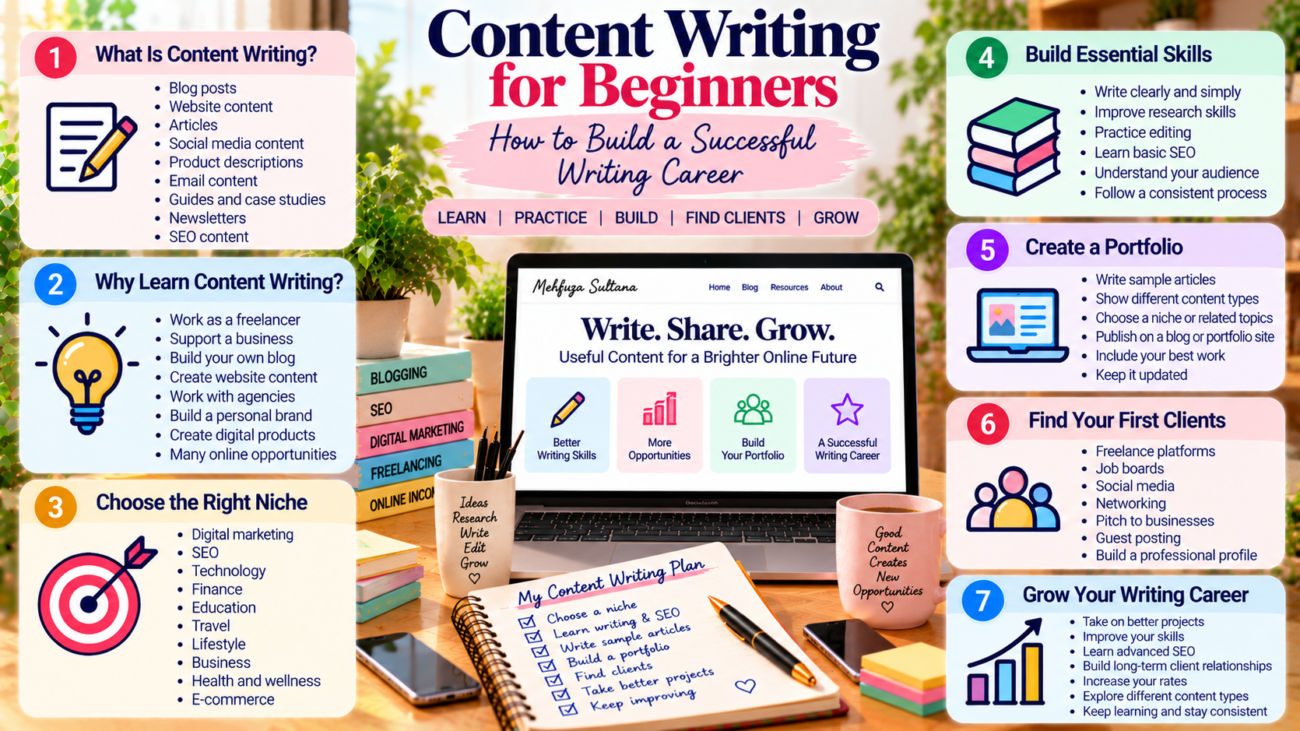
Starting a writing career can feel confusing when you do not know where to begin. You may enjoy writing, but you may not know which skills to learn, what type of content to create, or how to find your first client.
Content writing for beginners becomes easier when you follow a clear plan. You can start with basic writing skills, choose a suitable niche, learn SEO, create sample work, and slowly build your professional profile.
You do not need years of experience to get started. Instead, focus on learning the basics and creating useful content. As your skills improve, you can take on better projects and build stronger client relationships.
This guide explains how to start content writing, develop your skills, create a portfolio, find opportunities, and grow your writing career step by step.
For example, a blog post may educate readers. Website content may explain a service. A product description may help customers understand a product.
Good content is not simply about using correct grammar. It should also be clear, useful, relevant, and easy to understand.
If you are completely new to the field, you can also start with our content writing guide to understand the basics.
Why Learn Content Writing?
Content writing can be a useful skill for many different career paths.
You can use writing skills to:
Work as a freelancer
Support a business
Build your own blog
Create website content
Work with marketing teams
Write for agencies
Create digital products
Build a personal brand
The skill is also useful beyond freelance work.
For example, entrepreneurs can use writing to explain their services. Marketers can use it to communicate with customers. Bloggers can use it to build an audience.
Therefore, learning to write clearly can support many online career opportunities.
Choose the Right Content Writing Niche
A niche is a specific subject or industry you focus on.
Some common content writing niches include:
Digital marketing
SEO
Technology
Finance
Education
Travel
Lifestyle
Business
Health and wellness
E-commerce
You do not have to choose a niche immediately. However, having a clear area of interest can make it easier to build relevant experience.
Start by thinking about your existing knowledge and interests.
Ask yourself:
What subjects do I enjoy?
What do I already understand?
What topics can I research easily?
What type of audience do I want to write for?
You can also test a few topics before making a final decision.
A portfolio shows potential clients what you can do.
You do not need paid clients to create your first portfolio.
Instead, create your own writing samples.
For example, you could write:
Two blog posts
One website service page
One SEO article
One product description
A few social media captions
Choose topics that match the type of work you want.
If you want to write for digital marketing companies, create samples about SEO, social media, blogging, or online business.
Keep your best samples easy to find.
You can also read how to build a content writing portfolio with no experience for a detailed process.
Find Your First Content Writing Opportunities
Once you have some writing samples, start looking for opportunities.
You can explore:
Freelance platforms
LinkedIn
Job websites
Content agencies
Small businesses
Startups
Direct outreach
Professional networks
Do not apply for every available project.
Instead, look for opportunities that match your skills and preferred niche.
For example, if you have strong blog-writing samples, search for businesses looking for blog writers.
A focused approach can make your applications more relevant.
How to Build a Content Writing Routine
Writing regularly helps you improve faster.
You do not need to write for several hours every day.
Even 30–60 minutes of focused practice can help.
A simple routine could include:
Writing: Practice one short section or article.
Research: Study a topic and compare reliable sources.
Editing: Improve an older piece of writing.
SEO: Learn one basic SEO concept.
Reading: Read high-quality articles to understand structure and style.
Over time, this routine can improve both your speed and confidence.
Set Your Content Writing Rates
Once you start looking for paid work, you need to decide how you will charge.
Writers may charge:
Per word
Per article
Per project
Per hour
Monthly retainer
There is no single rate that works for everyone.
Your pricing can depend on:
Experience
Research requirements
Content length
Topic difficulty
SEO requirements
Project deadline
Client expectations
As a beginner, focus on building useful experience without accepting work that is unrealistic or poorly defined.
As your skills and portfolio grow, you can review your rates and take on more valuable projects.
Build Long-Term Client Relationships
Getting one client is useful. Building a long-term relationship can be even more valuable.
Good communication matters.
Before starting a project, clarify:
The topic
Word count
Deadline
Content format
Target audience
SEO requirements
Number of revisions
Payment terms
During the project, keep the client updated when needed.
After delivery, respond professionally to feedback.
Reliable communication and consistent quality can help turn one project into ongoing work.
Common Content Writing Mistakes to Avoid
Beginners often make mistakes while learning.
Writing Without Knowing the Audience
Content should have a clear reader in mind. Otherwise, the message may become too broad.
Focusing Too Much on Keywords
SEO matters, but readers come first. Avoid forcing keywords into every sentence.
Skipping Research
Even simple topics may need research. Check important facts before publishing.
Trying to Sound Too Professional
Complex words do not automatically make content better. Clear writing is often more effective.
Publishing Without Editing
Always review your draft before sending or publishing it.
Creating a Weak Portfolio
A portfolio should show the type of work you want to get. Choose relevant and polished samples.
Applying Without Reading the Brief
Read the project requirements carefully before sending a proposal.
How to Grow Your Content Writing Career
Once you have basic experience, you can gradually expand your skills.
For example, you can learn:
SEO content writing
Copywriting
Content strategy
Email marketing
Social media writing
Technical writing
Content editing
Content management
You can also create your own blog.
Writing on your own website gives you a place to practice, publish samples, build search visibility, and demonstrate your knowledge.
Over time, your blog can become part of your professional portfolio.
A Simple Content Writing Career Plan
You do not need to master everything at once.
Start by learning the basics of writing and research. Then choose one or two areas where you want to develop your skills.
Next, create several strong writing samples. After that, organize them into a simple portfolio.
Once your portfolio is ready, start applying for suitable projects and contacting potential clients.
As you gain experience, improve your writing, learn more about SEO, and expand your services.
Finally, review your progress regularly. Look at the type of work you enjoy, the clients you want to attract, and the skills that can help you move forward.
This approach keeps the process manageable.
Starting a writing career does not require you to know everything from day one.
The best approach is to learn one skill at a time and practice regularly. Begin with clear writing, research, editing, and basic SEO. Then choose a suitable niche and create useful samples.
Once you have a portfolio, look for relevant opportunities and communicate professionally with clients.
Most importantly, keep improving.
Content writing for beginners is not only about learning how to write. It is about understanding readers, solving problems, researching information, and communicating ideas clearly.
With consistent practice and a simple plan, you can turn writing into a valuable professional skill and gradually build a sustainable career.
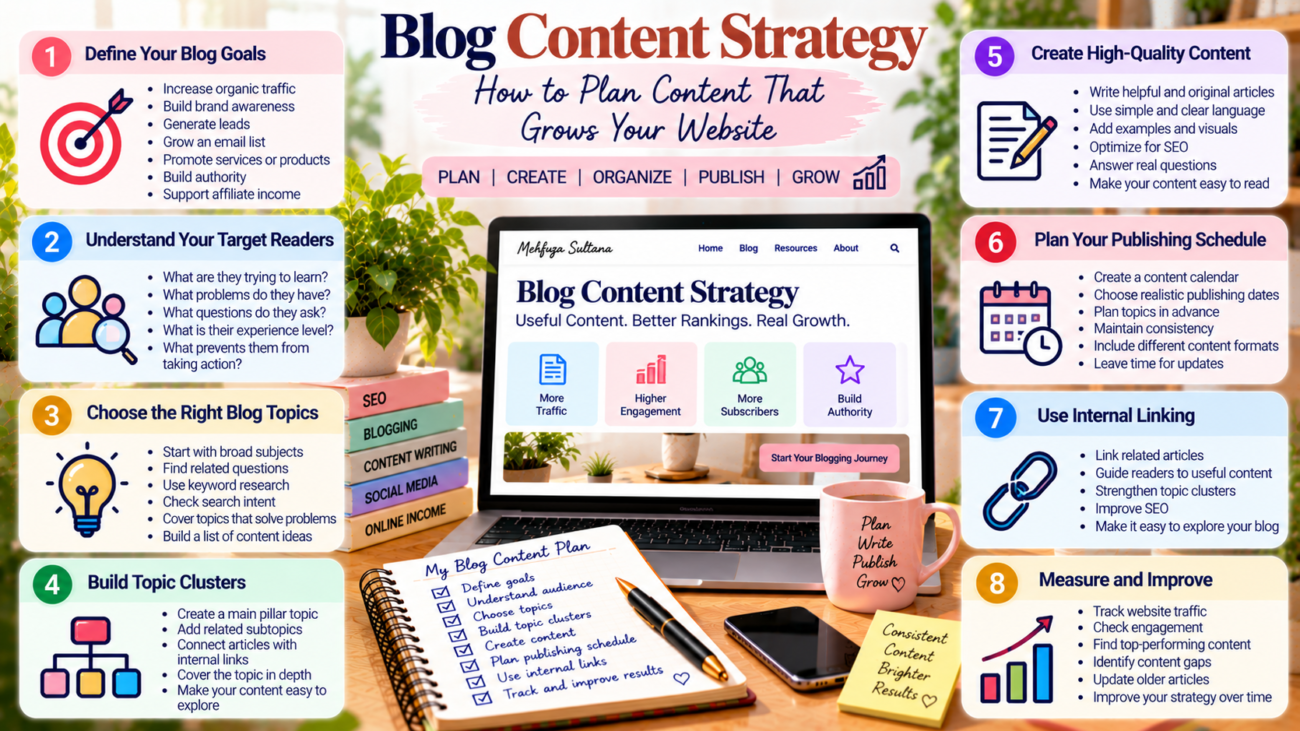
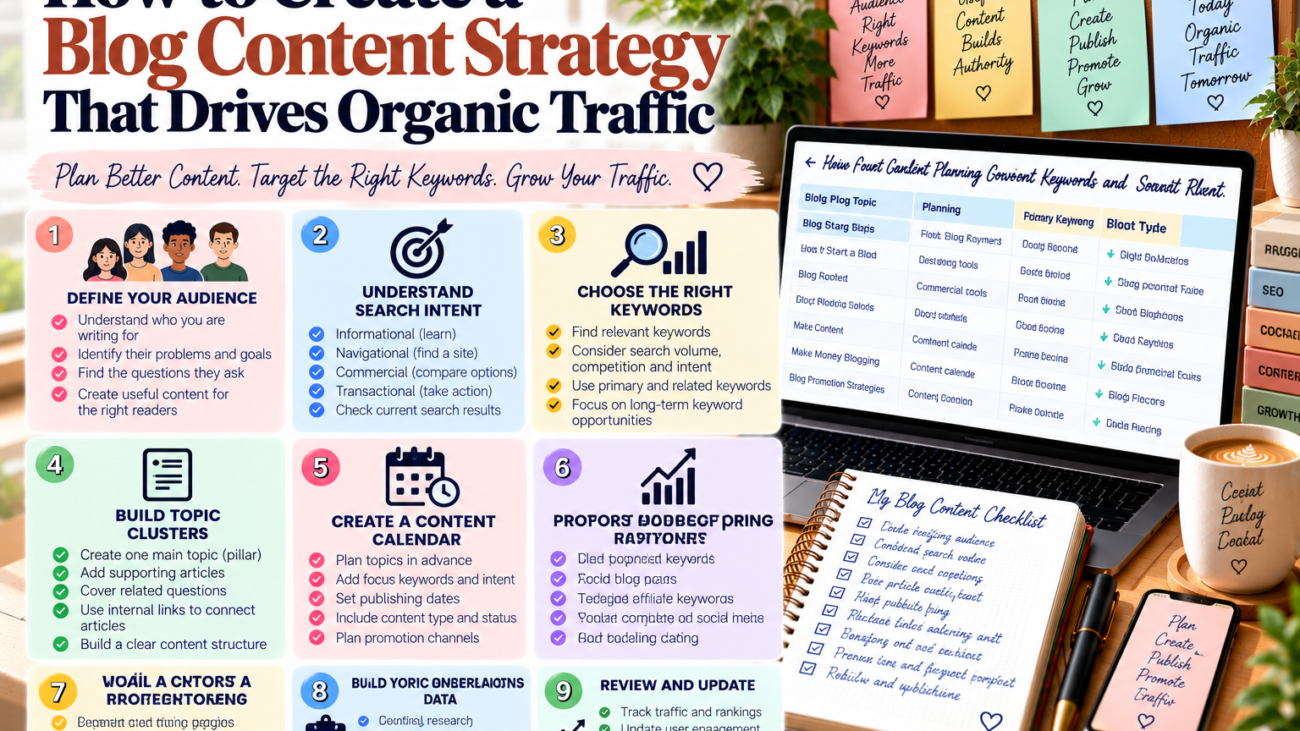
Publishing blog posts without a clear plan can make blogging feel difficult. You may have many ideas, yet still struggle to decide what to write next. A strong blog content strategy gives your website a clear direction.
Instead of choosing random topics, you can plan content around your audience, business goals, keywords, and search intent. As a result, your posts can work together instead of competing with each other.
A good strategy also helps you stay consistent. You can decide which topics to cover, how articles should connect, and when older content needs an update.
In this guide, you will learn how to create a practical blog content strategy. You will also learn how to choose topics, build topic clusters, create content briefs, plan your publishing schedule, use internal links, and measure results.
What Is a Blog Content Strategy?
A blog content strategy is a plan for creating, publishing, organizing, and improving blog content.
It answers important questions such as:
Who are you writing for?
What problems do your readers have?
Which topics should you cover?
What keywords do people search for?
What type of content should you create?
How should your articles connect?
How will you measure results?
For example, a digital marketing blog may cover SEO, content writing, social media, blogging, and online income.
Rather than publishing unrelated articles, you can organize these subjects into clear content groups. This makes the website easier to understand for both readers and search engines.
Why Your Blog Needs a Content Strategy
Without a plan, it is easy to publish whatever idea comes to mind. However, random publishing can create gaps, repeated topics, and weak connections between articles.
A clear blog content strategy helps you:
Choose useful topics
Understand your readers
Target relevant searches
Organize related articles
Build internal links
Maintain a publishing schedule
Find content gaps
Update older articles
Measure your progress
Most importantly, your blog starts working toward a larger goal.
For example, one article can introduce a topic while another explains it in more detail. A third article can then answer a related question. Together, these posts create a stronger content system.
Define Your Blog Goals
Before choosing topics, decide what you want your blog to achieve.
Your goal could be to:
Increase organic traffic
Build brand awareness
Generate leads
Promote services
Grow an email list
Build authority
Support affiliate income
Attract freelance clients
Your goal affects the type of content you create.
For instance, a blog focused on organic traffic may need more informational articles. On the other hand, a service-based website may also need comparison, solution-based, and commercial content.
Therefore, define one or two main goals before building your content plan.
Understand Your Target Readers
Your content should start with your readers, not just keywords.
Think about the people you want to attract. Ask yourself:
What are they trying to learn?
What problems are they facing?
What questions do they ask?
What level of knowledge do they have?
What prevents them from taking action?
What information would help them make a decision?
For example, beginners may search for simple explanations such as “what is SEO?” Later, they may search for more specific topics such as keyword research, internal linking, or technical SEO.
Understanding this journey helps you create content for different stages.
You can also use your audience research to decide how simple or detailed your articles should be.
Choose the Right Blog Topics
Topic selection is one of the most important parts of your blog content strategy.
Start with broad subjects related to your website. Then, break those subjects into smaller questions and problems.
For example:
Main topic: SEO
Possible supporting topics:
SEO for beginners
Keyword research
On-page SEO
Internal linking
Technical SEO
SEO content writing
Search intent
Content refresh
This approach gives you a wider content map.
You can then research keywords for each topic and check whether people are actually searching for those subjects.
For a deeper guide, see our keyword research guide.
Build Topic Clusters for Your Blog
Once you have your main topics, organize related articles into topic clusters.
A topic cluster usually has:
One main topic
Several supporting articles
Internal links connecting related pages
For example, an SEO cluster could have a main guide about SEO for beginners. Supporting articles could cover keyword research, on-page SEO, technical SEO, and internal linking.
This structure helps readers move from one useful article to another.
It also gives your website a clearer topical structure.
Use tools such as Google Search Console and Google Analytics to understand how your website performs.
Track useful signals such as:
Organic clicks
Impressions
Search positions
Organic traffic
Engagement
Conversions
Leads
Top-performing articles
Do not focus on one number alone.
For example, an article may receive many impressions but few clicks. This could suggest that the title or search result needs improvement.
Similarly, a page may receive less traffic but generate valuable leads. Therefore, always connect your results to your original goal.
Common Content Strategy Mistakes
Even a good plan can fail when the basics are ignored.
Here are some common mistakes:
Publishing Without a Clear Audience
If you do not know who you are writing for, your content may become too broad.
Choosing Topics Only by Search Volume
High search volume does not always mean high value. A smaller topic may attract readers who are more relevant to your goal.
Creating Similar Articles
Several posts targeting the same idea can make your website difficult to organize.
Ignoring Search Intent
Even a well-written article may struggle if it does not answer what searchers actually want.
Forgetting Internal Links
Useful articles should not remain isolated. Connect related pages whenever it makes sense.
Never Updating Older Content
Your content library can become outdated if you only publish new posts.
A Simple Blog Content Strategy Workflow
A simple workflow can make content planning easier.
Start by defining your blog goals and target readers. Next, choose your main topics and research relevant keywords.
After that, group related keywords and questions into topic clusters. Then, select individual article ideas from each group.
Once you have the topics, create a brief for each article. Include the search intent, main points, headings, internal links, and image ideas.
Next, add the articles to your content calendar. Give yourself realistic publishing dates instead of creating a schedule that is difficult to maintain.
After publishing, monitor performance and look for improvement opportunities. Update older content when information changes or a page needs stronger coverage.
Over time, this process creates a connected content library rather than a collection of unrelated posts.
A successful blog does not need hundreds of articles. It needs useful content with a clear purpose.
A strong blog content strategy helps you decide what to publish, who you are writing for, and how each article fits into your website.
Start with your audience and goals. Then research topics, build clusters, create useful briefs, and plan a realistic publishing schedule.
As your blog grows, connect related articles and review older content. Most importantly, use your performance data to improve your decisions.
With a clear plan, your blog can become easier to manage and more useful to the people you want to reach.
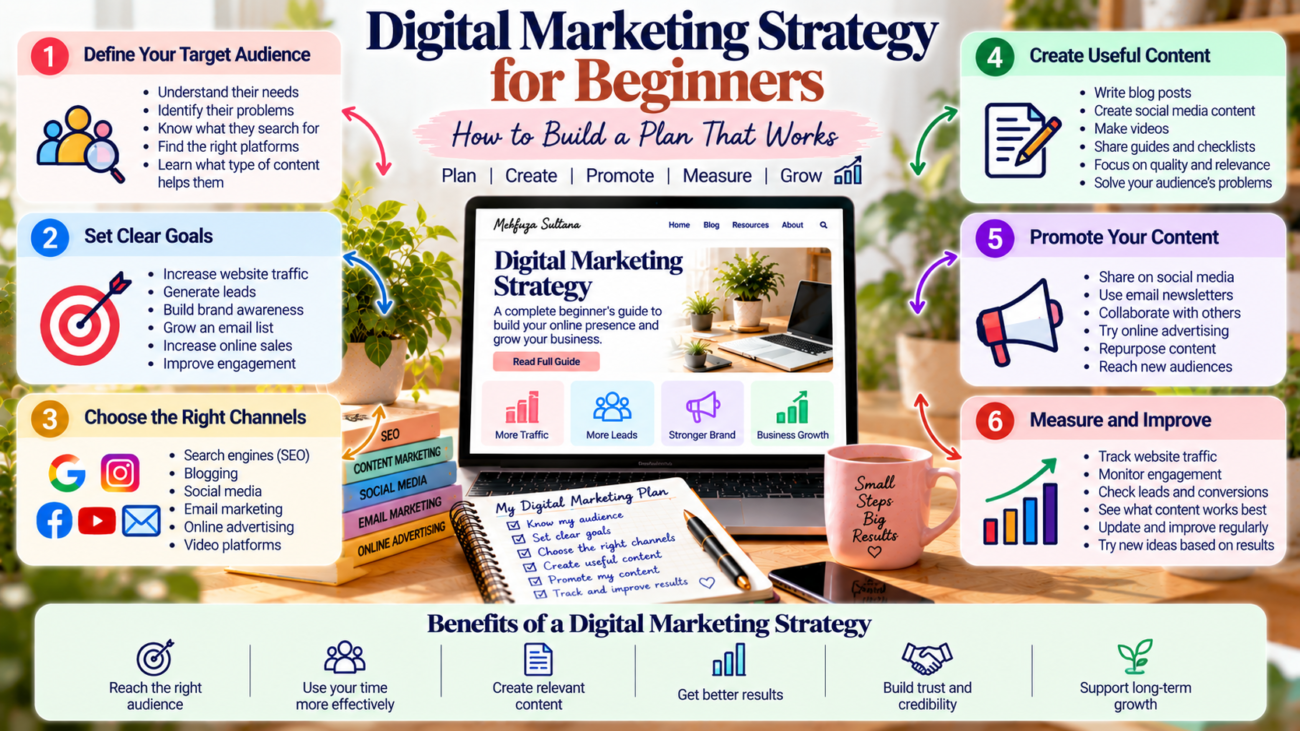
Starting digital marketing can feel confusing. There are many channels, tools, and strategies to choose from. However, you do not need to use everything at once. A clear digital marketing strategy for beginners can help you choose the right audience, set useful goals, create content, and measure your progress.
Instead of posting randomly or trying every new platform, start with a simple plan. First, understand your audience. Then, choose your goals, select suitable channels, create useful content, and track the results.
The goal is not simply to be present on every platform.
Instead, your strategy should connect your business goals with the people you want to reach.
For example, a small business may want to attract local customers. A blogger may want more organic traffic. Meanwhile, a freelancer may want to generate leads and build a professional reputation.
Each goal needs a slightly different approach.
Why Do You Need a Digital Marketing Strategy?
Without a plan, digital marketing can become a list of unrelated activities.
You may publish social media posts without knowing why. You may write blog articles without checking what people search for. Similarly, you may run advertisements without knowing whether they bring useful results.
A strategy gives these activities a clear direction.
It can help you:
Understand your audience
Choose suitable marketing channels
Create relevant content
Use your time more effectively
Track useful results
Improve your marketing over time
For example, if your main goal is website traffic, SEO and content marketing may become important parts of your plan. On the other hand, if you want direct customer enquiries, landing pages, social media, email, or paid advertising may have a larger role.
Therefore, begin with the result you want rather than the platform you want to use.
Your target audience is the group of people most likely to need or value your product, service, content, or expertise.
You can start by asking:
Who needs what I offer?
What problem are they trying to solve?
What information do they search for?
Which platforms do they use?
What prevents them from taking action?
What type of content helps them?
For example, a freelance content writer may target small businesses that need blog articles. A fitness creator may target beginners who want simple workout guidance.
The clearer your audience is, the easier it becomes to choose topics, messages, and channels.
Create a Simple Audience Profile
You do not need complicated research at the beginning.
Write down:
Audience: Who are you trying to reach?
Problem: What problem do they have?
Need: What solution are they looking for?
Search: What might they type into Google?
Platform: Where do they spend time online?
Action: What do you want them to do after seeing your content?
For a deeper guide, read How to Define Your Target Audience for Digital Marketing.
Set Clear Digital Marketing Goals
Once you understand your audience, decide what you want your marketing to achieve.
A goal gives your strategy a clear direction.
Common goals include:
Increase website traffic
Generate leads
Get more enquiries
Build brand awareness
Grow an email list
Increase online sales
Build a social media audience
Improve customer engagement
Try to make your goal specific.
Instead of saying:
“I want more traffic.”
You could define a clearer goal:
“I want to increase organic traffic to my website over the next few months.”
This makes it easier to choose suitable actions and measure progress.
Match Goals With Actions
Your marketing activities should support your goal.
For example:
Goal
Possible Actions
More organic traffic
SEO and blogging
More leads
Landing pages and useful content
More social engagement
Social media content
More sales
Product content and paid campaigns
More email subscribers
Lead magnets and email marketing
Stronger brand awareness
Social media and video content
The exact approach will depend on your business, audience, budget, and resources.
Choose the Right Digital Marketing Channels
You do not need to use every online channel.
Instead, choose platforms that match your audience and goals.
SEO
Search engine optimization helps your website become easier to discover through search engines.
SEO can include:
Keyword research
Useful content
On-page optimization
Internal linking
Technical improvements
Content updates
If you are building a website, SEO can become part of your long-term traffic strategy.
Content Marketing
Content marketing focuses on creating useful information for your audience.
This can include:
Blog posts
Guides
Videos
Social posts
Newsletters
Case studies
Tutorials
Good content can answer questions, build trust, and support other marketing activities.
For example, one detailed blog post can later become several social media posts, an email, a video idea, or a checklist.
Social Media Marketing
Social media can help you communicate directly with your audience.
Depending on your audience, you might use platforms such as Instagram, Facebook, LinkedIn, YouTube, or Pinterest.
However, the goal should not be to post everywhere.
Choose the platforms where your audience is most likely to engage with your content.
Email Marketing
Email marketing allows you to communicate directly with people who choose to hear from you.
You can use email to share:
New blog posts
Helpful tips
Product information
Offers
News
Educational content
Over time, an email list can become a useful part of your digital marketing system.
Paid Advertising
Paid advertising can help you reach a specific audience through platforms such as search engines and social networks.
However, paid campaigns need clear goals and tracking.
Before spending money, understand what action you want users to take and how you will measure the result.
Create a Digital Marketing Content Plan
Once you know your audience, goals, and channels, plan the content you will create.
A content plan helps you avoid random publishing.
Start by listing the questions and problems your audience has.
For example, if you help small businesses with SEO, your content topics could include:
SEO basics
Keyword research
On-page SEO
Website content
Internal linking
Local SEO
Common SEO mistakes
Then, organize these topics into groups.
You can also connect related articles with internal links. This makes it easier for readers to discover more useful information.
For a detailed process, read How to Create a Digital Marketing Content Plan.
Create Content for Different Stages
Not every person in your audience is ready to buy immediately.
Some people are still learning. Others are comparing solutions. A smaller group may already be ready to take action.
Therefore, create different types of content.
Awareness content can introduce a topic or problem.
Consideration content can explain solutions and compare options.
Action-focused content can help readers take the next step.
This approach creates a more complete content journey.
Build and Publish Useful Content
After planning your topics, create content that answers real audience needs.
Start with a clear headline. Then, explain the problem early.
Use headings to organize the article. Add examples where they make an idea easier to understand.
Also, avoid adding information simply to make the article longer.
Instead, ask:
Does this section help the reader?
If the answer is no, remove it or improve it.
For blog content, keyword research can help you discover topics people search for. However, keywords should support the content rather than control every sentence.
Keep Your Brand Message Consistent
Your website, blog, social media pages, and emails should communicate a similar overall message.
This does not mean every post needs to look or sound exactly the same.
Instead, keep your main ideas consistent.
For example, if your brand focuses on simple digital marketing for beginners, your content should continue to reflect that purpose.
Consistency can help people understand what you offer and why they should follow your work.
Track Your Digital Marketing Metrics
Creating content is only one part of digital marketing.
You also need to understand what happens after publishing.
Useful metrics may include:
Website traffic
Organic search traffic
Engagement
Clicks
Leads
Email sign-ups
Conversion rate
Sales
Cost per lead
The right metric depends on your goal.
For example, if your goal is brand awareness, reach and engagement may provide useful information. If your goal is sales, conversions and revenue may matter more.
Therefore, do not track every number just because a platform provides it.
Focus on measurements that help you understand whether your marketing is moving toward your goal.
For a more detailed guide, read How to Measure Digital Marketing Performance: Key Metrics to Track.
Review and Improve Your Strategy
Digital marketing is not a one-time task.
Your audience may change. Search behaviour can change. Platforms can introduce new features. Your business goals may also change.
Because of this, review your strategy regularly.
Look at:
Which content gets attention?
Which pages attract visitors?
Which channels bring useful traffic?
Which topics generate enquiries?
Which content receives little response?
Where do people leave your website?
Then, use what you learn to make changes.
For example, if one topic consistently attracts readers, you can create related content around it. Similarly, if a page receives traffic but few people take action, you may need to improve its content or call to action.
Common Digital Marketing Mistakes to Avoid
Beginners often make a few simple mistakes.
Trying Every Platform
Being active everywhere can become difficult to manage.
Instead, start with one or two channels that fit your audience.
Posting Without a Goal
Content should have a purpose.
Before publishing, know whether you want to educate, attract traffic, build trust, generate leads, or encourage another action.
Ignoring Your Audience
A strategy built around what you want to say may not match what your audience wants to know.
Therefore, research their questions and problems regularly.
Focusing Only on Quantity
More content does not always mean better results.
Useful, focused content can be more valuable than publishing many weak posts.
Not Measuring Results
Without tracking, it becomes difficult to know what is working.
Even basic measurements can help you make better decisions.
A Simple Digital Marketing Strategy Workflow
You can use this simple process when building your own plan:
Understand → Set Goals → Choose Channels → Plan Content → Publish → Measure → Improve
First, understand your audience and their needs.
Next, set clear marketing goals.
Then, choose the channels that fit those goals.
After that, create a practical content plan.
Publish useful content consistently. Once you have enough data, review the results.
Finally, improve your strategy based on what you learn.
This creates a repeatable system instead of a random list of marketing tasks.
A digital marketing strategy for beginners does not need to be complicated.
Start by understanding your audience. Then, choose clear goals and select the channels that support those goals.
After that, create useful content and publish it consistently. Track the results as your website, social media accounts, or business grows.
Most importantly, do not try to master every digital marketing channel at the same time.
Start small, learn from your results, and improve your strategy as you go.
With a clear plan, digital marketing can become a more organized way to attract the right audience, build trust, and grow your online presence.
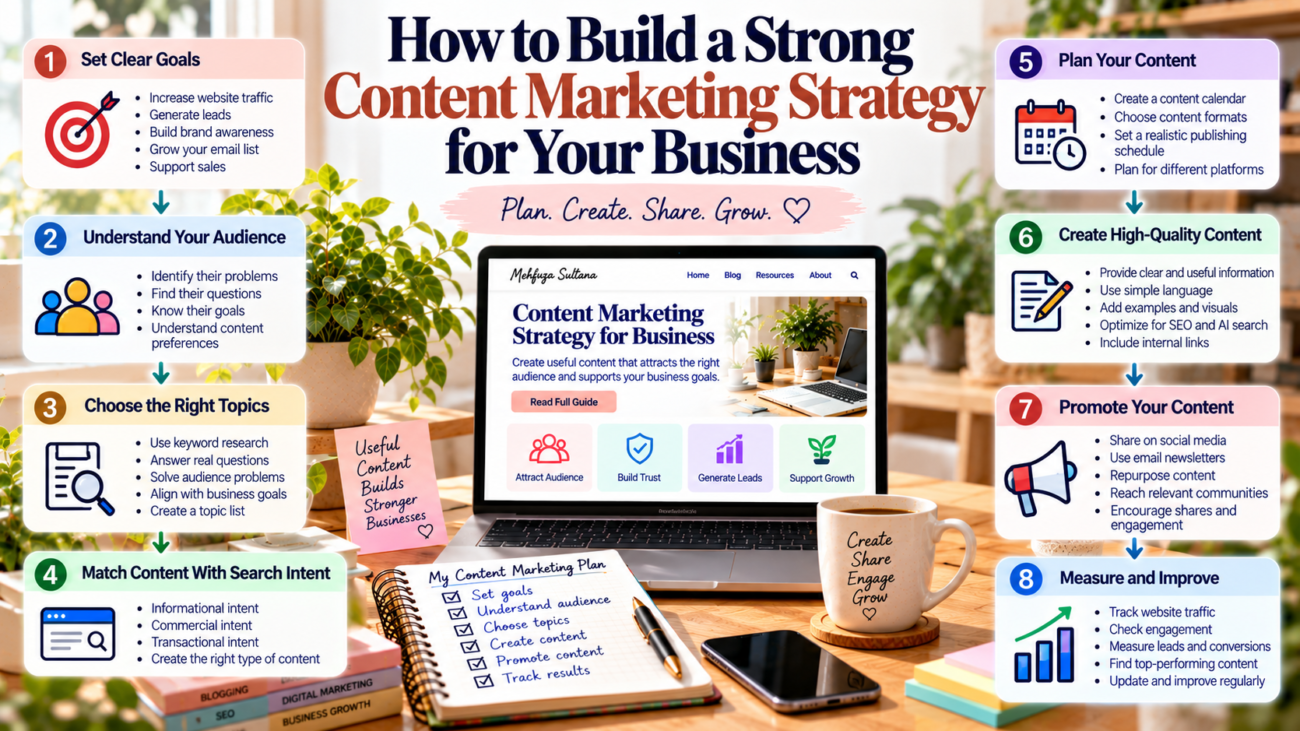
Creating content is easy. Creating content that attracts the right people and supports your business goals takes a clear plan. A strong content marketing strategy helps you decide what to create, who you want to reach, where to publish, and how to measure your results.
You do not need to publish content every day. Instead, focus on creating useful content that answers real questions and solves problems for your audience. With the right approach, your content can support brand awareness, website traffic, leads, and long-term growth.
In this guide, you will learn how to build a simple content marketing strategy from the ground up. You will also learn how to choose topics, understand your audience, plan content, promote your work, and improve your results.
What Is a Content Marketing Strategy?
A content marketing strategy is a plan for creating, publishing, and promoting useful content for a specific audience.
This content can include:
Blog posts
Social media posts
Videos
Emails
Guides
Case studies
Infographics
Checklists
Ebooks
The goal is not simply to create more content. Instead, your content should have a clear purpose.
For example, a blog post may bring visitors from Google. A social media post may introduce your brand to new people. An email may help you build a relationship with an existing audience.
Therefore, each piece of content should support a larger business or marketing goal.
Why Your Business Needs a Content Marketing Strategy
Publishing random content can make your marketing difficult to manage. You may have many ideas, but you may not know which ones deserve your time.
A clear strategy gives your content direction.
It can help you:
Understand what your audience needs
Choose useful topics
Create content consistently
Improve your website traffic
Build trust with readers
Support your SEO efforts
Generate leads
Promote products or services
Measure content performance
For example, if your goal is to increase organic traffic, you can focus on topics your audience searches for on Google.
If you want more leads, you can create helpful guides and add clear calls to action.
As a result, your content becomes part of a larger marketing system instead of a collection of unrelated posts.
Start Your Content Marketing Strategy With Clear Goals
Before creating content, decide what you want it to achieve.
Your goal should be specific enough to guide your decisions.
Some common content goals include:
Increase website traffic
Generate leads
Build brand awareness
Grow an email list
Increase product interest
Educate potential customers
Build authority in a topic
For instance, a new website may focus on organic traffic first. A service business may focus more on leads. Meanwhile, an established brand may use content to educate customers and support sales.
Choose one or two main goals first. This makes your strategy easier to manage.
Understand Your Target Audience
Good content starts with a clear understanding of your audience.
Think about the people you want to reach. Ask yourself:
What problems do they have?
What questions do they ask?
What information do they need?
What goals are they trying to achieve?
What type of content do they prefer?
What stops them from taking action?
You can learn more by reviewing comments, customer questions, social media discussions, reviews, and search results.
Your existing website data can also provide useful information about the topics people already visit.
The better you understand your audience, the easier it becomes to create useful content.
Choose the Right Content Topics
Once you understand your audience, start building a list of topics.
Do not choose topics only because they seem interesting. Instead, connect each topic with an audience need or business goal.
Keyword research can help you discover what people search for. You can also study related questions and common problems.
For example, a website about freelancing could cover:
How to Start Freelancing
How to Create a Freelance Portfolio
How to Find Freelance Clients
How to Write a Freelance Proposal
How to Set Freelance Rates
You can also use a keyword mapping guide to organize related keywords and connect them with the right pages.
This approach helps prevent random topic selection.
Match Content With Search Intent
Finding a keyword is only one part of content planning. You also need to understand why someone searches for it.
Search intent usually falls into a few common categories:
Informational Intent
The person wants to learn something.
Examples include:
What is content marketing?
How does SEO work?
What is keyword research?
Commercial Intent
The person is researching options before making a decision.
Examples include:
Best email marketing tools
SEO tools for small businesses
Best website platforms for bloggers
Transactional Intent
The person is ready to take action.
Examples include:
Buy SEO software
Hire a content writer
Sign up for an email marketing tool
Navigational Intent
The person wants to find a specific website, brand, or page.
Understanding intent helps you create content that matches what readers actually need.
Build Content Around Topic Groups
A strong content marketing strategy should not depend on isolated blog posts.
Instead, group related topics together.
For example, if your main topic is blogging, you could create supporting content about:
Blog writing
Keyword research
Blog SEO
Content planning
Internal linking
Content promotion
Blog monetization
Your main guide can then connect with these supporting articles.
This creates a clear content structure and helps readers discover more useful information.
It also gives search engines more context about the topics your website covers.
For more information, see our guide on how to build a blog SEO strategy.
Create a Realistic Content Plan
A strategy becomes easier to follow when you turn it into a practical publishing plan.
Start by deciding how often you can realistically publish.
You could publish:
One article each week
Two articles each week
Two articles each month
A mix of blogs and social posts
Consistency matters more than publishing a large amount of content at once.
Create a simple content calendar with details such as:
Content
Topic
Keyword
Format
Publish Date
Blog
Beginner SEO Guide
SEO for beginners
Article
Week 1
Blog
Keyword Research
keyword research
Article
Week 2
Social Post
SEO Tip
SEO tips
Image
Week 2
Blog
Content Planning
content strategy
Article
Week 3
You can also use a blog content calendar to organize publishing dates and upcoming topics.
Create Useful and Easy-to-Read Content
Your content should help the reader do something, understand something, or solve a problem.
Avoid writing only to increase word count.
Instead, focus on:
Clear explanations
Useful examples
Simple language
Short paragraphs
Descriptive headings
Practical tips
Relevant statistics
Original insights
For example, instead of simply explaining what a content calendar is, show readers how to create one.
This makes the information easier to understand and use.
Connect Your Content With Internal Links
Internal links connect one page on your website to another relevant page.
They help readers discover related information. They can also help search engines understand the structure of your website.
For example, a blog about content planning could link to:
Keyword research
Blog content calendars
SEO content planning
Content refresh strategies
Internal linking
Use natural anchor text that clearly describes the linked page.
Do not add links only for SEO. Each link should provide a useful next step for the reader.
Promote Your Content After Publishing
Publishing an article does not mean your work is finished.
Your audience may not find it immediately. Therefore, promotion can help your content reach more people.
You can promote a blog through:
LinkedIn
Facebook
Instagram
Pinterest
Email newsletters
Online communities
Relevant discussions
You can also turn one article into several smaller pieces of content.
For example, one blog post can become:
Three social media posts
One short video
One email
One infographic
Several discussion points
This allows you to get more value from the work you have already created.
Measure Your Content Marketing Strategy
You need data to understand whether your content is working.
Useful metrics can include:
Organic traffic
Page views
Search impressions
Clicks
Engagement
Email sign-ups
Leads
Conversions
However, do not track every number simply because it is available.
Choose metrics that match your goals.
For example, if your goal is organic traffic, search impressions and clicks can be useful. If your goal is lead generation, form submissions and conversions may matter more.
Review your results regularly. Then, use what you learn to improve future content.
Update Your Content Over Time
Content can become outdated.
Statistics change. Search behavior changes. Products change. Your own business can also change.
Therefore, review important content from time to time.
Look for:
Outdated information
Broken links
Missing sections
Old examples
Weak introductions
New keyword opportunities
Changes in search intent
Updating useful content can help keep your website relevant.
You can learn more about this process in our guide to content refresh strategy.
Avoid Common Content Marketing Mistakes
A few common mistakes can make content marketing less effective.
Creating Content Without a Goal
If every article has a different purpose, your website can lose direction.
Trying to Target Everyone
Content works better when it speaks to a clear audience.
Focusing Only on Keywords
Keywords matter, but useful content should come first.
Publishing Too Much Too Quickly
A large publishing schedule can become difficult to maintain.
Ignoring Existing Content
You do not always need to create something new. Older content may have opportunities for improvement.
Not Measuring Results
Without tracking results, it becomes harder to know what deserves more attention.
A Simple Content Marketing Strategy Workflow
You can follow this simple process:
Understand → Research → Plan → Create → Publish → Promote → Measure → Improve
Start by understanding your audience and defining your goals. Next, research useful topics and keywords.
Then, organize those topics into a realistic content plan. Create helpful content that matches the reader’s search intent.
After publishing, promote the content through suitable channels. Finally, measure the results and improve your strategy based on what you learn.
This creates a repeatable process instead of forcing you to start from zero every time.
Final Thoughts
A strong content marketing strategy gives your content a clear direction.
You do not need a huge budget or a large publishing team to get started. Begin with a clear audience, useful topics, realistic publishing goals, and a simple measurement process.
Over time, connect related content, promote your best work, and update older articles when needed.
Most importantly, focus on helping your audience. When your content consistently answers useful questions and solves real problems, it can support your website and business growth for the long term.
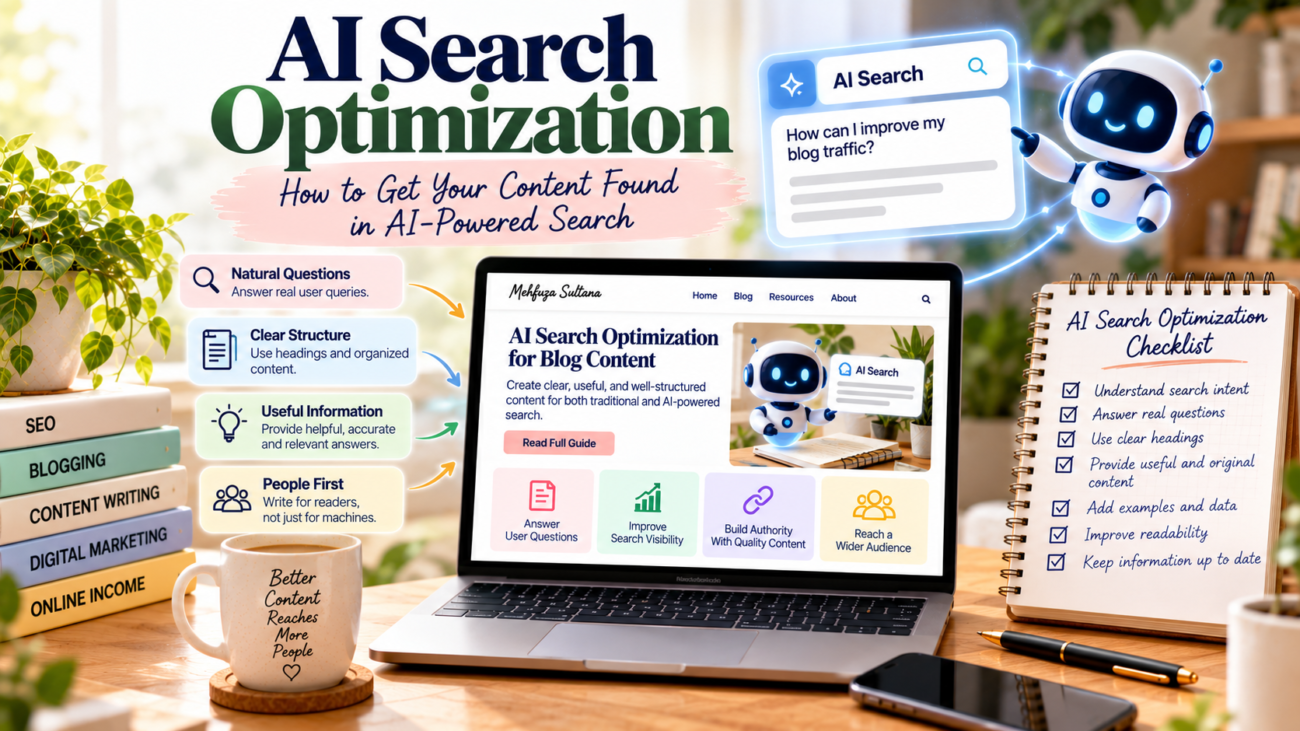
Search is changing. People are no longer using search engines only to find a list of website links. They are also asking questions and getting direct answers from AI-powered search features.
Because of this change, AI search optimizationis becoming an important part of modern content planning. Bloggers and website owners need to think about how their content can provide clear, useful answers that search systems can understand.
Traditional SEO still matters. However, content now needs to work well for both traditional search results and newer AI-powered experiences.
This guide explains what AI search optimization means, why it matters, and how you can prepare your blog for the changing search landscape.
What Is AI Search Optimization?
AI search optimization is the process of creating and improving content so that AI-powered search systems can understand, use, and potentially surface it when answering user questions.
Traditional SEO often focuses on helping pages appear in search results. AI search adds another layer because systems may use information from multiple sources to create an answer.
That means your content needs to be:
Clear
Useful
Well organized
Easy to understand
Relevant to the search
Supported by trustworthy information
For example, instead of creating an article only around the keyword “keyword research,” you could answer related questions such as what keyword research is, why it matters, how to do it, and what mistakes beginners should avoid.
This gives the topic more depth.
Why AI Search Optimization Matters for Bloggers
Search behavior is becoming more conversational. People can ask longer questions and expect useful answers without visiting several pages first.
For bloggers, this creates both challenges and opportunities.
A short article that only repeats a keyword may provide little value. In contrast, a well-structured article can answer several related questions in a clear way.
Search Is Becoming More Conversational
Users can now search using natural questions instead of short keyword phrases.
For example, someone might search:
“How can I improve my blog traffic without spending money on ads?”
A useful article should address the actual problem behind that question.
Therefore, understanding search intent is becoming even more important.
Clear Answers Are Easier to Understand
AI systems need to process information from web pages. Clear headings, short paragraphs, direct explanations, and useful examples can make your content easier to understand.
Good structure also helps human readers.
So, writing for AI search should not mean writing only for machines. Your primary goal should still be helping people.
How AI Search Optimization Differs From Traditional SEO
Traditional SEO focuses heavily on factors such as:
Search intent
Keywords
Page structure
Internal links
Technical SEO
Backlinks
Search visibility
AI-powered search adds more focus on how clearly a page answers a question and how useful its information is within a broader answer.
This does not mean that traditional SEO is no longer useful.
Instead, you can think of AI search optimization as an additional layer of your existing SEO strategy.
Your existing SEO guide for beginners can help you build the basic foundation before adding these newer practices.
Create Content Around Real Questions
One of the simplest ways to prepare your blog for AI-powered search is to answer real questions.
Start by identifying what your audience wants to know.
For example, a beginner blogging audience may ask:
How do I start a blog?
How often should I publish?
How do I find blog topics?
Why is my blog not getting traffic?
How can I improve my blog SEO?
Each question can become an article or a section within a larger guide.
Use Natural Language
Do not write questions only because they contain a keyword.
Instead, understand the problem behind the search.
A reader searching for “how to start a blog with no experience” probably needs practical guidance, not a paragraph filled with the same keyword several times.
Write as if you are explaining the answer to a real beginner.
This approach improves readability and gives your content a natural flow.
Build Helpful and Complete Content
A strong article should answer the main question without forcing the reader to search for basic information elsewhere.
That does not mean every article needs to be extremely long.
The right length depends on the topic.
Instead, focus on covering the important parts of the subject.
For example, an article about keyword research could explain:
What keyword research means
Why it matters
How to find keywords
How to check search intent
How to choose keywords
Common mistakes
How to use keywords naturally
This creates a useful resource without adding unnecessary information.
You can also connect the article to your detailed keyword research guide when readers need deeper information.
Organize Your Content With Clear Headings
Content structure matters for both readers and search systems.
Use one clear H1 for the article title. Then divide the content into relevant H2 sections.
When a section needs more detail, use H3 headings underneath the relevant H2.
For example:
Heading Level
Heading
H1
AI Search Optimization: How to Get Your Content Found in AI-Powered Search
H2
What Is AI Search Optimization?
H2
Why AI Search Optimization Matters
H2
Create Content Around Real Questions
H3
Use Natural Language
H2
Build Helpful and Complete Content
Use Topic Depth Instead of Keyword Repetition
Repeating one keyword again and again does not make an article more useful.
Instead, build depth around the main subject.
For example, if your main topic is blog SEO, related areas may include:
Keyword research
Search intent
Internal linking
Content structure
Technical SEO
Content updates
Organic traffic
These related topics help you explain the main subject naturally.
Your keyword mapping guide can also help you decide which keywords belong to which pages.
Make Important Answers Easy to Find
Readers should not have to search through several paragraphs to understand your main point.
When answering a question, give the direct answer first. Then explain it with examples or supporting details.
For example:
What is search intent?
Search intent is the reason behind a user’s search. It helps you understand what type of information the person expects to find.
After the direct answer, you can explain different types of search intent and provide examples.
This format improves readability.
It also makes your content easier to scan.
Support Important Claims With Reliable Sources
Trust matters when creating content for search.
If you make a factual claim about search, SEO, technology, or industry changes, support it with a reliable source when appropriate.
Google’s documentation provides guidance about how search works and how website owners can create useful content. Google Search Central
For performance data, Google Search Console can help you review queries, clicks, impressions, and other search information. Google Search Console
These sources can also help you keep your information current.
Strengthen Internal Links Between Related Pages
Internal links connect pages on your website.
They help readers discover related information and create a clearer website structure.
For example, an article about AI search can link to:
Your SEO beginner guide
Your keyword research guide
Your content strategy article
Your internal linking guide
Your content refresh guide
Use descriptive anchor text that tells readers what they will find after clicking.
Avoid forcing links into every paragraph.
Instead, add them where they genuinely help the reader.
Keep Your Content Easy to Read
AI search optimization should not make your writing complicated.
Use simple language whenever possible.
Short paragraphs can make long articles easier to scan. Clear examples can explain difficult ideas faster.
You should also vary your sentence openings. Avoid writing several sentences that begin with the same word.
For example, instead of:
AI can analyze content. AI can understand questions. AI can identify topics. AI can generate answers.
Write:
AI systems can analyze different types of content. They can also process questions and identify related topics. In some cases, these systems use information from several sources to create an answer.
The second version sounds more natural and avoids repetitive sentence openings.
Keep Your Content Updated
Search technology changes quickly.
New search features can appear. User behavior can change. Your own content can also become outdated.
For that reason, review important articles regularly.
You also need to understand how people find and use it.
Search Console can show useful search performance data. Website analytics can help you understand visitor behavior.
Look at metrics such as:
Organic clicks
Impressions
Search queries
Engagement
Page views
Conversions
Do not focus on one number alone.
For example, more impressions do not always mean that visitors are taking useful actions. Look at several signals together.
Over time, these insights can help you improve your content strategy.
Avoid Common AI Search Optimization Mistakes
Some common mistakes can reduce the value of your content.
Writing Only for Search Engines
Content should help people first.
Avoid awkward keyword placement or sentences that sound unnatural.
Publishing Low-Value AI Content
AI tools can help with research, outlines, and editing. However, automatically generated text may still need human review, examples, fact-checking, and useful experience.
Ignoring Search Intent
A keyword does not tell the complete story.
Always consider what the person wants to accomplish with the search.
Making Every Article Too Broad
One article does not need to answer every question about a subject.
Keep the main topic focused and connect it to related articles through internal links.
Forgetting Existing Content
New content is not always the answer.
Sometimes an older article can perform better after you improve its structure, examples, links, and outdated information.
A Simple AI Search Optimization Workflow
You do not need a complicated process to prepare your blog.
Start by choosing a topic that matters to your audience. Next, research the questions people ask around that subject.
Then, check the search intent and review the type of content already appearing in search.
After that, create a clear outline with useful H2 and H3 sections. Write direct answers and support them with examples where helpful.
Next, add relevant internal links, reliable external sources, useful images, and descriptive alt text.
Before publishing, check the article for accuracy, readability, and outdated information.
Finally, monitor the page after publication. Use the results to improve the article and guide future content decisions.
This process combines traditional SEO with the needs of modern search.
AI Search Optimization
AI search optimization is not about finding a trick to appear in every AI-generated answer.
Instead, it is about creating content that clearly answers real questions, provides useful information, follows a logical structure, and gives readers a reason to trust your website.
Traditional SEO still provides the foundation. At the same time, AI-powered search makes clear answers, topic depth, helpful structure, and reliable information increasingly important.
Start with the basics. Understand your audience, create useful content, connect related pages, keep important information updated, and measure your results.
As search continues to change, a people-first approach gives your blog a stronger foundation for both traditional and AI-powered search experiences.
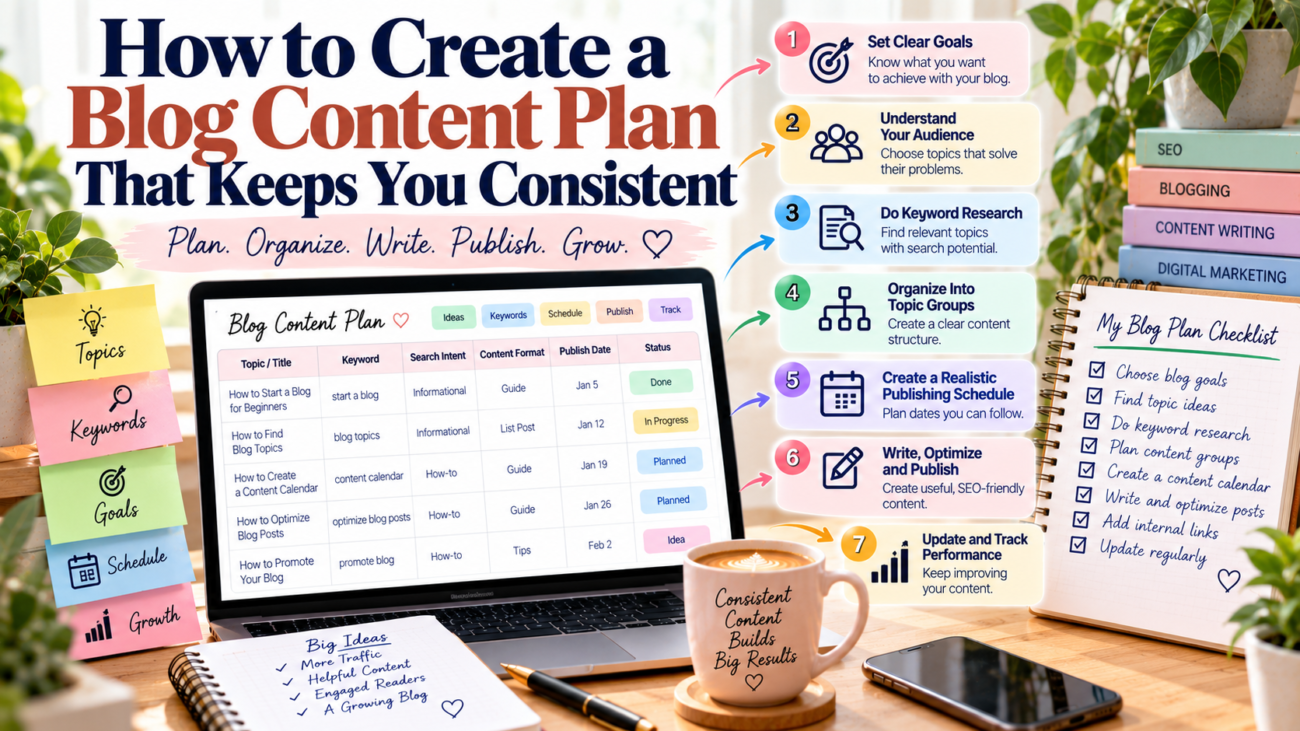
Publishing a blog post once in a while is easy. Staying consistent is much harder when you do not know what to write next. A clear blog content plan can solve this problem by helping you organize topics, keywords, publishing dates, and content goals in one place.
Instead of choosing a topic every time you want to publish, you can prepare your ideas in advance. As a result, writing becomes more organized and less stressful.
A good plan also helps you create content that supports your bigger website goals. You can use it to cover important topics, connect related articles, and keep your publishing schedule realistic.
In this guide, you will learn how to create a practical blog content plan that you can actually follow.
What Is a Blog Content Plan?
A blog content plan is a simple system for deciding what you will publish, when you will publish it, and why the content matters.
It usually includes:
Blog topics
Target keywords
Search intent
Content format
Publishing dates
Internal links
Content goals
Updates and revisions
For example, imagine you have a blog about digital marketing. Instead of randomly publishing articles about SEO, Instagram, email marketing, and blogging, you can group related topics together.
One month could focus on beginner SEO. Another month could cover social media marketing. This approach makes your website easier to organize.
More importantly, your readers can follow a clear learning path.
Why You Need a Blog Content Plan
Without a plan, blogging can quickly become difficult. You may spend too much time choosing topics, repeat similar ideas, or publish articles that do not support your main goals.
A structured plan helps you avoid these problems.
It Saves Time
Topic research takes time when you start from zero for every article. Having a list of planned topics gives you a starting point.
You can also prepare titles, keywords, and outlines before your writing day. Therefore, more of your time can go toward creating the actual content.
It Helps You Stay Consistent
Consistency does not mean publishing every day. Instead, it means following a schedule that you can maintain.
For example, publishing one useful article every week is often more realistic than planning five articles and then stopping after one month.
A simple content plan helps you choose a publishing frequency that fits your available time.
It Keeps Your Content Focused
A website should not feel like a collection of unrelated articles.
Your topics should connect to your main subjects. This creates a stronger content structure and gives readers more useful information to explore.
For example, a beginner SEO topic can lead readers to articles about keyword research, on-page SEO, internal linking, and technical SEO.
Start Your Blog Content Plan With Clear Goals
Before choosing topics, decide what you want your blog to achieve.
Your goal could be to:
Increase organic traffic
Build authority in a topic
Generate leads
Promote a service
Grow an email list
Support affiliate income
Educate your audience
Build a personal brand
One blog does not need to achieve every goal at the same time.
Choose the most important goal for your current stage. Then, select topics that support it.
For example, if your goal is organic traffic, focus on useful search-based topics. If your goal is lead generation, create content that answers customer questions and naturally connects readers with your services.
This simple decision makes the rest of your planning easier.
Choose Topics Your Audience Actually Needs
A useful topic should solve a real problem for your audience.
Start by thinking about the questions your readers ask. Look at common problems, beginner concerns, mistakes, and tasks they want to complete.
You can also use keyword research to discover what people search for online.
For a blog about freelancing, for example, your audience may search for:
How to start freelancing
How to create a freelance portfolio
How to find freelance clients
Freelancing skills for beginners
How to write a freelance proposal
These topics can become the foundation of your content plan.
You can also explore related searches and questions to find smaller topics that support your main subject.
Build Your Blog Content Plan Around Topic Groups
Once you have several ideas, organize them into topic groups.
A topic group contains several related articles that support one broader subject.
For example:
Main topic: SEO for Beginners
What Is SEO?
How to Do Keyword Research
How to Optimize Blog Posts
What Is Internal Linking?
What Is Technical SEO?
How to Track SEO Performance
This structure gives your blog a clear direction.
It also makes internal linking easier because related articles can naturally point to one another.
For example, your keyword research article can link to your guide about choosing keywords. Your on-page SEO article can then link to your internal linking guide.
If you are building a larger content system, your topic cluster strategy can help you connect related articles around broader subjects.
Add Keywords Before You Start Writing
Keywords should be part of your planning process, not something you add at the end.
For every planned article, choose one main keyword that matches the topic and search intent.
Then, note a few related phrases that can help you cover the subject naturally.
For example:
Topic: How to Start a Blog Main keyword: start a blog Related phrases: blogging for beginners, create a blog, blogging guide
Do not force these phrases into every paragraph. Instead, use them where they make sense.
A separate keyword research guide can help you build a stronger list of search terms before adding topics to your plan.
Match Each Topic With Search Intent
Search intent means the reason behind a search.
Someone searching for “what is SEO” probably wants to understand the basic concept. A person searching for “best SEO tools for bloggers” may be comparing different options.
These searches need different types of content.
Informational Intent
The reader wants to learn something.
Examples include:
What is content writing?
How does SEO work?
How do I start a blog?
Commercial Intent
The reader is researching products, tools, or services.
Examples include:
Best keyword research tools
SEO tools for small businesses
Best blogging platforms
Transactional Intent
The reader is ready to take an action, such as buying or signing up.
Examples include:
Buy SEO software
Sign up for an email marketing tool
Hire a content writer
Understanding intent before writing helps you create content that matches what readers expect.
Create a Realistic Publishing Schedule
A content plan becomes useful when you turn it into a schedule.
However, avoid creating a schedule that is too difficult to maintain.
If you can realistically publish four articles a month, plan four articles. You can always increase your publishing frequency later.
For example:
Week
Content Topic
Type
Goal
Week 1
SEO Basics for Beginners
Educational
Organic traffic
Week 2
Keyword Research Guide
Educational
Search visibility
Week 3
On-Page SEO Tips
Educational
Website growth
Week 4
Internal Linking Guide
Educational
Content discovery
This simple system gives you a clear publishing path without making the process complicated.
You can also use a blog content calendar to organize your publishing dates and upcoming topics.
Turn One Topic Into Multiple Content Ideas
One broad subject can produce many useful articles.
Suppose your main subject is content writing.
You could create articles about:
What content writing is
How to write a blog post
Content writing tips for beginners
How to find content writing clients
Content writing tools
Common content writing mistakes
This approach saves research time because the topics are connected.
It also helps you build depth around an important subject instead of publishing random articles.
Keep Track of Your Content Ideas
Do not depend on memory to manage your blog ideas.
Create one simple spreadsheet or document with columns such as:
Topic
Keyword
Intent
Status
Publish Date
SEO Basics
SEO for beginners
Informational
Planned
Week 1
Keyword Research
keyword research
Informational
Writing
Week 2
On-Page SEO
on-page SEO
Informational
Planned
Week 3
You can add more columns as your needs grow.
For example, you might include the article URL, internal links, content update date, and traffic results.
The goal is not to create a complicated system. Your plan should make blogging easier, not create more work.
Review Your Blog Content Plan Regularly
A content plan should not remain unchanged for months.
Search behavior can change. New questions can appear. Some articles may perform better than expected, while others may receive little traffic.
Therefore, review your plan regularly.
Check which topics are bringing visitors. Look for articles that need more detail. Find older posts that contain outdated information.
You can then adjust upcoming topics based on what you learn.
Google Search Console can help you review search performance, queries, clicks, impressions, and other useful data. Google Search Console
A practical workflow can make your blogging routine much easier.
Start by defining your main audience and blog goal. Next, choose a broad topic that supports that goal. Then, research keywords and related questions that your audience may search for.
After that, group similar ideas together and check the search intent for each topic. Select the topics that provide the most useful value to your readers.
Once your topics are ready, add them to your publishing calendar. Include the target keyword, content format, publishing date, and any important internal links.
Finally, review your published content regularly. Update older articles when information changes, add useful internal links, and adjust your future plan based on performance.
This workflow keeps your content creation organized without making it complicated.
Common Blog Planning Mistakes to Avoid
Even a simple plan can fail if it is built around the wrong priorities.
Publishing Too Much Too Quickly
More content does not always mean better results. Focus on useful articles that answer real questions.
Choosing Topics Only Because They Sound Interesting
A topic may sound interesting but have little value for your audience. Always connect your ideas to reader needs and your overall blog goals.
Ignoring Search Intent
A keyword alone does not tell you what type of article to create. Check what information searchers are actually looking for before writing.
Making the Schedule Too Difficult
An unrealistic schedule can quickly lead to missed deadlines. Choose a publishing frequency you can maintain.
Forgetting Older Content
Your work does not end when an article is published. Review older posts and improve them when necessary.
Your content plan does not need dozens of columns or complicated software.
Start with five basic details:
Topic
Main keyword
Search intent
Publishing date
Content status
Once you become comfortable with the system, add other details such as internal links, content goals, performance data, and update dates.
The best system is the one you can actually use every week.
Final Thoughts
A blog content plan gives your blogging work direction. Instead of deciding what to publish at the last minute, you can prepare topics, keywords, search intent, and publishing dates in advance.
Start small. Choose a realistic publishing schedule and focus on topics your audience genuinely needs.
Over time, connect related articles, review your results, and update your plan when your audience or goals change. With a simple system, blogging becomes more organized and easier to maintain.
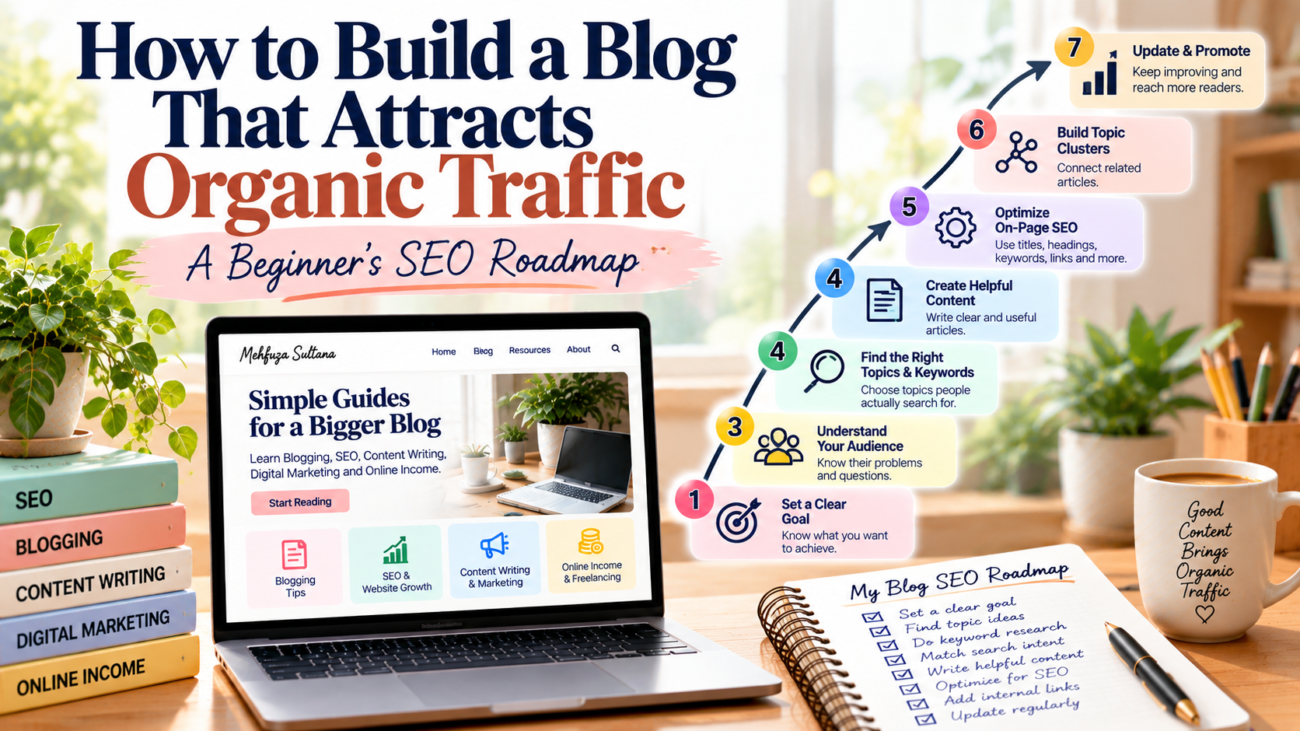
Starting a blog is simple, but getting regular visitors takes time. Therefore, you need a clear plan to reach the right readers. A strong blog SEO strategy can help you choose useful topics, target relevant searches, and grow your website through organic traffic.
However, you do not need to publish hundreds of articles at once. Instead, start with helpful content and focus on topics your readers need. As a result, your blog can build a strong base for long-term growth.
In this guide, you will learn how to build a blog SEO strategy step by step. For example, you will learn how to choose topics, research keywords, understand search intent, connect related articles, and improve your content over time.
Start Your Blog SEO Strategy With a Clear Goal
Before you create content, decide what you want your blog to achieve.
For example, your goal may be to:
Get more organic traffic
Build an audience
Get leads
Grow an email list
Promote your services
Build trust
Earn money from your website
A clear goal makes content planning easier. For instance, a beginner blog may focus on simple guides. On the other hand, a business blog may also need product guides, comparison posts, and service content.
As a result, your goal can guide the type of content you create.
Define Your Target Reader
After setting your goal, think about your readers.
Ask yourself:
Who are they?
What do they want to learn?
What problems do they have?
What questions do they ask?
How much do they already know?
For example, a blog for new writers should use simple language. It should also explain each step clearly.
Therefore, knowing your readers should come before choosing your topics.
Similarly, Google Analytics can help you understand what visitors do after they reach your website.
You can also use Google Search Central to learn more about Google’s search guidance.
However, do not focus only on rankings.
A page can still be useful if it brings the right readers, leads, or email subscribers.
Improve Your Blog SEO Strategy With Regular Changes
SEO improves through testing and updates.
For example, a page may get many impressions but few clicks. In that case, review the title and description.
Similarly, if readers visit one page but do not open another article, add useful internal links.
If the information is old, update it. If search intent has changed, adjust the content.
As a result, small changes can make your articles more useful.
Avoid Common Blog SEO Mistakes
Publishing Without a Plan
Random publishing can make your blog difficult to organize.
Instead, create a simple topic plan before writing.
Targeting Only Broad Keywords
Broad keywords can be difficult to target.
Therefore, also look for specific searches that match your readers’ needs.
Ignoring Search Intent
A keyword alone does not tell you what to write.
Instead, check what searchers expect to find before you create the article.
Creating Similar Articles
Check your existing content before creating a new page.
This simple step can help reduce overlap.
Forgetting Internal Links
Connect related articles so readers can continue learning.
In addition, internal links can help create a clear site structure.
Using Difficult Words
Complex words do not always make content better.
Instead, use simple words when they explain the idea clearly.
Never Updating Old Posts
Important articles should not be forgotten after publishing.
Therefore, review them and make changes when needed.
Follow a Simple Blog SEO Strategy Workflow
A simple workflow can make your SEO work easier. Start by defining your audience and choosing a useful topic. After that, research the main keywords and check the search intent.
Next, review the search results before creating your outline. Once the outline is ready, write helpful content with clear headings and simple language.
The next stage is page optimization. Add internal links, external links, useful images, and suitable alt text. Also, write a clear SEO title and meta description.
Before publishing, check the whole article once more. Make sure the links work and the content matches the search intent.
After publishing, share the article on suitable platforms. Then, check its search performance over time.
Finally, update the article when you find old information, missing details, or new opportunities.
This simple process keeps your SEO work organized. It also gives you a clear path from topic research to publishing and future updates.
Final Thoughts on Your Blog SEO Strategy
A strong blog SEO strategy starts with useful content and a clear audience.
First, choose topics that solve real problems. Then, use keyword research to understand what people search for. Next, match your content with search intent.
After that, connect related articles with internal links. Also, optimize important page elements and add useful images.
Finally, track your results and improve your content over time.
You do not need to learn every SEO method at once.
Instead, start with the basics. Build a simple process. Then, keep improving it.
Over time, a clear blog SEO strategy can help you create a stronger website, reach more readers, and build a better base for organic traffic.
Publishing one blog post every week sounds like a good plan until you sit down and decide what to write about.
You may have ten ideas one day and absolutely none the next. Worse, you might spend hours writing an article only to discover that it gets little traffic, does not connect with your other content, or does not support your actual business goals.
The problem is not always the quality of your writing.
Often, the bigger problem is the strategy behind the writing.
A successful blog needs more than individual articles. Instead, your posts should work together to answer audience questions, target relevant search topics, build authority, attract the right visitors, and guide readers toward the next useful step.
That is where a practical content strategy becomes important.
Whether you are blogging for beginners, building a personal brand as a freelancer, creating a content writing portfolio, or growing a small business through organic traffic, you do not need a complicated marketing system.
Instead, you need a repeatable process.
In this guide, you will learn how to create a blog content strategy from the ground up. We will cover audience research, content pillars, topic research, search intent, topic clusters, content calendars, SEO, internal linking, content promotion, and performance measurement.
What Is a Content Strategy for a Blog?
A blog content strategy is a plan that determines:
Who you are creating content for
What problems you will solve
Which topics your website will cover
What keywords and questions you will target
How your articles will connect
When you will publish
How you will promote your content
How you will measure and improve performance
In simple terms:
Content strategy is the plan behind your content.
It answers an important question:
“Why are we creating this article, who is it for, and how does it support the rest of the website?”
This is different from simply keeping a list of blog ideas.
A content idea is one possible article.
A content calendar tells you when you will publish that article.
On the other hand, a content strategy explains why the article exists, what audience need it addresses, where it fits within your website, and what you want it to accomplish.
As a result, this distinction can completely change the way you approach blogging.
Why Random Blogging Often Doesn’t Work
Imagine two bloggers.
Blogger A
They publish:
10 Instagram tips
3 recipes
2 freelance articles
4 random AI articles
1 blogging guide
Each article might be useful individually. However, there is no clear relationship between the topics.
Blogger B
This blogger decides to build authority around content writing.
They create:
Main topic: Content Writing & Blogging
Then publish:
What Is Content Writing?
How to Write a Blog Post
Content Writing Tips
Copywriting vs Content Writing
Keyword Research for Writers
How to Become a Freelance Content Writer
How to Find Content Writing Jobs
Now, the articles have a clear purpose.
They can link to one another where relevant. In addition, they can support a broader pillar page and guide readers from learning the basics to applying the skills professionally.
That is the difference between publishing content and building a content system.
The 5C Framework for a Better Blog Content Strategy
If you are starting from scratch, use this simple framework.
1. Customer
Who are you trying to help?
2. Core Topics
What subjects should your website become known for?
3. Content
What questions and problems should you solve?
4. Connections
How will your articles relate to and internally link to one another?
5. Conversion
What useful next step should readers take after reading?
Together, these five areas give your blog a clear direction.
More importantly, this framework prevents you from treating every blog post as an isolated piece of content.
Step 1: Define Your Blog’s Main Goal
Before researching keywords or creating blog content ideas, decide what you want your website to achieve.
First, ask:
“What should my blog help me accomplish?”
Your answer might be:
Build professional authority
Generate organic traffic
Attract freelance clients
Build an email audience
Promote a service
Sell digital products
Generate affiliate income
Build a personal brand
Educate a specific audience
You can have several goals. However, choose one primary goal for your content strategy.
Example
Suppose you are a freelance content writer.
Your goal might be:
Build organic traffic around content writing and blogging while attracting potential freelance clients.
That goal immediately influences your content choices.
For example, you would prioritize articles that demonstrate your expertise and answer questions potential clients or aspiring writers are already asking.
Therefore, your goal becomes a filter for future content decisions.
Step 2: Understand Exactly Who You’re Writing For
A strong content strategy starts with people—not keywords.
Before choosing topics, create a simple audience profile.
For example, ask:
Who is my ideal reader?
What are they trying to accomplish?
What problems are they facing?
What do they already know?
What are they confused about?
What mistakes are they making?
What questions are they searching for?
What would make their work easier?
For example:
Audience
Beginner bloggers
Goal
Get their first consistent website visitors
Problems
Do not know what to write
Struggle to find topics
Do not understand SEO
Publish inconsistently
Do not know how articles should connect
Preferred content
Simple explanations
Step-by-step tutorials
Examples
Checklists
Templates
Practical workflows
Now, you are not creating content for “everyone.”
Instead, you are solving specific problems for a specific reader.
As a result, your topics become more focused and useful.
Step 3: Choose 3–5 Core Content Pillars
One of the easiest ways to make a blog unfocused is trying to cover everything.
Instead, choose a small number of broad topics that are closely connected to your expertise and audience.
These become your content pillars.
For a website focused on digital growth, for example, you could have:
Content Writing & Blogging
SEO & Website Growth
Digital Marketing & Social Media
Online Income & Freelancing
Each pillar can then be divided into narrower subjects.
For example:
SEO & Website Growth
→ Keyword Research → On-Page SEO → Technical SEO → Internal Linking → Topical Authority → Google Ranking
This gives you a clear answer whenever you are wondering:
“What should I write next?”
If a new idea does not fit any of your core topics, ask whether it genuinely serves your audience before adding it to your editorial plan.
Step 4: Find Topics Your Audience Actually Wants
Once you have your content pillars, turn them into specific article ideas.
This is where keyword research and audience research become important.
A keyword is simply a phrase someone enters into a search engine.
Examples include:
content writing tips
how to write a blog post
blogging for beginners
keyword research for beginners
how to monetize a blog
However, do not make the mistake of choosing topics based only on search volume.
A topic can have thousands of searches and still be a poor fit for your website.
For this reason, evaluate each topic using four questions.
Is it relevant?
Does it belong to your website’s core subject?
Is it useful?
Does it solve a genuine reader problem?
Is it searchable?
Are people likely to search for information about it?
Does it support another page?
Can it connect naturally to your existing content?
The strongest topics usually sit at the intersection of all four.
As a result, you can extend the life of your original content without rewriting the entire piece from scratch.
Step 11: Optimize Your Content for SEO—Without Writing for Robots
SEO should support your content strategy, not control every sentence.
For each article, focus on the following areas.
Use a clear primary topic
First, make sure readers understand what the article is about.
The main topic should be clear from the title, introduction, and headings.
Create descriptive headings
Clear headings make an article easier to scan.
They also help readers understand the structure before reading every section.
Use related terminology naturally
For a blog content strategy article, related concepts might include:
content calendar
search intent
keyword research
content planning
topic clusters
content brief
internal linking
content distribution
organic traffic
Answer related questions
Think beyond one keyword.
Ask yourself:
What else would someone need to know to solve this problem completely?
For example, someone searching for content strategy may also need information about keyword research, search intent, content calendars, and internal linking.
Add internal links
Connect the article to relevant pages on your website.
These links should help readers find the next useful resource.
Keep the writing natural
Do not repeat a keyword simply because an SEO tool tells you to.
If a phrase sounds unnatural, leave it out.
Ultimately, good SEO should make content more useful, not harder to read.
Step 12: Create a Simple Internal-Linking System
Internal linking is one of the easiest things to overlook when publishing new content.
Every time you publish an article, ask:
Which existing pages would help this reader next?
Then add useful contextual links.
For example:
How to Write a Blog Post
could link to:
Keyword Research for Beginners
On-Page SEO
Internal Linking
Content Strategy
At the same time, those related articles can link back to the broader content pillar.
Think of internal links as roads between related pages.
However, the goal is not to add links everywhere.
Instead, make it easy for readers to continue learning.
You can also use your keyword mapping guide to plan connections between related pages.
A Complete Content Strategy Example
Let’s put everything together.
Imagine you are building a blog for beginner freelance writers.
Audience
Students, beginners, and aspiring freelance writers.
Main goal
Build organic traffic and eventually attract freelance writing clients.
Core pillar
Content Writing & Blogging
Supporting cluster
Article
Primary Topic
Search Intent
What Is Content Writing?
Content writing basics
Informational
How to Write a Blog Post
Blog writing
Informational
Content Writing vs Copywriting
Writing specialties
Informational
SEO Writing for Beginners
SEO content
Informational
How to Build a Writing Portfolio
Freelance career
Informational
How to Find Content Writing Jobs
Writing jobs
Transactional
Now connect them.
Content Writing & Blogging Pillar
↓
What Is Content Writing?
↓
How to Write a Blog Post
↓
SEO Writing for Beginners
↓
How to Build a Writing Portfolio
↓
How to Find Content Writing Jobs
Notice what happened.
The content now follows the reader’s journey:
Learn → Practice → Improve → Build → Earn
Therefore, the blog is no longer just a collection of articles. It becomes a learning path.
That is what a strong content strategy should do.
Build Your First Content Strategy in 30 Minutes
You do not need to spend an entire weekend planning your blog.
Instead, set a timer for 30 minutes and answer these questions.
Question
Your Answer
Who is my ideal reader?
What problem do I help them solve?
What is my main blog goal?
What are my 3–5 core content pillars?
What questions does my audience ask?
Which topics have search potential?
What should my main pillar page cover?
Which supporting articles should I create?
How will the articles internally link?
How often can I realistically publish?
How will I measure success?
What should readers do next?
By the end of this exercise, you should have the foundation of an actual content plan.
More importantly, you will have a practical starting point instead of a long list of disconnected ideas.
What Should You Measure?
Publishing is not the finish line.
Once your articles are live, look at how they are performing.
Visibility
Are your pages appearing in search results?
Organic traffic
Are people actually visiting from search engines?
Click-through rate
Are people clicking when your page appears?
Engagement
Are readers staying long enough to consume the content?
Conversions
Are readers signing up, contacting you, purchasing something, or taking another meaningful action?
Internal-link performance
Are readers moving from one relevant article to another?
However, do not judge every article by traffic alone.
For example, a page with modest traffic can still be valuable if it attracts the right audience and generates meaningful results.
Therefore, look at several metrics instead of relying on one number.
When Should You Update Old Blog Posts?
Your content strategy should not end after publication.
Over time, some articles become outdated because:
Search behavior changes
Tools change
Platforms update their features
Statistics become old
Examples stop being relevant
Better information becomes available
Your website gains new related content
For this reason, review important articles periodically.
Ask:
Is the information still accurate?
Does the article completely answer the reader’s question?
Are there newer pages I should link to?
Can the introduction be improved?
Is the search intent still being satisfied?
Updating an existing useful article can often be more productive than constantly creating something completely new.
Common Content Strategy Mistakes to Avoid
Publishing Whatever Comes to Mind
Having an idea is not enough.
First, ask whether it supports your audience and overall website structure.
Chasing Search Volume Alone
A high-volume keyword is not automatically valuable if it attracts the wrong audience.
Instead, consider relevance, search intent, competition, and usefulness.
Ignoring Search Intent
A keyword can look perfect on paper.
However, your article may still perform poorly if it does not match what searchers expect.
Therefore, check the search results and understand the purpose behind the query before writing.
Creating Too Many Similar Articles
Five articles answering essentially the same question can create unnecessary overlap.
Before creating a new post, check what you already have.
Then decide whether the new article provides a genuinely different purpose.
Forgetting Internal Links
Do not let useful articles become dead ends.
Instead, give readers a natural next step through relevant internal links.
A sustainable publishing schedule is better than an ambitious schedule that you abandon after a month.
Therefore, choose a pace you can maintain.
Never Reviewing Performance
Your first content plan is not permanent.
Instead, use what you learn from your audience and search performance to improve the next version.
What Should You Do After Creating Your Content Strategy?
Once your strategy is ready, do not wait for the perfect plan.
First, start with your most important pillar.
Then, create a few strong supporting articles around it.
For each article, follow this simple process:
Research → Plan → Write → Optimize → Internally Link → Publish → Promote → Measure → Improve
This becomes your repeatable content workflow.
Over time, your website can develop a library of connected resources rather than a collection of random blog posts.
Frequently Asked Questions
What is a content strategy in blogging?
A content strategy is a plan for deciding what content to create, who it is for, what goals it supports, how different articles connect, how content will be distributed, and how performance will be measured.
How do I create a content strategy for my blog?
Start by defining your goal and audience.
Then choose your core content pillars, research relevant topics and keywords, understand search intent, create topic clusters, plan a publishing calendar, build internal links, promote your content, and measure results.
What is the difference between a content strategy and a content calendar?
A content strategy explains the overall purpose, audience, topics, structure, and goals of your content.
A content calendar organizes the specific content you plan to publish and when you plan to publish it.
Therefore, the calendar is part of the larger strategy.
How many blog posts should I publish per week?
There is no universal number.
For many beginners, one useful article per week is a realistic starting point. More importantly, choose a schedule you can maintain consistently.
Should every blog post target a keyword?
Every article should have a clear topic and purpose.
However, you should not force keywords into your writing.
Instead, focus on the reader’s problem, search intent, and broader topic.
How long should a content strategy last?
A content strategy can guide your blog for months or years.
Still, review it regularly because your audience, search behavior, business goals, and content performance can change over time.
Conclusion
A successful blog is not built simply by publishing more articles.
Instead, it grows through the right content for the right audience, connected into a useful system.
Before writing your next article, do not only ask:
“What should I write about?”
Instead, ask:
“Who am I helping, what problem am I solving, where does this article fit, and what should the reader do next?”
That small change in thinking can transform the way you approach blogging.
Start with one clear goal.
Next, choose a few core topics and research the questions your audience actually cares about.
Then, build topic clusters and connect your articles with useful internal links.
After that, create a realistic content calendar and publish consistently.
Finally, measure what works and improve your strategy as you learn.
You do not need hundreds of articles to build a useful website.
You need connected, purposeful, helpful content that gets better over time.
If you are building your knowledge from the ground up, the next step is to learn how to create individual articles that readers actually want to finish and how to structure them for both people and search engines.
A clear content strategy for your blog helps you stop guessing what to publish and start creating content with a purpose. You can also use our keyword mapping guide to connect related pages and organize your content.
Without a plan, you may publish many articles but still struggle to attract the right readers. Therefore, a practical blog content strategy gives every article a clear role and helps your content work together.
What Is a Content Strategy for a Blog?
A content strategy for a blog is a simple plan for deciding what content to create, who it is for, how you will publish it, and how you will measure its results.
A good strategy answers questions such as:
Who is your target audience?
What problems do they have?
Which topics should you cover?
What keywords do they search for?
What type of articles should you create?
How often should you publish?
How will you promote your content?
How will you measure results?
The goal is not to publish as many posts as possible. Instead, the goal is to create useful content that helps your readers and supports your website goals.
Content Strategy for a Blog Starts With Your Audience
Before choosing topics, understand who you want to reach.
Your audience could include:
Beginners
Students
Freelancers
Bloggers
Content writers
Small business owners
Content creators
Marketing professionals
Next, identify their questions, problems, goals, and interests.
For example, someone new to blogging may search for:
How to start a blog
How to write a blog post
How to find blog topics
How to do keyword research
How to get blog traffic
How to make money blogging
These questions can become the foundation of your content plan.
Your goal will influence the type of content you create.
For example, a website focused on organic traffic may need more educational SEO content. On the other hand, a service-based website may also need articles that explain problems and guide readers toward a service.
Therefore, clear goals make it easier to decide which topics deserve your time.
Choose Topics for Your Blog Content Strategy
Next, decide which broad subjects your website will cover.
These broad subjects become your content pillars.
For a digital marketing website, the pillars might include:
Content Writing & Blogging
SEO & Website Growth
Digital Marketing & Social Media
Online Income & Freelancing
Each pillar can then contain smaller, closely related topics.
As a result, your website gets a clear structure instead of becoming a collection of unrelated articles.
Build Content Clusters for Your Blog Strategy
After choosing your main topics, create groups of related articles.
For example, under Keyword Research, you could create:
How to Conduct Effective Keyword Research for Your Blog
How to Find Low-Competition Keywords for Your Blog
Long-Tail Keywords: How to Find and Use Them in Blog Content
How to Choose the Right Keywords for Your Blog Posts
Keyword Mapping for SEO
These articles can link to one another and to the main keyword research guide.
This creates a connected website structure. It also gives readers a clear path to discover related information.
For example, if an article is designed to attract search traffic, organic clicks and impressions may be important.
On the other hand, if another article supports a service, leads or conversions may matter more.
You can use Google Search Console to understand how your pages perform in Google Search.
Follow a Simple Blog Content Strategy Workflow
You can turn your strategy into a repeatable process.
Start by defining your audience and setting a clear goal. Then, choose a topic that fits one of your content pillars.
Next, research keywords and related questions. After that, check search intent and review the search results.
Once you understand the topic, create your outline. Then write useful content with clear explanations, examples, and practical advice.
After writing, optimize the article. Check the headings, keywords, links, images, and readability.
Finally, publish and promote the article. Over time, measure its performance and update the content when needed.
This simple workflow helps you stay organized. More importantly, it turns content creation into a repeatable process.
Common Blog Content Strategy Mistakes to Avoid
Writing Without a Clear Audience
Trying to reach everyone can make your content too general.
Instead, create content for a clear group of readers.
Choosing Topics Randomly
Random topics can make your website difficult to organize.
Therefore, choose topics that fit your main content pillars.
Focusing Only on Search Volume
High search volume does not automatically mean a keyword is right for your website.
Consider relevance, intent, competition, and business value as well.
Ignoring Search Intent
An article may target the right keyword but still fail to satisfy the searcher’s needs.
For this reason, always check what people expect to find before writing.
Publishing and Forgetting
Content often needs updates, internal links, promotion, and improvement.
So, review important articles from time to time.
Creating Too Much Content
More articles do not always mean better results.
Instead, focus on useful and relevant content that supports your audience and website goals.
Final Thoughts on Building a Content Strategy for Your Blog
A successful content strategy for your blog gives every article a clear purpose.
Start with your audience and goals. Then choose content pillars, research keywords, understand search intent, build content clusters, create a content calendar, add internal links, and measure your results.
Most importantly, think of your blog as a connected system rather than a collection of random posts.
When your articles support one another, your websitebecomes easier to navigate, easier to manage, and more useful to your audience.
Posting on social media can help a business reach new people, build trust, and generate sales. However, likes and followers do not always show whether your marketing is creating real business value. This is where social media marketing ROI becomes important.
Social media marketing ROI helps you compare what you spend on social media with the value your marketing creates. Once you understand this relationship, you can make better decisions about your content, advertising, time, and budget.
What Is Social Media Marketing ROI?
Social media marketing ROI measures the return a business receives from its social media investment.
The basic idea is simple:
ROI = (Return − Investment) ÷ Investment × 100
For example, imagine you spend $500 on social media marketing and generate $1,000 in revenue that you can reasonably attribute to that activity.
Your calculation would be:
($1,000 − $500) ÷ $500 × 100 = 100% ROI
A positive ROI means the return was greater than the investment. However, the calculation is only useful when you define your costs and returns clearly.
Why Social Media Marketing ROI Matters
Social media can take both money and time.
You may spend money on:
Social media advertising
Content creation
Design
Video production
Influencer partnerships
Social media tools
You may also spend hours creating posts, answering comments, managing campaigns, and analyzing results.
Therefore, measuring ROI helps you understand which activities are contributing to your business goals.
For example, a post with 5,000 views may look impressive. However, if another post with 1,000 views generates several qualified leads, the second post may have greater business value.
This is why social media marketing ROI should not be measured through engagement alone.
Decide What Return You Want to Measure
Before calculating ROI, decide what “return” means for your business.
Different businesses may measure different outcomes.
Your return could include:
Product sales
Service bookings
Qualified leads
Website purchases
App downloads
Email sign-ups
New customers
Subscription revenue
For example, an online store may focus on purchases. A consulting business may focus on qualified leads and booked calls.
Your measurement system should match your business model.
Calculate Your Total Social Media Investment
The investment side of the equation includes more than your advertising budget.
Consider all major costs connected to the campaign.
These may include:
Advertising Costs
Include the money spent on paid campaigns across platforms such as Instagram, Facebook, LinkedIn, TikTok, or YouTube.
Content Production Costs
Consider the cost of photography, video production, graphic design, editing, or freelance content creation.
Tools and Software
You may use scheduling platforms, analytics tools, design software, or other subscriptions.
Staff or Freelancer Time
If employees or freelancers spend significant time managing social media, their working time can also be part of the investment.
You do not need to make the calculation unnecessarily complicated. Start with the costs that are directly connected to the activity you are measuring.
Your website is often where social media attention turns into a measurable action.
Someone may discover your Instagram post, visit your website, read a blog post, and later become a customer.
Therefore, tracking social traffic can help you understand what happens after someone clicks your content.
You can use analytics tools to monitor:
Sessions from social platforms
Landing pages
Pages viewed
Engagement
Conversions
Revenue from tracked traffic
Google Analytics can be used to analyze website traffic and user behavior. You can also use campaign tracking parameters to identify traffic from specific campaigns.
For example, suppose 1,000 people click your social media advertisement. If only five people submit a lead form, the campaign may need further analysis.
This is why conversion tracking is important.
A conversion could be:
Social post → Website visit → Product page → Purchase
Or:
Social ad → Landing page → Lead form → Sales call
Tracking this journey helps you understand where people take action and where they leave.
For more detail, read How to Track Social Media Conversions and Leads.
Understand the Difference Between Revenue and ROI
Revenue and ROI are not the same thing.
Revenue tells you how much money was generated.
ROI considers both the return and the investment.
For example:
Campaign A
Revenue: $2,000 Investment: $1,500
Campaign B
Revenue: $1,500 Investment: $500
Campaign A generated more revenue. However, Campaign B generated a higher return compared with its investment.
Therefore, looking only at revenue can give you an incomplete picture.
Use Attribution Carefully
One of the biggest challenges in measuring social media marketing ROI is attribution.
A customer may discover your business through Instagram, visit your website later through Google, and finally purchase after receiving an email.
So which channel deserves credit?
The answer depends on your attribution model and measurement setup.
Social media may influence a customer without being the final source of the purchase. Therefore, avoid assuming that every conversion can be explained by one channel alone.
Instead, look at customer journeys across multiple touchpoints where your data allows it.
Compare Organic and Paid Social Media
Organic and paid social media should not always be evaluated in exactly the same way.
Organic content may help build:
Brand awareness
Trust
Community
Long-term audience growth
Website traffic
Paid campaigns may focus more directly on:
Leads
Sales
Website conversions
Product promotion
Audience acquisition
You can measure both, but their goals may be different.
For example, an educational Instagram post may not generate immediate sales but could help build an audience that later converts through another campaign.
Measure ROI by Campaign
Instead of combining every social media activity into one number, consider measuring individual campaigns.
For example:
Campaign
Investment
Return
ROI
Product Promotion
$500
$1,000
100%
Lead Generation
$400
$800
100%
Brand Awareness
$300
—
—
Not every campaign will have an immediate financial return.
Brand awareness campaigns may require different measurements, such as reach, website visits, branded searches, or audience growth.
The important point is to define the campaign goal before judging the result.
Improve Social Media Marketing ROI
Once you start measuring your results, use the data to improve future campaigns.
You can test:
Different content formats
New audiences
Different offers
New headlines
Landing pages
Calls to action
Posting times
Ad creatives
For example, if one type of post consistently generates qualified leads, you could create more content around that topic.
Similarly, if an advertisement receives many clicks but few conversions, review the landing page, offer, audience, or message.
The goal is not simply to collect data. Use the data to make better marketing decisions.
Avoid These Social Media ROI Mistakes
Several common mistakes can make your measurement less useful.
Measuring Likes as the Main Result
Likes can show engagement, but they do not automatically represent revenue or leads.
Ignoring Time Costs
Content creation and social media management require time. If you ignore that investment, your ROI calculation may look better than it really is.
Using the Same Goal for Every Campaign
A brand-awareness campaign and a sales campaign should not be judged by exactly the same metric.
Not Tracking Conversions
Without conversion tracking, it can be difficult to connect social activity with business outcomes.
Looking at One Campaign in Isolation
A single campaign may perform differently because of seasonality, audience changes, competition, or the offer.
Reviewing results over time can provide more useful context.
Create a Simple Social Media ROI Dashboard
You do not need an advanced dashboard to get started.
A simple spreadsheet can track:
Metric
Result
Social media spend
$500
Website visits
2,000
Leads
80
Customers
20
Revenue
$1,500
ROI
200%
You can update this information weekly or monthly.
Over time, the data can help you identify patterns and compare campaigns.
How Often Should You Measure Social Media ROI?
The right frequency depends on your campaign and business.
For an active paid campaign, you may review performance regularly. For organic content, monthly reviews may provide more useful patterns than checking every post several times a day.
A simple routine could be:
Weekly: Check campaign performance and major changes.
Monthly: Compare campaigns, conversions, and revenue.
Quarterly: Review your broader social media strategy and budget.
This approach gives you enough information without turning measurement into a daily distraction.
Build a Better Social Media Measurement Process
A practical measurement process starts with a clear business goal. Next, choose the metrics that match that goal instead of tracking every available number.
After that, track your social media investment, including the main costs linked to your campaigns. Then, set up website and conversion tracking so you can see what happens after people interact with your content.
Once the data is available, measure revenue or another useful return. Where the data supports it, calculate your social media ROI and compare the results across campaigns and channels.
Finally, use these findings to improve future campaigns. This approach helps you focus on useful data and make better decisions over time.
This process gives you a clearer view of what your social media activity is actually contributing.
Social media marketing ROI gives businesses a practical way to connect social media activity with business results.
Start by defining what you want social media to achieve. Then track your investment, choose meaningful metrics, monitor conversions, and review revenue where appropriate.
Remember that not every social media activity will produce an immediate financial return. Some content supports awareness, trust, or future conversions.
The most useful approach is to measure results based on the goal of each campaign and use the information to improve your next decision.
When you consistently connect social media activity with measurable business outcomes, your marketing becomes easier to understand, manage, and improve.